Academia vs Industry on Fixing Known Vulnerabilities Before Exploits Happen
Why is this Security meme funny?
Level 1: Only After You Fall
Imagine you notice your shoelaces are untied. A friend warns you, "Hey, your laces are undone – you might trip." You shrug and say, "Yeah, I know, but I'm not going to tie them until I actually fall on my face." Pretty silly, right? You already knew about the problem, but you waited for an accident to happen before fixing it. That’s exactly what this meme is poking fun at: the goofy idea of ignoring a known problem until it causes real trouble. In the meme’s case it’s about a software bug instead of shoelaces, but the lesson is the same – fix things before you get hurt, not after.
Level 2: No Exploit, No Fix
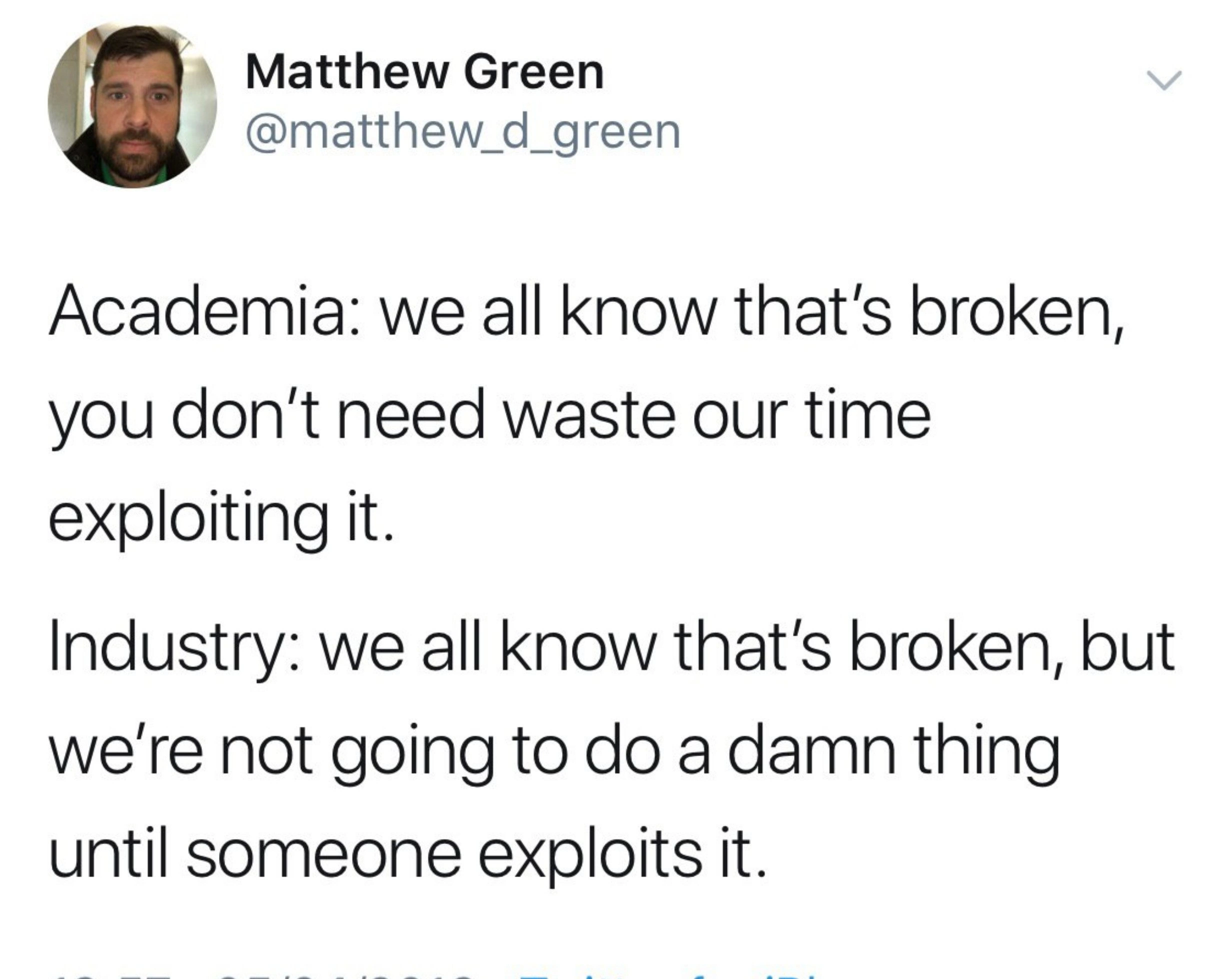
Let’s break down the joke in simpler terms. Academia here means the university researchers and security experts who study computer systems. Industry means the companies and engineering teams that build and maintain those systems in the real world. The tweet is contrasting how each group deals with a known security problem – basically a bug or weakness in software that bad guys could exploit.
Academia’s view: Researchers are saying "we all know that’s broken, no need to exploit it." In plain English, they mean everyone already understands this part is unsafe, so there’s no point in actually hacking it again just to prove the obvious. For example, if a professor discovers an encryption algorithm has a flaw, they might publish a paper explaining why it's broken. They won’t necessarily write a malicious program to break a real system with it, because the academic community already accepts from the theory that it's broken. In academia, once a vulnerability is identified and explained, they often move on to the next problem instead of building an actual attack tool. Their goal is to advance knowledge, not to demonstrate every possible hack.
Industry’s view: Engineers are effectively saying "we all know that’s broken, but we won’t fix it until someone exploits it." This means the company is aware of the weakness but isn't going to invest time fixing it until it causes real trouble. Imagine a software team knows there's a bug in the code that could let hackers in. They might have learned about it from an internal test or a researcher’s report. But fixing bugs – especially in a large application – can be expensive and delay other work. So the team might decide to prioritize other tasks, figuring “we’ll get to it later” since no attacker has used it yet. In other words, they treat it as low priority until a breach actually happens. The day someone writes an exploit and breaks in through that bug, it becomes an emergency and everyone scrambles to patch it. Essentially: no hack, no fix.
Why does this happen? Companies juggle a lot of priorities and tend to focus on issues that are on fire right now. A known vulnerability that hasn't been used by attackers yet is like a time bomb that hasn’t exploded – it feels abstract, easy to ignore. Responsible disclosure policies try to help (that’s when researchers quietly inform companies about flaws so they can fix them before the bad guys find out), but even then there's often a delay between knowing about a problem and actually fixing it. If nobody has exploited the bug yet, managers might underestimate its urgency. They think, "We'll address it eventually," and put resources toward more visible matters — like building new features, improving performance, or fixing bugs that are actively causing errors for users today. This is a common security tradeoff in industry: balancing immediate needs versus potential threats.
The tweet is funny (and a bit alarming) because it points out this backwards logic. Essentially, the academic side is thinking, "We know it's broken; you don't have to set the house on fire to prove it." Meanwhile, the industry side is saying, "We know it's broken, but we won't call the firefighters until we see flames." In other words, one side thinks a known problem should be addressed before it causes damage, and the other side often waits until after the damage is done.
If you're a junior developer or new to cybersecurity, the takeaway is that just because a problem is known doesn't mean it gets fixed right away. Ideally, we should patch known vulnerabilities before the bad guys exploit them. But as this meme jokingly highlights, people often procrastinate until something actually goes wrong.
Level 3: Whitepapers vs Wait-and-Pray
This meme nails a painful irony in tech security culture that senior engineers and infosec folks know too well. Both sides – academic researchers and corporate teams – start by saying "we all know that's broken," but then they diverge in a darkly comic way. In academia, once a vulnerability is documented (often in a conference whitepaper), scholars lose interest in developing a full-blown exploit. After all, why waste time weaponizing a bug everyone already acknowledges? It's like they're saying, "No need to demo how to hack it, we proved it's flawed on paper." Meanwhile, in the corporate world, everyone might agree a flaw exists, but management effectively responds with a wait-and-pray strategy: "Yeah, it's broken, but we're not going to do a damn thing until it causes an incident." In other words, if it ain't exploited, don't fix it.
The humor (and horror) here comes from how these attitudes feed into each other. The vulnerability sits there known but unaddressed. Academics won't waste more time on it; industry won’t allocate resources to fix it. It's a stalemate of procrastination. Real-world security teams have seen this pattern play out: a critical security issue gets flagged and added to the backlog with a note of "we should fix this eventually." But "eventually" never comes until a hacker actually exploits it. Only then does the problem rocket to the top of the priority list, with panicked managers asking, "Why didn’t we tackle this sooner?" – the very same managers who earlier insisted there was no budget or urgency for that bug when it was just a hypothetical threat.
We've all sat in those post-incident meetings feeling a mix of frustration and vindication. A classic real example was the Equifax breach in 2017: an Apache Struts flaw (CVE-2017-5638) was publicly known and a patch was available, but the company delayed implementing it. Attackers pounced, millions of personal records were compromised, and suddenly that ignored issue became a five-alarm fire. The engineers who had been waving the warning flag got a bitter "told you so" moment (cold comfort as it was).
From a seasoned developer's perspective, the meme rings true because it skewers some systemic issues:
- Risk procrastination: Companies often accept the trade-off of delaying a fix in favor of new features or tight deadlines. There’s no immediate pain, so they gamble that the security risk will stay theoretical. It’s the classic security tradeoff – convenience now versus catastrophe later.
- Academic vs. practical incentives: Researchers publish findings to advance knowledge (and careers); engineers juggle priorities to keep the product roadmap on schedule. There's usually no reward for fixing a hypothetical vulnerability, but plenty of fallout if it becomes a real incident. This misalignment means known issues get papered over until they blow up.
- "No exploit, no fix" loop: Without an exploit in the open, business leaders tend to downplay the threat. Without proactive fixes, attackers eventually oblige by creating an exploit. That inevitable "I told you so" cycle is almost a rite of passage in large organizations.
In daily engineering life, this dynamic means there are often tickets in Jira or bug trackers labeled "SECURITY – fix X vulnerability" that linger unattended. Everyone acknowledges they're important in theory, but they get continuously deprioritized. The tweet condenses that whole saga into two blunt statements: one from the academic side that’s almost jaded ("we know it's broken, we’re tired of harping on it"), and one from the industry side that’s complacent ("we know it's broken, but we'll wait for disaster"). Seasoned devs chuckle (or groan) at this tech humor because they've lived through it. It's funny because it's painfully true in the world of cybersecurity.
Level 4: PoC or GTFO
At the highest technical level, this meme highlights a perverse incentive in security vulnerability management, almost like a game of chicken. In academic security research, if a weakness in a system is logically proven, there's often no need to build a malicious exploit to demonstrate it – the vulnerability's existence is considered axiomatic. (Academics might say "we all know that's broken" in the sense that the flaw is mathematically or logically proven.) By contrast, many industry teams operate under the tacit motto "Proof-of-Concept or it didn't happen" – a riff on "PoC or GTFO". In other words, unless someone actually writes an exploit and shows real-world consequences, the issue languishes unfixed.
This dynamic can be modeled as a risk calculus. Organizations weigh the cost to fix versus the expected cost of not fixing. Formally, if $P(\text{exploit})$ is perceived as near-zero (because no exploit has been seen yet), then the expected loss $P(\text{exploit}) \times \text{Impact}$ seems negligible. The result? Known bugs sit in a backlog. It's a bit of twisted economics: a vulnerability widely recognized in theory gets treated as Schrödinger's bug – simultaneously acknowledged and ignored until observed in the wild. Only when $P(\text{exploit})$ abruptly jumps to 1 (after an exploit emerges) does management spring into action.
We’ve seen this play out with cryptography and other critical systems. Take the hashing algorithm MD5: researchers broke its collision resistance academically by the early 2000s, so anyone in the know understood it was broken. Yet industry continued using MD5 in practice (even in certificates and passwords) well into the late 2000s. It wasn’t until attackers exploited it – famously in 2008 when a team demonstrated a forged CA certificate using an MD5 collision – that companies finally scrambled to eliminate it. The same story repeated with SHA-1: cryptographers declared it weak years before Google produced a real collision in 2017, which at last forced organizations to abandon it. Academia had long flagged these algorithms as broken, but it took flashy exploits to drive real action.
Another example lies in software patching practices. Companies often follow a scheduled update cycle (like Microsoft's "Patch Tuesday") for known issues. But that schedule gets thrown out the window if a vulnerability is found being actively exploited in the wild – then it's all-hands-on-deck for an emergency patch. Before that point, the same bug might have been publicly listed in the CVE database with a high severity score, yet ignored internally as "theoretical." This shows an almost textbook case of responsible disclosure delay: the lag between vulnerability disclosure and actual mitigation can stretch until a proof-of-concept (PoC) exploit is published or hackers start abusing it.
In essence, the meme points out the gulf between knowledge and action. It's presenting a security zero-sum mindset: Academia already considers the system broken once a flaw is identified, whereas Industry acts as if the system isn’t truly broken until a hacker breaks it. For a grizzled infosec veteran, this paradox is all too familiar. It's a collision of two worlds: one driven by theoretical assurance, and the other by the corporate culture of reactive risk management. In the end, the fundamental laws of security don't care – a vulnerability doesn't get safer just because nobody's exploited it yet. As the dark joke goes, a vulnerability is Schrödinger's cat: both harmless and catastrophic, until opened by an exploit.
Description
The image is a screenshot of a tweet in the standard Twitter layout: a small circular profile photo is partially blurred for anonymity, next to the bold display name and handle “@matthew_d_green”. The tweet reads in full: “Academia: we all know that’s broken, you don’t need waste our time exploiting it. Industry: we all know that’s broken, but we’re not going to do a damn thing until someone exploits it.” The white background and black text are framed by Twitter’s light-mode UI, with a faint time-stamp and engagement icons cropped out below. Technically, the post humorously contrasts academic security researchers - who document flaws without actively weaponizing them - with commercial engineering teams that postpone remediation until a real-world exploit forces action, highlighting cultural differences in vulnerability management and risk tolerance
Comments
6Comment deleted
Academia delivers a formal proof the bug exists; industry delivers a formal process to defer the Jira ticket until the CVE gets its own logo
The real vulnerability here is thinking that a CVE with a logo and marketing website is what finally gets your CISO to approve the security budget you've been requesting since 2019
The industry's approach to security vulnerabilities follows a well-established pattern: CVE published → CVSS 9.8 → 'We'll add it to the backlog' → Exploit in the wild → 'ALL HANDS ON DECK' → Emergency patch → Postmortem concluding 'we should be more proactive' → Repeat. It's essentially TDD (Threat-Driven Development) where the test is a production breach, and the red-green-refactor cycle is measured in incident response tickets rather than milliseconds
Academia: 'Vuln trivially known, next.' Industry: 'Vuln trivially known - until the CISO's inbox explodes with breach alerts.'
In academia, a CVE is proof of concept; in industry, it’s proof of budget
Academia calls it “trivial to exploit”; enterprise calls it “risk accepted” - until the PoC gets a logo and finally sails through CAB