The Classic 30-Minute Bug Fix
Why is this Bugs meme funny?
Level 1: Quick Fix? Not Quite
Have you ever thought something would be really easy but then it turned out to be really hard once you started doing it? That’s the funny feeling this picture is sharing. Imagine you see your shoelace has a little knot, and you tell your friend, “I can untangle this in just a minute!” You feel sure it’s going to be simple. But then, as you start untying it, you realize the knot is much worse than it looked. The laces are looped and pulled through each other in all sorts of crazy ways. Suddenly, that one-minute job turns into a long struggle. Maybe a few minutes later, you’re sitting on the floor with a super knotted shoelace, feeling frustrated and stuck.
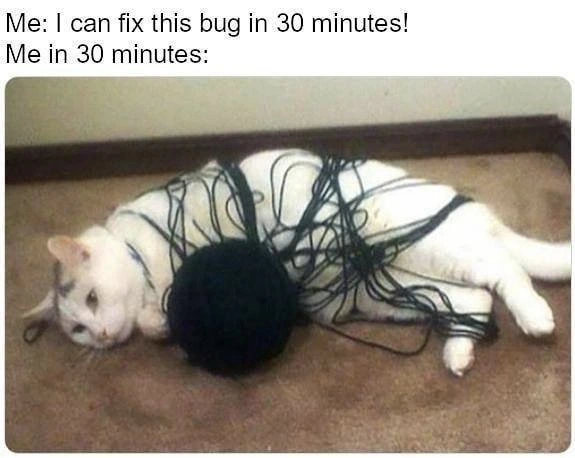
In the meme’s picture, the cat is just like you in that situation. The cat thought it was just playing with a fun ball of yarn for a moment, but look what happened – it got all tangled up and can’t move! The cat looks a bit guilty and defeated, as if it’s saying, “This was supposed to be easy… now I’m trapped.” We find it funny because we’ve all been there in our own way. It’s that “oh no” moment when you realize a quick task isn’t quick at all. Just like the cat wrapped in yarn, sometimes we start doing something simple and end up in a big mess. The meme makes us laugh and say, “Yep, I know that feeling!”
Level 2: Spaghetti Code Surprise
If you’re newer to coding or just starting out, this meme might seem dramatic, but it’s highlighting a real relatable developer experience. Let’s break down what’s happening. The text at the top says, “Me: I can fix this bug in 30 minutes!” and then “Me in 30 minutes:” followed by the image of a cat hopelessly tangled in yarn. In simpler terms, a bug is a mistake or error in a software program that makes it behave in unintended ways (like a game crashing when you press a certain button or a website not showing the right data). Fixing a bug, called debugging, means finding the cause of the error in the code and correcting it so the program works properly. The joke here is that the person (the “Me”) thought this debugging job would be super quick – just 30 minutes – but half an hour later they are in a much bigger mess, symbolized by that poor cat wrapped up in yarn.
Why a cat in yarn? It’s a funny metaphor for what happens to a developer when a “simple” code fix becomes very complicated. The cat probably started by playing with what seemed like one loose string, and before it knew it, the entire yarn ball had unwound and wrapped around its body. In a programming context, you might start fixing one small part of the code, but then discover that part is connected to another part, which leads to another issue, and so on. The yarn represents the code’s dependencies and intertwined logic – basically, how different pieces of the software rely on each other. When code is written without clear structure (often called spaghetti code because it’s all tangled like a bowl of spaghetti noodles), a bug fix isn’t straightforward. You pull on one string (change one line of code) and five other strings (other parts of the program) might move or get knotted. Suddenly, a fix you thought was isolated ends up affecting many parts of the system. This is the unexpected_complexity the meme tags mention – the hidden complications you only discover once you’re deep into the fix.
Let’s clarify a few terms that might help. A call stack is like a trail the program leaves as it executes functions. For example, Function A calls Function B, which calls Function C – this chain is the call stack at that moment. If a bug happens deep in that chain (say inside Function C), you might have to climb back up through A and B to fully understand it. It’s kind of like following a single thread through a big tangle of yarn to see where it goes. If the code is well-organized, this isn’t too bad. But if the code is a knotted mess of function calls and shared variables, tracing that call stack feels like trying to follow one thread through a whole yarn ball – confusing and easy to get tangled or lost. Beginners often haven’t experienced this level of confusion yet, so they might underestimate how tricky a bug can become.
Spaghetti code, mentioned above, is a fun nickname developers use for code that has a very messy structure. In spaghetti code, everything is intertwined: maybe a function does many unrelated things, or lots of parts of the program directly interfere with each other, rather than each part being neatly separated. It’s like a pile of spaghetti where you can’t pull out one noodle without affecting the others. If you’ve ever had a set of earbud headphones get knotted up in your pocket, you have a sense of what tangled code feels like! By contrast, well-designed code is more like organized Lego blocks – pieces connect in clear, planned ways. When code is more like tangled yarn, fixing one thing often means you accidentally tug on something else. For instance, you might fix a bug in the login screen of an app, and then discover the profile page is now showing weird data because it turns out both screens shared some hidden connection in the code. Oops!
Another important concept here is overconfidence_in_estimates. In software development, estimating how long a task will take is notoriously hard. New developers (and even experienced ones on a good day) often underestimate the work. You might think, “This bug is just a typo, I’ll fix it in a jiffy,” only to realize that typo was masking a deeper problem or that fixing it requires understanding a section of code you’ve never looked at before. Suddenly that “quick fix” demands reading through documentation or dozens of files to fully solve it. This is super common – there’s even a running joke that the two default time estimates developers give are “5 minutes” or “no clue,” because so often that “5 minutes” turns into an hour or more. The meme plays on that joke: the Me in 30 minutes part implies the person is now completely tangled up, just like the cat, far from finished with the task.
Now, consider deadline_pressure. When someone says “I can do this in 30 minutes,” they’ve basically set a mini-deadline for themselves. If a developer tells their team or manager that a bug will be fixed in half an hour, you can imagine the stress when minute 29 rolls around and nothing is working yet. The image of the cat lying there, eyes a bit vacant, wrapped in yarn, captures that moment of “I’m in trouble, and the clock is ticking.” It’s both funny and a little anxiety-inducing for anyone who’s been in that spot. This is why estimating tasks is taken seriously in professional teams – everyone wants to avoid these surprises. But no matter how much you plan, bugs_in_software have a way of surprising you. Part of becoming a seasoned programmer is learning to expect the unexpected and give yourself buffer time.
In summary, the meme uses a cute cat and a ball of yarn to illustrate a common programming pitfall: tasks that seem easy but turn out to be tangled_yarn_metaphor levels of complicated. The top text “Me: I can fix this bug in 30 minutes!” represents the confidence or optimism we often have at the start. The image below, “Me in 30 minutes:” with that trapped cat, represents the reality many of us face during debugging – feeling stuck, entangled, and a bit defeated by the complexity we didn’t anticipate. It’s a lighthearted reminder to all developers (especially newer ones) that debugging_troubleshooting can be full of surprises. Don’t feel bad – it happens to everyone! In fact, more experienced developers tend to smile at this meme because they’ve been there many times. It’s practically a rite of passage to say “I’ll be done in half an hour” and then have to sheepishly admit later that it took way longer. The important takeaway is: in coding, things are often more complex than they appear, so be careful with those super-optimistic time estimates (and maybe keep a sense of humor for when you find yourself in a yarn-ball situation).
Level 3: The 30‑Minute Trap
Every seasoned engineer recognizes the bug_fix_estimation folly here: confidently boasting “I can fix this bug in 30 minutes!” only to end up ensnared in a nightmare of unexpected complexity. The meme’s upper caption sets up a classic expectation_vs_reality scenario that draws a knowing, weary chuckle from developers. Why? Because we’ve all lived it. That innocent-sounding bug fix uncovers a tangled mess of interdependent code — a veritable ball-of-yarn architecture — and suddenly that quick fix estimate becomes a marathon debugging session. In the photo, the white cat sprawled on the floor, completely entangled in yarn, is the perfect visual metaphor for a programmer caught in a chaotic web of legacy code and mysterious side-effects. The cat’s defeated expression says it all: “This is way more than I bargained for.” It’s a relatable_developer_experience – humorous in hindsight, exasperating in the moment.
Underneath the humor lies a hard truth about software maintenance. That dark green yarn might as well be spaghetti code – tightly coupled, twisty program logic where everything affects everything else. Pull one thread in the code and you end up reworking half the module. In theory, maybe the bug really should have been a 5-line change in one function. But real-world codebases accumulate quirks and technical debt over time. Perhaps a quick fix in the UI layer unexpectedly breaks a calculation in the backend because of a shared global state. Or you adjust one database query and suddenly an edge case in a far-off module throws a NullPointerException due to some unhandled null that’s been lurking there. It’s the unexpected_complexity hiding beneath the surface that turns a half-hour patch into an afternoon of chasing threads (both the coding kind and maybe the coffee-fueled forum kind).
This meme nails an inside joke in debugging culture: Hofstadter’s Law – “It always takes longer than you expect, even when you take into account Hofstadter’s Law.” The developer’s initial optimism (“30 minutes tops!”) was a trap born of overconfidence_in_estimates. Seasoned devs have a reflexive cynicism about such promises. We’ve learned the hard way that even a “simple” bug can be connected to a tangled web of dependencies. Maybe fixing that function reveals that its output was being implicitly relied on by three other modules (none documented, of course). Now you’ve got to untangle logic across the codebase. The call stack starts looking like a bowl of spaghetti — recursive calls, event listeners, asynchronous callbacks all criss-crossing. It’s as if the code itself is laughing at your deadline_pressure, tying you up in more knots the more you struggle.
One painful example: imagine a supposedly minor bug in the user login code. You think it’s just a small typo or an off-by-one error in an if-statement. Thirty minutes later, you discover the real issue is buried two layers down in the authentication service, where a race condition in multi-threaded code occasionally creates inconsistent user sessions. To fix that, you have to refactor a shared utility that half the application relies upon. Now the me in 30 minutes has morphed into me, 6 hours and one broken build later, staring at a wall of failing unit tests like our feline friend immobilized in yarn. Each attempt to “quickly patch” one thing surfaces two more hidden issues. It’s debugging whack-a-mole — classic debugging_frustration that every developer recognizes.
The humor really lands because of how realistic it is. This cat might look comically pathetic, but any programmer on a tough bug fix has worn that same look of defeat. The contrast between the confident “I got this” and the “oh no, this has me completely stuck” is both funny and painfully accurate. It satirizes the eternal optimism of developers versus the harsh reality of legacy systems and software complexity. Offices late at night are filled with engineers who fell into this trap, promising a quick turnaround to their team or boss, only to trigger a cascade of unforeseen complications. The meme’s popularity in developer_humor circles says it all: we laugh to keep from crying, because we’ve been that cat – ensnared by a “simple” bug that turned out to be Medusa’s hairdo of code snarls.
From an architectural perspective, the image evokes the “big ball of yarn” (akin to the infamous big ball of mud software architecture) where a system has no clear structure, just an entangled mix of modules. Bugs in such a system are notoriously hard to fix cleanly – you tug at one problem and the vibrations ripple out everywhere. Perhaps the code lacks proper separation of concerns, so a UI change impacts business logic, or there are hidden side effects that only manifest under certain conditions. The result? A developer can’t fix one thing without tripping over another, much like that cat can’t move without yanking a dozen threads tighter. The meme underscores this with dark humor: it’s a critique of overly optimistic DeveloperProductivity promises in the face of messy reality. It’s effectively whispering to every coder, “Next time you think it’s a quick fix, remember the cat.” Because nine times out of ten, that “half-hour” bug fix is lying in wait to snare you in a web of BugsInSoftware far more complex than you anticipated.
Ultimately, this cat-in-yarn meme resonates deeply with Debugging_Troubleshooting veterans and newbies alike because it captures a universal truth in programming: No bug lives in isolation. There’s always context, always connections. The humor has a slight edge of tragedy (or at least resigned acceptance) to it. We laugh seeing the cat utterly immobilized because we see ourselves – the developer who optimistically dived in, only to be pinned down by a snarled mass of code relationships. It’s a cautionary tale and a commiseration all in one image. The next time someone on the team cheerily declares, “Give me 30 minutes!”, don’t be surprised if a cynical veteran nearby mutters, “Famous last words,” and shows them this very meme.
Description
A two-part meme that contrasts a developer's optimism with the harsh reality of debugging. The top section contains text that reads, 'Me: I can fix this bug in 30 minutes!'. Below this, a second line of text says, 'Me in 30 minutes:'. The bottom section is an image of a white cat lying helplessly on a brown carpet, completely entangled in a mess of black yarn from a nearby ball. The cat's expression is one of defeat and exhaustion. This meme perfectly captures the common developer experience of grossly underestimating the complexity of a bug. The tangled yarn serves as a potent metaphor for 'spaghetti code,' unforeseen side effects, or a problem that reveals deeper, systemic issues within the codebase. For senior engineers, it’s a humorous and deeply relatable reminder that a seemingly simple fix can quickly devolve into a complex mess, making task estimation one of the hardest problems in software engineering
Comments
7Comment deleted
That's the face of someone who just realized the bug isn't in their code, it's in a minified, third-party dependency with no source maps
Turns out that “30-minute” null-check was actually a decade-old thread pulling on circular DI, legacy Hadoop YARN configs, and a monolith that hisses whenever you touch it
The '30-minute fix' that turns into a distributed tracing nightmare across 17 microservices, three time zones, and a race condition that only manifests when Mercury is in retrograde
Started with a null pointer exception, ended up refactoring the entire dependency injection container, rewriting three integration tests, updating four microservices that somehow depended on the 'fixed' behavior, and discovering that the original bug was actually a feature request from 2019 that never got properly documented. The cat perfectly captures that moment when you realize the 'quick fix' has spawned seven new JIRA tickets and you're now the de facto owner of a legacy subsystem nobody else understands
Every '30‑minute bug' is just a thin wrapper around temporal coupling, hidden global state, and a surprise yarn.lock conflict - by the end, I'm the transitive dependency
“30 minutes tops” until the bug turns into the monolith’s yarn ball - pull one thread and you’re negotiating with side effects, feature flags, and caches
Quick fix? More like pulling the thread on a leaky abstraction - now your microservices are a knotted ball of eventual consistency regret