
GPU Geo-Tracking Bill Meme Explained
The meme is a Tom’s Hardware tweet about Senator Tom Cotton’s bill requiring AMD, Intel, and Nvidia to embed geo-tracking in high-performance AI and HPC chips. The dive covers export-control motives, silicon feasibility, privacy risks, and why engineers call it a compliance nightmare.
Level 1: Toy on a Leash
Imagine you have a super cool remote-controlled toy – let’s say a drone or maybe a special gaming device – that your parents or the school are a bit worried about. It’s really powerful and could potentially cause trouble if used the “wrong” way. Now, instead of just trusting you or setting some basic rules, they decide to build a tracker into it that always knows where the toy is. Not only that, but if you try to take this toy out of your yard or to a friend’s house, it might actually stop working or send an alert! Sounds a bit extreme, right?
It’s like if your favorite high-tech toy car had a little GPS collar on it, just like a pet might. And whenever the toy moves, it’s checking, “Am I still in the approved play zone? If not, I might have to freeze the wheels.” You as the kid just wanted to play, but now there’s this constant watchdog in the toy. It’s both frustrating and kind of funny in a silly way – funny because it’s such an over-the-top way to keep an eye on things.
That’s basically what this meme is about: grown-ups wanting to put a “leash” on a very advanced computer gadget (the GPU) so it doesn’t go places they don’t want. We find it humorous because it reminds us of a parent or authority that’s so worried, they take a measure that feels almost cartoonishly strict. It’s like turning a joke into reality. We laugh a bit, but also feel a little “yikes!” imagining a world where every cool gadget has a built-in chaperone wherever it goes.
Level 2: GPUs on a Leash
Let’s break down what’s going on in this meme in simpler terms. The tweet is basically a news bite: a U.S. Senator (Tom Cotton) has introduced a bill – a proposed law – that would force American chip makers (think Nvidia, AMD, Intel) to put geo-tracking features into their high-end processors. These processors are mainly super-powerful GPUs used for things like advanced AI (training big neural networks, for example) or HPC (High Performance Computing, which is like supercomputing tasks such as climate modeling, physics simulations, etc.). So what does geo-tracking mean? It means the chip would be able to know and report its physical location, like using GPS coordinates. Essentially, the government wants these fancy chips to have a built-in ability to say “I am here in this specific country/region” whenever needed.
Why on earth would they want that? It comes down to compliance requirements – that’s a fancy way of saying “rules you have to follow.” In tech, compliance often involves laws about where and how you can use certain technology. Lately, there’s been a lot of worry about powerful AI technology getting into the wrong hands or being used in unauthorized ways. High-end GPUs are a bit like the engines that drive advanced AI. The U.S. is trying to prevent these engines from being misused or sent to rival countries without permission (this ties into export controls and trade restrictions – like how certain advanced tech can’t be shipped to certain countries). So the idea with the bill is: if the chips themselves can report where they are, it might enforce those rules. Think of it like a high-tech form of those ankle bracelets courts put on people under house arrest – but here it’s for hardware.
When the meme says “hardware offload for compliance nightmares,” it’s poking fun at the idea of solving a bureaucratic problem with a technical feature. Hardware offload usually refers to doing tasks in specialized hardware to make things faster or more efficient (for example, some network cards can do encryption so the CPU doesn’t have to). But in this context, they’re joking that compliance – which is usually handled by policies and software checks – would be shoved onto the hardware itself. In other words, instead of trusting companies and users to obey the law, the chip will be built to enforce the law by design. That’s why it might be a nightmare: compliance issues are already complex and tricky, and pushing them into the hardware could make engineers’ lives very complicated.
Let’s unpack the components one by one:
GPU (Graphics Processing Unit): Originally created to render graphics (like in PC gaming), GPUs turned out to be really good at doing many simple operations in parallel. This makes them excellent for AI/ML tasks – for instance, training a machine learning model involves tons of matrix math which GPUs can handle much faster than normal CPUs. So when we talk about high-performance AI chips, we often mean powerful GPUs (or similar accelerators) that can crunch huge amounts of data quickly.
High-performance processors (HPC processors): HPC stands for High Performance Computing. These are chips used in supercomputers. They might be top-end CPUs or GPUs designed for heavy workloads. For example, Nvidia’s top AI GPUs (like the A100 or H100) are used in HPC clusters and AI research labs. They’re very expensive and very powerful.
Geo-tracking features: This means some kind of technology in the chip that can determine or broadcast its geographic location. How might that be done? Possibly via an onboard GPS receiver (like how your smartphone can get its location from satellites) or by using network info (like IP address to location mapping) or some radio-based solution. The bill doesn’t specify the tech, just that it needs to be there. So it’s basically saying “make sure the chip can ‘know’ where it is, anywhere in the world.”
“Starting six months after enactment”: Enactment means when the bill becomes law. The tweet says the requirement would kick in six months later. This short timeline is part of why engineers are freaking out – six months is a blink of an eye in hardware development.
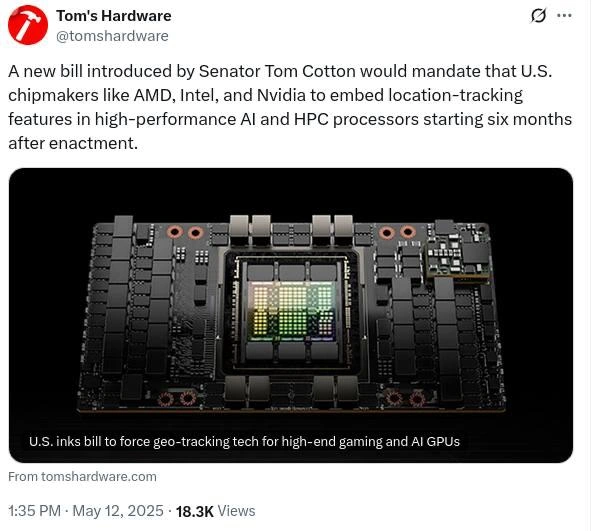
Tom’s Hardware tweet: Tom’s Hardware is a well-known tech news outlet (they report on CPUs, GPUs, PC components, etc.). The tweet is telling us about this proposed law in a straightforward news tone. The image attached (the website card preview) shows a big circuit board with a GPU in the center. That’s likely a high-end graphics card or accelerator board. The little rainbow-colored squares in the chip might be an illustrative graphic – possibly representing the many cores or just for visual flair. Essentially it’s showing a fancy GPU, which is what the law is about. The caption on the image “U.S. inks bill to force geo-tracking tech for high-end gaming and AI GPUs” rephrases the same info: “inks bill” means the bill was introduced (like ink on paper), and it specifically mentions gaming GPUs too. That implies even top-tier graphics cards for gaming could fall under this law (since nowadays the line between a gaming GPU and an AI GPU can be just licensing or firmware – the hardware might be similar). So gamers with ultra-high-end cards might end up with geo-tracking in their drivers/hardware as well, not just big data centers.
Security and Data Privacy: The meme is tagged with these because, naturally, if every high-end chip has to track its location, that raises security and privacy questions. Security-wise, you might ask: can this tracking be hacked or misled? Could someone use it to disable a bunch of hardware remotely? Data privacy-wise: who gets access to the location data? Does your GPU periodically send its location to the manufacturer or government? People get understandably nervous when you talk about forcing devices to potentially phone home. It reminds us of surveillance or at least very heavy oversight. The tag SurveillanceCapitalism hints at the general trend where companies collect data (including location) to make money or control user experience – like how smartphones and apps track us for targeted ads. Here, though, it’s more about government surveillance, but the lines can blur if companies are the ones implementing and managing the feature.
ComplianceRequirements: This term refers to all the rules companies must follow. For example, a compliance requirement might be “don’t sell this chip to countries on the embargo list” or “make sure we can trace where our chips end up.” Usually compliance is handled with processes and maybe software checks (like a system won’t activate unless certain criteria are met). By yanking it into hardware, the requirement becomes a physical part of the product.
Now, how does all this connect to a developer meme and jokes about “peasants” not accessing powerful GPUs? There’s a bit of community humor in calling people without access to top-notch gear “peasants” (like, “oh, you only have a GTX 1060 GPU? Peasant!” – it’s tongue-in-cheek elitist gamer/dev humor). Recently, advanced AI GPUs are so pricey and restricted that only big corporations or well-funded labs have them, so everyone else jokes that we’re the “peasants” who can’t use this “forbidden tech.” It was meant as an exaggeration. But this tweet’s scenario makes it literally true in a sense: if such a law passed, average folks or small companies might truly be unable to get unrestricted high-end GPUs, because each unit would be under watch. Maybe you could only purchase one if you register it, or it might be geofenced to authorized locations (like validated data centers). It’s like enforcement of a class divide in who can compute freely with the best chips. The meme poster is basically saying “Remember how we joked about this? Well… now it’s not so jokey anymore!”
For a junior developer or tech enthusiast, imagine the practical side: You build a cool AI project and manage to get your hands on a top GPU accelerator to run it. But then, due to this built-in compliance feature, the GPU might refuse to run your code at full speed because, say, you’re physically located in a country that’s not cleared (or maybe even just a room with poor GPS signal, causing it to error out). It’s a frustrating thought – your hardware would have capabilities locked or monitored not for any technical reason but due to legal rules encoded in it. That’s what people mean by a “compliance nightmare.” It blends the worlds of law and tech in a way that could make life difficult for engineers: we’d have to understand regulations just to know how our hardware will behave.
Let’s also clarify microcode because it was mentioned. Microcode is like a low-level program or firmware that lives inside CPUs and GPUs, defining how certain instructions or internal processes work. It’s updatable (like how Intel and AMD release CPU microcode updates to fix bugs or security issues). If a geo-tracking feature is added, it could come in the form of additional microcode or firmware that interfaces with a new sensor or logic block. Senior engineers joke about auditing or ignoring it because usually only the chip maker truly understands that firmware – outsiders rarely see the source code. So you often have to just trust it. A junior dev might not deal with microcode directly, but it’s good to know it’s there; it’s why your CPU can get a patch for something without changing the hardware physically.
One more term: SurveillanceCapitalism. This is a broad term (coined by scholar Shoshana Zuboff) describing an economic system built on tracking users and monetizing their data. The connection here is that we’re increasingly putting tracking into everything (for profit, control, or security). So the meme tags suggest this law is an example of that on the hardware level – even if the motive is national security rather than profit, it’s part of the same trend of “monitor first, ask questions later.”
So for someone new-ish in tech, the meme is highlighting a very current event in a humorous way: Government says “track those fancy chips!” and tech folks are half-laughing, half-groaning because they know it would be a huge deal. It touches on hardware design, global politics (US vs other countries in tech race), security fears, and the ever-growing reach of surveillance. The tone is joking but also cautionary – like “today it’s just a tweet, tomorrow it could be reality, and then our job as devs gets even crazier.”
In simple terms: GPUs with GPS strapped on. If that sounds wild, that’s the point. It’s both a literal description and a metaphor for how far things might go in controlling technology. For a junior dev or enthusiast, it’s a peek into the intersection of our coding world with the larger forces of law and politics, served with a side of sarcasm that’s common in developer humor.
Level 3: LoJacked GPUs
This meme strikes a nerve with seasoned engineers because it combines compliance requirements with hardware in a way that screams “nightmare fuel.” The tweet references Senator Tom Cotton pushing a bill to geo-tag high-end GPUs. Picture the likes of Nvidia, AMD, and Intel being told by law, “implement an always-on location tracker in your fastest chips, pronto.” The humor here is dark and familiar: we've seen grand ideas from non-technical leadership before, and they often become a dumpster fire for the folks in the trenches. Hardware offload for compliance sounds like a punchline only an enterprise architect or a government bean-counter would conjure. It’s basically saying: “Hey, instead of trusting companies and developers to follow export laws or use restrictions, let’s make the chip itself tattletale or self-police. Problem solved!” Any senior dev or hardware engineer reading that is likely doing a facepalm, because they can already envision the slew of issues and unintended consequences.
First off, mandating a hardware change within six months betrays a deep ignorance of how silicon is developed. Six months is barely enough to spin up a minor revision of an existing design, let alone architect and validate a new subsystem across complex GPUs. These aren’t little Arduino gadgets; we’re talking about HPC chips with multi-billion transistor counts that normally take years of design and testing. A law like this would send chip designers into full panic mode. Expect emergency meetings with titles like “Geo-Tracking Architecture Impact” where exhausted engineers ask, “Can we slap a GPS module on the board? Can firmware handle this? Do we need to re-spin the ASIC?” Meanwhile, project managers are updating Gantt charts with a new deep red bar labeled “(Unplanned) Government Compliance Feature – VERY URGENT.” The whole thing has “compliance nightmare” written all over it – exactly as the meme caption says.
We also find this funny (in a grim way) because it echoes the dystopian vibe of Big Brother tech. Seasoned devs joke about how everything is tracking us these days (your phone, your fridge, the toaster maybe). Now imagine your pricey AI accelerator card phoning home like, “Dear manufacturer, I am currently in a data center at coordinates 37.42° N, 122.08° W. Please advise.” It’s SurveillanceCapitalism meets government mandate. The meme’s subtext is essentially: “Remember when we joked only the elite (not the poor peasants) could use top GPUs? Well, now they might literally enforce it with GPS and law.” It’s a gallows humor take on how real-world policy is catching up with what used to be absurd exaggeration.
From an industry AIIndustryTrends standpoint, it’s no coincidence AI chips are under the microscope. There’s massive hype around AI being a strategic asset – almost a new nuclear arms race but with neural networks. High-end GPUs (like Nvidia’s A100/H100 or AMD’s MI200 series) are the critical fuel for training advanced models. Governments are freaked out that these chips could enable rival nations (or unauthorized groups) to leap ahead in AI capabilities. AI hype vs reality comes into play here: policymakers act as if a handful of GPUs can instantly yield a superintelligence or magical military tech. Reality check: yes, these chips are powerful, but they’re not instant WMDs. However, the hype is driving extreme measures – like this bill – to exert control. Seasoned engineers see the historical parallel: in the 90s, strong encryption was classified as a munition; exporting 128-bit SSL was treated like shipping a missile. We had jokes about “T-shirts printed with encryption code” to poke fun at those rules. Fast forward, and advanced GPUs are the new hot item on the export control list. The meme basically says, “What’s next, slapping a tracking collar on every GPU so it doesn’t defect to the enemy?” And boom – that’s literally what the bill proposes.
Now consider the security trade-offs and practical snafus. Putting a tracker in a GPU for compliance means the GPU will likely have to either limit functionality or report home if it’s in an unauthorized location. How might that work? Maybe the GPU won’t run at full speed (or at all) unless it confirms it’s in an approved country. So a datacenter in Europe or Asia with these chips might suddenly get throttled or bricked if the geo-check system Thinks™ it’s somewhere it shouldn’t be. Cue the senior engineer nightmare: the entire cluster goes down at 3 AM because the geo-tracking feature had a hiccup and falsely flagged a bunch of GPUs as “out of zone.” On-call engineers would be scrambling, logs would be sparse (do we even get logs for “GPS failed, unit entering lockdown”?), and you can bet the incident post-mortem will be full of rage: “Why the heck did we trust some black-box tracker? And who’s got the override key? Call vendor support, I guess…” It’s always at 3 AM, right? The meme resonates because anyone who’s maintained systems with weird vendor-mandated features knows the pain of when those go wrong. It’s giving us flashbacks to things like DRM servers going offline and preventing legit users from using software they paid for – except here it’s hardware deciding it doesn’t like where it woke up today.
Another aspect is microcode and firmware complexity. Senior folks know that modern GPUs already run a ton of firmware internally (scheduling threads, managing memory, etc.). Much of it is proprietary and not visible to end users. Adding geo-tracking means even more opaque firmware. Will companies share the source? Highly unlikely – that’s sensitive both from IP and security standpoint. So we’ll get a mysterious “security blob” update in our driver stack that “enables compliance features.” Are we supposed to audit it? Most likely, we’ll just shrug and roll it out, hoping it doesn’t break anything. It becomes one of those things you ignore until it pages you. And when it does, boy, good luck. Imagine diffing firmware dumps to figure out why a GPU thinks it’s in North Korea when it’s actually in New Jersey.
And let’s talk DataPrivacy and user rights. A lot of seniors have a reflexive cringe when they hear “always-on tracking,” because we’ve been through the debates: who owns the data, who has access, what else can it be used for? The government might say, “Trust us, it’s only for stopping bad guys from misusing AI chips.” But once the capability exists, you know others will want to tap into it. Maybe corporations will use it to enforce their own policies (“This GPU is licensed to run in X cloud region only; if moved, it deactivates”). It could enable a new kind of product lock-in. If that sounds far-fetched, look at how printers refuse off-brand ink or how some software deactivates if your hardware changes. Now hardware could deactivate if your hardware changes location! It’s the ultimate region lock. We had DVD region codes and software license regions; now it’s hardware region enforcement. Seniors have seen this pattern: compliance requirements often start narrow but then get expanded or repurposed. What starts as “national security feature” could morph into a general surveillance tool. Maybe marketers spin it as anti-theft: “Our GPUs come with LoJack! If someone steals your expensive AI rig, you (and the Feds) can track it down.” Sure, that might actually appeal to some data center operators… until a crafty hacker finds a way to abuse it.
The cultural reference lurking here is the old division between “haves” and “have-nots” in tech. The meme explicitly mentions “jokes about high-power GPU being not allowed to be accessed by poor peasants.” This was a tongue-in-cheek commentary on how only big players (rich companies, government labs, etc.) get the top-tier silicon, while indie developers or smaller labs are priced out or locked out. Now, with an actual law, that class barrier could be enforced technologically. It’s both funny and depressing: funny as hyperbole turned real, depressing because it edges toward an official techno-feudalism. Picture a future where to run a state-of-the-art AI, you need not just money but also government permission – your hardware will literally refuse to run otherwise. That’s the nightmare scenario hiding behind the laugh.
Finally, the meme lampoons the idea that more tech is the answer to a policy problem. It’s so on the nose for engineers: instead of addressing root issues (like supply chain security or diplomatic agreements), someone in power says “just solve it with tech magic.” It’s reminiscent of bosses saying “can’t we just add a quick check in the code to fix this huge compliance issue?” – but here it’s a senator saying it about actual chips. Senior devs have that weary humor about them: they’ll shake their head with a grin, because they know this opens a Pandora’s box of complexity. If this becomes law, we’ll be seeing CVEs (security vulnerability bulletins) down the line like “CVE-2026-XXXXX: Exploit in GPU geo-tracking module allows spoofing location, enabling unauthorized use of restricted AI chips”. And somewhere, a grumpy engineer will sip coffee and say “I told you so.”
In summary, the meme is funny to us because it’s an absurdly plausible example of technology and bureaucracy colliding. It highlights the senior perspective: we’ve been around this block – government mandates, compliance hacks, unintended side-effects – and while we’ll comply because we must, we also know it’s likely to be a mess. It’s humor with a side of I-can’t-believe-they’re-serious, underscored by real concerns about privacy, security, and plain old feasibility. It’s like the industry’s collective sardonic laugh, followed by a sigh, knowing that if this actually happens, we’re in for a wild ride.
Level 4: Silicon Panopticon
At the cutting edge of Hardware and policy, this proposal essentially creates a panopticon in silicon. It suggests baking a geo-tracking mechanism directly into high-performance AI and HPC processors, possibly turning each GPU into a watchdog of its own whereabouts. On a theoretical level, this raises questions about trusted computing and cryptographic attestation: how can a chip prove its location with integrity? One could envision a mini GPS receiver or similar sensor on the die, feeding coordinates into a secure coprocessor. The processor might carry a secret key, using it to sign geolocation data so that any remote auditor can verify “this chip says it’s in California, and here’s the cryptographic proof.” This is akin to a Trusted Platform Module (TPM), but for geography – a Trusted Location Module, if you will. The irony is that achieving a truly tamper-proof geo-fence is fundamentally hard. Physical access is the ultimate root of trust in reverse: if someone can physically hold a chip, they can often find a way around its safeguards. Consider the theoretical cat-and-mouse: determined adversaries could employ GPS spoofing or shield devices so they can misreport location. There are advanced concepts like distance–bounding protocols (to verify a device is actually at a claimed location by measuring signal round-trip time), but embedding such capabilities into a GPU borders on science fiction. We’re talking about injecting radio-frequency circuits and secure clock logic into an already jam-packed chip design. Modern GPUs have billions of transistors optimized for matrix math and shader operations; carving out silicon for a surveillance subsystem isn’t trivial. There would be trade-offs in chip area, power, and complexity — essentially a new non-functional requirement grafted onto designs optimized for FLOPs. This could interfere with the processor’s pipeline if not carefully isolated. Imagine a scenario where a GPU’s fetch–decode cycle stalls, not due to a cache miss or branch mispredict, but because the geo-tracking unit is busy acquiring a satellite fix or awaiting secure clearance to execute certain instructions in a given jurisdiction. It’s like a bizarre new form of pipeline hazard: location hazards. Formal verification of such a system would be mind-bending, since state space now includes the device’s position on Earth. We’d be introducing a new variable into the execution model – call it LocationRegister – that could gate whether certain operations proceed at full speed. In theoretical computer science terms, we’re almost creating a machine that’s not just Turing-complete, but jurisdiction-complete: its behavior can depend on a real-world geopolitical state that isn’t purely computational.
From a SecurityTradeoffs perspective, embedding a tracker at hardware level could strengthen export control in theory, but it also expands the attack surface. Every new on-die feature is a potential new vulnerability. A poorly implemented location tracker might be tricked by malicious input (imagine feeding it counterfeit satellite data or exploiting a buffer overflow in the tracking firmware). Or adversaries could find a way to disable or manipulate it via hardware hacks, like a modified board that intercepts the sensor. Meanwhile, honest users get no choice but to trust this opaque feature. The microcode or firmware driving it might be inaccessible, making it effectively a black box baked into the machine. Security researchers often warn that any backdoor for “good guys” can become a backdoor for bad actors too. If the government can query or deactivate a GPU based on location, what stops a sophisticated hacker from doing the same if they compromise the control infrastructure? This veers into the territory of the Clipper Chip redux: that infamous 1990s proposal to put an encryption backdoor chip in communications devices. Clipper was rooted in solid math (it used an escrowed key system), but it failed spectacularly in practice and public opinion. The geo-tracking GPU feels like a twist on that, moving from eavesdropping on data to eavesdropping on position. It’s a shift from "who are you calling?" to "where is your compute happening?". The fundamental DataPrivacy concern is enormous: we’d be creating a fleet of high-end processors that are effectively reporting to some authority about their whereabouts. It’s a step toward a ubiquitous surveillance fabric at the hardware level – a Silicon Surveillance State. Technically, one can appreciate the boldness of trying to solve compliance via hardware offload (why rely on messy software geofencing when the chip can enforce the law itself, right?). But it’s also a collision of vastly different domains: semiconductor physics meets legal code. And as any engineer knows, adding more roles to a system (especially one as complex as a GPU) invites emergent chaos. The laws of thermodynamics and information theory don’t bend for Congress: more functions crammed in the same space mean more heat, more possible faults, and more things that can’t be fully tested before deployment. In summary, at this deep technical level we see an attempted hardware-based panacea for a policy problem – one that dances with cryptographic protocols, hardware design constraints, and the age-old problem of connecting physical reality with digital guarantees. It’s a fascinating, if fraught, intersection of computing theory and the real world, evoking equal parts awe at the ambition and skepticism about the practicality.



Great, now instead of just worrying about kernel panics we get to worry about kernel subpoenas - try sudo gpsctl --disable on THAT
Finally, a feature that lets your GPU phone home about its location while it's already phoning home about telemetry, crash reports, and driver updates. Now your H100 can tell the government exactly which data center rack it's mining crypto from instead of training your LLM
Nothing says 'land of the free' quite like your GPU phoning home to report its coordinates. I'm sure the performance overhead of mandatory geolocation will be negligible - just like how TSA security theater has zero impact on travel times. Can't wait for my next kernel panic to include GPS coordinates in the stack trace, really helps with debugging those shader compilation errors
Geo-tagged GPUs: when the RCA reads “cluster failed because device thinks it’s in the wrong country,” and the fix is adding continent to your Terraform modules plus a geo‑aware admission controller
Mandated telemetry etched in silicon: the ultimate supply-chain backdoor no zero-trust architecture can firewall
Can’t wait for the postmortem where half the training run dies because the new on‑die compliance attestor lost GPS in the colo, decided our H100s were in a sanctioned region, and tripped the export‑control kill switch
And how long until rendered meaningless?
Please, connect to the internet to activate your GPU 🤡🤡🤡
"i'm sorry you got the gpu lite version you will be shown ads in your games made with ai on your own device"
South Park Season 1, Episode 1 "Cartman Gets an Anal Probe" (by extraterrestrials) Season 27, Episode 1 "Everyone Gets an Anal Probe" (by Nvidia and Starlink)
If they will block it in places like Russia and China - it is good imo
Well I am doing exactly what you suggested. What you said is not contradictory to what I said
No it's not. It's like hating on Nazis and waging sanctions and bombs on Germany in WW2. It's a good and moral thing
I don't agree with your opinion. Opposition to evil, like Russia in 2025, is fueled by hate and emotions. And practice over the history shows that it is not futile.
Lol, they are killing like million of people, annexing territory and ruining lives of 10s of millions. And yet in your head it is normal, but hating them for that is not normal? That some serious intellectual gymnastics, lol.
There is nothing wrong with hate towards the country for waging wars and annexations. It is normal. It is a tool of punishment through calls to action.
Typical Russian whataboutism. Literally a meme
If you annex shit it's not genocide resolution, it's a landgrab and you are evil
Vietnam war was after WW2 treaties , not before😂
I don't agree here. Landgrab is more evil. It fuels conflicts for generations