
AI Compute Offshoring Meme Explained
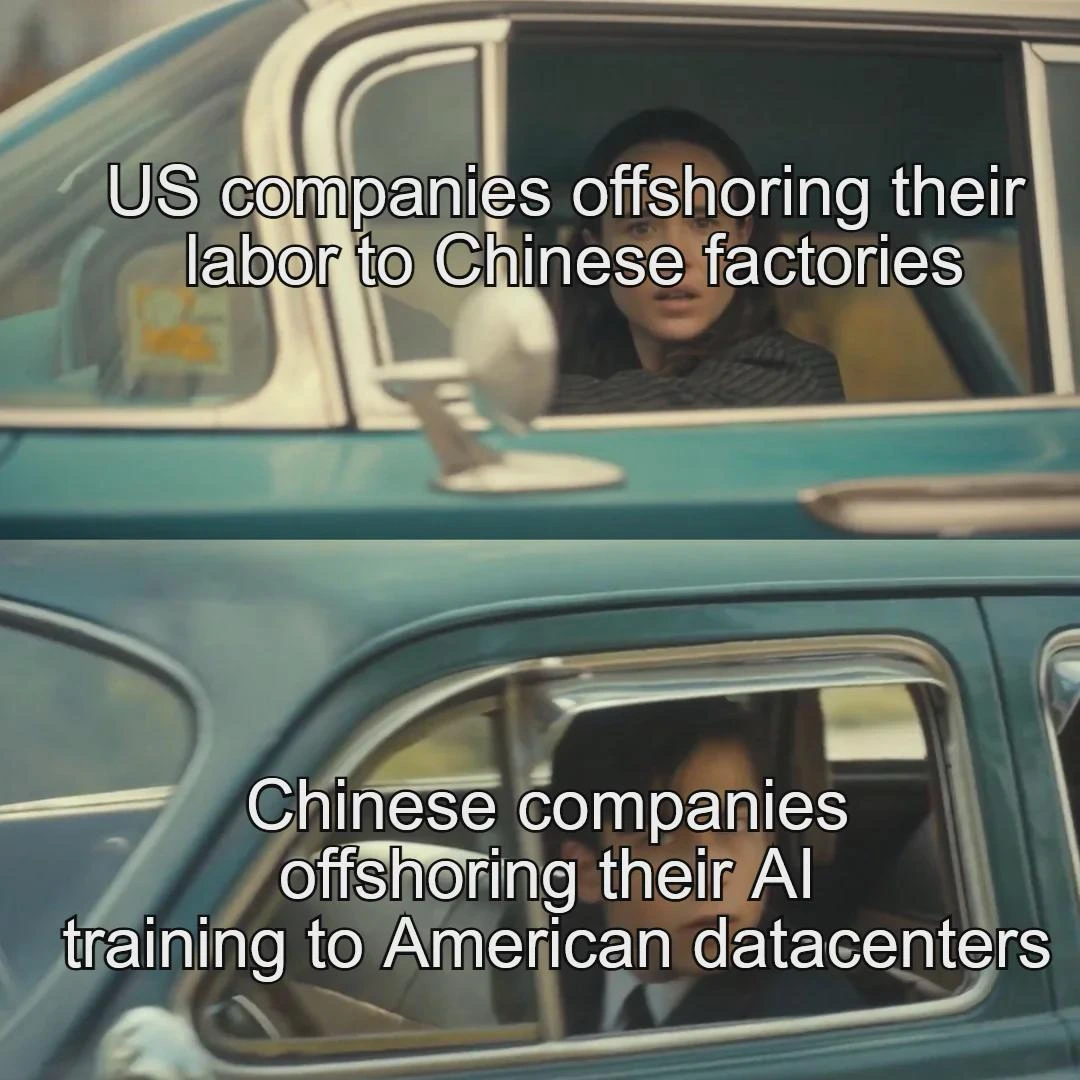
Two cars exchange a wary look: U.S. labor offshoring to Chinese factories versus Chinese AI training on American compute. The dive explains compute arbitrage, GPU clusters, and export-control tension with cloud services.
Level 1: Borrowing the Big Workshop
Imagine one neighbor used to send all their toys to the other neighbor’s workshop because it had lots of workers and tools. Years later, the second neighbor designs a giant robot but has to borrow the first neighbor’s powerful machines to build it. They pass each other, exchange the look shown in the picture, and realize they have both been playing the same game with different kinds of factories.
Level 2: Factories for Matrices
AI training is the repeated adjustment of a model’s numerical parameters so that its predictions improve. Most of the heavy work consists of enormous matrix calculations. A GPU can perform many similar calculations at once, which makes it well suited to this task. Parallel computing divides the work among many GPUs; distributed computing coordinates that work across multiple machines.
A data center is the building and supporting infrastructure around those machines: racks, network switches, storage, electrical systems, backup power, and cooling. A cloud service provider lets a customer rent some of that infrastructure without owning the building or installing the hardware. The customer can submit training code from another country, receive checkpoints and metrics over the network, and pay for usage. In simplified form:
training data + model code
            |
            v
 rented accelerator cluster  --->  trained model weights
This is why the lower caption calls training “offshoring.” The intellectual work may remain with the Chinese company, but the power-hungry computation runs on remote equipment. It resembles a startup sending a design to a contract factory: one party specifies what to build, another supplies the expensive production machinery.
The resource constraint is concrete. A developer cannot replace a large, tightly connected training cluster with ordinary laptops merely by waiting a little longer; communication overhead, memory capacity, and total runtime can make that impractical. Cloud rental avoids a huge upfront purchase, but it creates trade-offs around cost, availability, data governance, vendor dependence, and regulatory compliance. The two people staring across the frames represent businesses discovering that supply-chain dependence works in both directions.
Level 3: Arbitrage Changes Direction
US companies offshoring their labor to Chinese factories
Chinese companies offshoring their AI training to American datacenters
The two occupants exchange a wary sideways glance through matching teal car windows, turning a geopolitical supply chain into a moment of mutual recognition: Oh, so now you are doing it too. The upper frame invokes decades of U.S. companies moving manufacturing to China for lower costs, mature supplier networks, and enormous production capacity. The lower frame reverses the route, depicting Chinese companies sending an AI workload toward American infrastructure because that is where much of the most desirable accelerator capacity, cloud tooling, and technical ecosystem has historically been concentrated.
That symmetry is the joke, but it is deliberately imperfect. Factory offshoring moves production processes and affects human jobs; remote AI training purchases compute as a service. A model’s code and data can cross a network while the physical GPUs remain bolted into racks elsewhere. The meme treats both as forms of resource arbitrage: a company locates an expensive stage of production wherever the needed combination of capacity, cost, expertise, and access is most favorable. Globalization has apparently become full-duplex.
The technical backdrop is a collision between export controls and cloud abstraction. Restricting the shipment of an advanced GPU controls where a physical chip may be delivered. Renting time on a remotely hosted cluster raises a different question: has a controlled capability effectively crossed a border even if the hardware has not? Rules can address remote access, corporate ownership, end users, and model weights, but enforcement is harder than checking a crate at customs. Cloud providers must identify who ultimately controls an account and what workload is running, while customers can operate through affiliates, contractors, or data centers in third countries. None of that means every offshore training arrangement is illegal; it means the neat boundary between “exporting hardware” and “selling a service” is under pressure.
Large-model training makes access especially valuable because the scarce unit is not merely “a GPU.” A useful training cluster needs thousands of accelerators, high-bandwidth memory, fast interconnects, storage able to feed data continuously, reliable power and cooling, and software that keeps the devices working in parallel. If one worker falls behind or a network link becomes congested, the rest can spend expensive time waiting at synchronization barriers. The commercial product is therefore an operating system for a small industrial plant, not a pile of graphics cards with an invoice attached.
The meme also exposes an old corporate habit: political rhetoric favors national self-sufficiency until quarterly targets need a resource available somewhere else. Executives can describe manufacturing offshoring as efficiency and compute offshoring as resilience, while policymakers describe the same movements as strategic dependence. The label changes with the meeting; the dependency survives. Building domestic alternatives takes years because semiconductor fabrication, packaging, power infrastructure, networking, developer tools, and trained operators are complementary systems rather than interchangeable purchases.
The phrase “American datacenters” should be read as the meme’s compressed premise, not proof that all Chinese AI training literally occurs inside the United States. Workloads may use domestic hardware, older inventory, compliant accelerators, or capacity hosted in several countries. The satire needs only the broader reversal: companies once associated with receiving outsourced physical production may now seek scarce digital production capacity from the economy that outsourced it.
The global supply chain is now full-duplex: jobs go east, gradients go west.