
Systems Stack Research Meme Explained
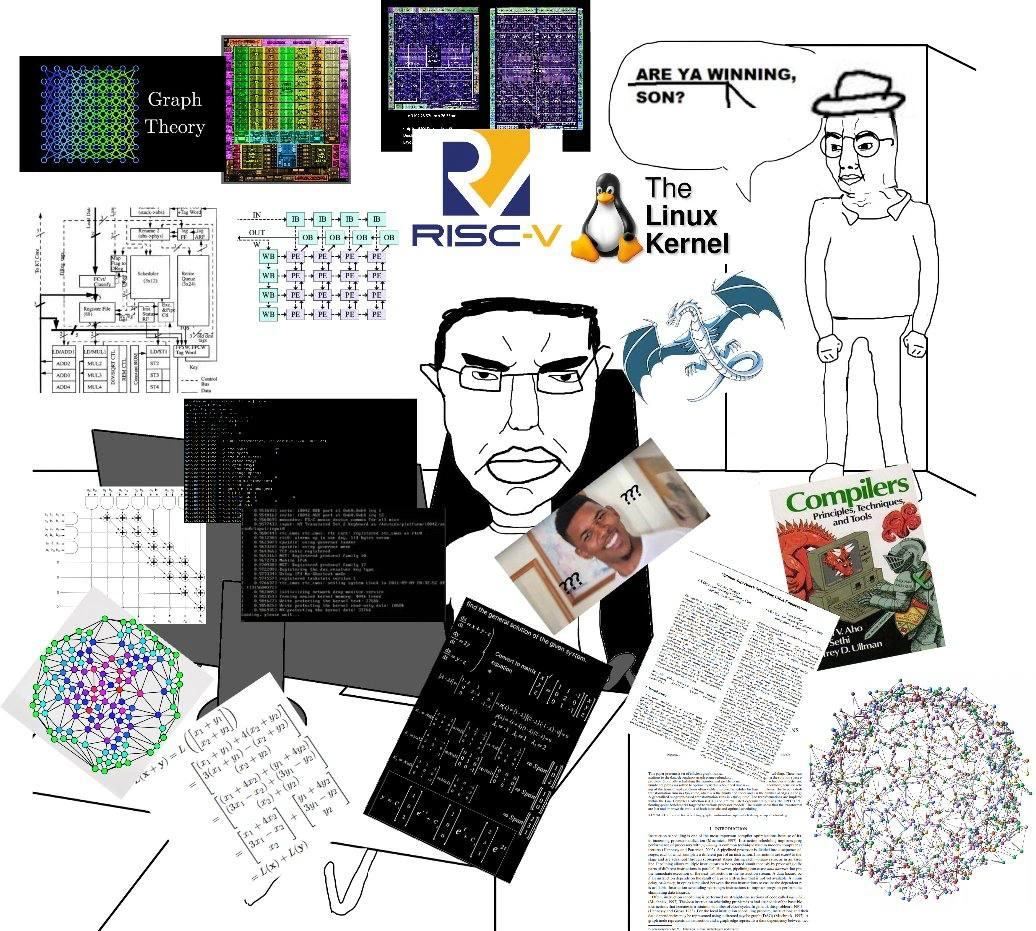
The meme surrounds a stressed engineer with compilers, RISC-V, Linux, graphs, and papers while a parent asks “are ya winning?” The dive shows how languages, kernels, and silicon constrain one another with no clean finish line.
Level 1: A Very Hard Puzzle
It is like a parent asking whether a child has won a puzzle, only to find that the puzzle covers the whole room, every piece changes the pieces beside it, and the instruction book has dragons on its cover. The child is not losing exactly; “winning” is simply much harder to define than the parent expected.
Level 2: The Systems Stack
Graph theory studies objects and the relationships between them. In software, those objects might be functions, code blocks, dependencies, or network nodes. A compiler translates a programming language into a lower-level form a machine can execute; the visible book titled Compilers: Principles, Techniques, and Tools is widely recognized by its dragon cover and represents the theory behind that translation.
RISC-V is an open-standard instruction-set architecture: the defined vocabulary and behavior that software expects from a compatible processor. It is not one specific chip. Different chips can implement the same RISC-V instructions with different pipelines, caches, and performance characteristics. The chip images and processor diagrams visualize that implementation side.
The Linux kernel is the central privileged program that coordinates hardware and applications. It has architecture-specific support so Linux can be built for different processor families, including RISC-V. The terminal windows suggest the practical work connecting these concepts: compiling code, running tools, examining logs, and repeating after the machine explains—usually without tact—that one assumption was wrong.
Level 3: No Final Boss
ARE YA WINNING, SON?
The inherited meme format expects a yes-or-no answer about a game. Here, the seated figure is surrounded by terminal output, equations, papers, chip layouts, compiler imagery, network graphs, and an unexplained photograph literally marked ???. The father’s simple status question collides with systems research, where progress might mean proving one property, reducing one benchmark regression, understanding one kernel trace, or discovering that a month’s hypothesis was wrong in an educational way.
That mismatch is the core developer pain point. In ordinary product work, “done” can already be slippery; in low-level research, even the score is disputed. A compiler optimization can accelerate one workload and slow another. A pipeline change can improve throughput while increasing power or verification cost. A kernel patch can build cleanly and still fail under a rare concurrency pattern. The room looks like someone tried to open every dependency of the question “why is this slow?” and learned that the dependency graph contains the entire discipline.
The stern glasses and crowded desk also parody the identity of the deeply technical specialist. The material signals impressive breadth—compiler design, CPU architecture, kernel development, and mathematical foundations—but the visual result is not mastery at rest. It is cognitive siege. Academic papers overlap code; graphs cover the floor; the famous textbook is present but has not made anything visibly calmer. The tiny ??? marks are especially honest: technical depth often increases the number of unknowns one can name with precision.
This is why the image resonates beyond student workload. Senior systems engineers routinely cross abstraction boundaries because failures refuse to respect team charts. A performance anomaly might require reading generated assembly, checking cache behavior, inspecting a scheduler trace, and then discovering that the original algorithm was the real problem. Tools promise clean layers, but production cheerfully hands you a bug report that lives between all of them.
Level 4: From Graphs to Gates
The collage is not merely “a lot of computer science.” Its visible pieces form a plausible vertical slice through a computer system. A compiler begins with source text, builds structured representations, analyzes program behavior, and eventually selects machine instructions. Those instructions target an instruction-set architecture such as the prominently displayed RISC-V. A processor implementation then fetches and executes them through datapaths and pipeline stages like the block diagrams at left. The Linux Kernel sits across that boundary: it is compiled into target instructions, then uses the architecture’s privileged mechanisms to manage memory, scheduling, interrupts, and devices.
The Graph Theory panel and the several dense node-and-edge diagrams belong in this stack more naturally than their chaos suggests. Compilers repeatedly turn programs into graphs:
- A control-flow graph represents basic blocks as vertices and possible transfers such as branches as edges.
- A data-flow analysis propagates facts across those edges until the facts stabilize at a fixed point.
- An interference graph connects temporary values that are simultaneously live; register allocation can then be approximated as graph coloring, with spills inserted when too many values compete for too few physical registers.
This is where the classic Dragon Book cover and the blue compiler dragon become more than decorations. Parsing is only the front gate. Behind it are intermediate representations, dominance relations, loop analysis, instruction selection, register allocation, and scheduling. Each transformation must preserve program meaning while improving some combination of speed, code size, compile time, and hardware utilization. “Correct output” is the invariant; almost everything else is a trade-off that can awaken another dragon.
The processor diagrams add a second graph-like scheduling problem. A pipeline overlaps work on multiple instructions, but dependencies create hazards: one instruction may need a value that an earlier instruction has not produced, a branch may redirect control, or two operations may contend for one resource. Forwarding, stalls, speculation, and scheduling mitigate those conflicts. The compiler can rearrange some instructions, the microarchitecture can handle others dynamically, and both sides must obey the RISC-V architectural contract. The colorful die images above the logo show the physical end of this abstraction stack, where elegant models finally meet wire delay, area, power, and heat.
The joke’s technical excess therefore has a coherent center: one stern person appears to be studying the interfaces where languages, algorithms, operating systems, and silicon constrain one another. A local decision in one layer can leak everywhere else. An instruction-set extension needs compiler support; compiler assumptions must match the ABI; the kernel needs architecture-specific code; and the hardware must implement the promised behavior. “Winning” would require the whole chain to remain correct and fast, which is less a finish line than a long-running negotiation with physics.



Whether he is winning is undecidable, but at least the kernel builds.