
Code Review Requires Tests Meme Explained
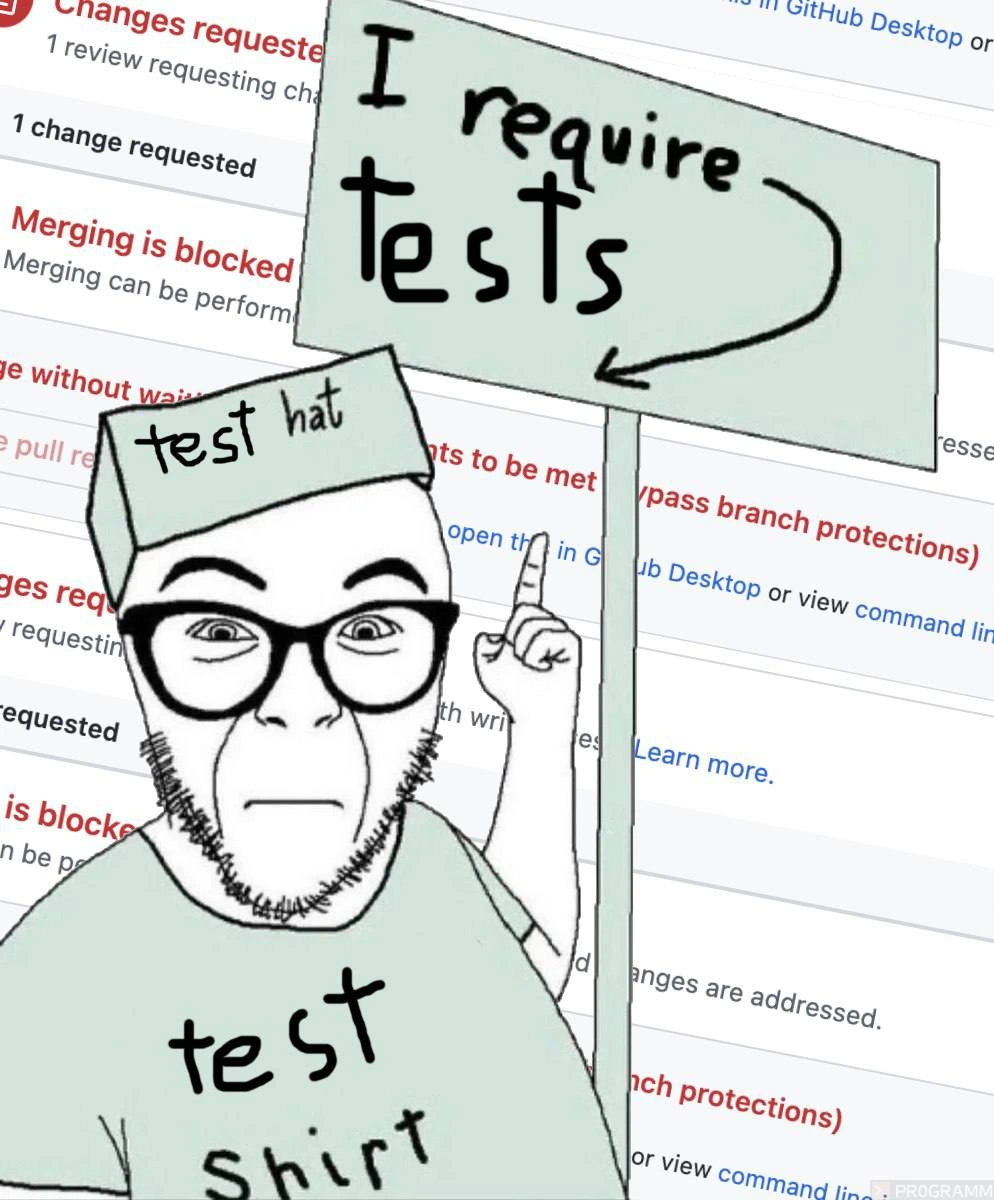
A reviewer in a “test hat” and “test shirt” demands tests while GitHub shows Changes requested and Merging is blocked. The dive covers pull-request gates, CI, regression tests, coverage traps, and how to ask for tests that catch real risk.
Level 1: The Bridge Inspector
It is like building a bridge and meeting an inspector whose hat and shirt both say “inspection.” He refuses to open the gate until someone puts weight on the bridge and proves it will hold. His costume is ridiculous, but the rule is sensible: finding the weakness before people cross is much better than discovering it afterward.
Level 2: Red Means Not Yet
Git is a version-control system that records changes to code. Developers commonly work on a separate branch and open a pull request (PR) proposing that those changes be merged into a shared branch such as main.
A reviewer can inspect the changed lines, ask questions, approve the PR, or request changes. On GitHub, a requested-changes review becomes a true blocker when the repository’s rules require pull-request reviews. Branch protection can also require automated status checks, resolved conversations, current branches, signed commits, or successful deployments before merging.
Continuous integration (CI) is the automation that runs when code changes. It may compile the project, execute tests, run static analysis, scan dependencies, and report a status back to the pull request. When that status is required, a failed check prevents the merge. The red text behind the reviewer visualizes both kinds of control: a human has rejected the current revision, and repository policy enforces the rejection.
Testing terms describe different goals:
- A unit test checks one small piece of logic in isolation.
- A regression test ensures a fixed bug does not return.
- continuous testing runs checks repeatedly as code evolves.
- test-driven development writes a failing behavioral test before implementing the behavior.
- coverage measures which code was executed during tests, not whether the tests were good.
For someone submitting an early PR, “please add tests” usually means the reviewer wants durable evidence that the change works and will keep working. The fastest constructive response is to ask which behavior or risk needs demonstration, add a focused case, run the relevant suite locally, and push the update. The PR will rerun CI, and the reviewer can replace “Changes requested” with approval once the requirement is genuinely met.
Level 3: Wardrobe Coverage Is Complete
I require tests
The reviewer does not merely recommend testing. He has become testing. A folded test hat, a test shirt, thick glasses, raised finger, and expression of absolute procedural certainty turn one pull-request comment into a full professional identity. His wardrobe has 100% label coverage; the proposed code apparently does not.
Behind him, the GitHub interface repeats the consequences in red:
Changes requested
1 change requested
Merging is blocked
That background is important. This is not a reviewer leaving an optional style preference and wandering away. A protected branch has converted human judgment into an enforced merge gate. Until the blocking review is approved or properly dismissed—and until any other configured requirements pass—the pull request cannot enter the target branch. “I require tests” is backed by repository policy rather than the volume of the reviewer’s finger.
The underlying engineering argument is strong. A code review is a point-in-time inspection of a change; an automated test is an executable claim that can be checked on every future change. A reviewer can reason that a parser handles malformed input today, but a regression test preserves a concrete example:
def test_rejects_expired_token():
    token = make_token(expired=True)

    assert authenticate(token) == AuthResult.EXPIRED
If a later refactor accidentally accepts that token, continuous integration can reject the pull request before production does its own, rather more expensive review.
Tests also force vague requirements into observable behavior. “Handle retries correctly” becomes questions such as: How many attempts occur? Which errors are retryable? Is the operation idempotent? What happens when the final attempt fails? Writing the assertions often uncovers missing product decisions before it uncovers a code defect. That is why experienced reviewers ask for tests around boundary cases, failure paths, concurrency, authorization, data migration, and bugs that have already escaped once.
The branch-protection fragments make the process systemic:
developer pushes commit
        ↓
pull request opens or updates
        ↓
CI builds, tests, and scans the exact revision
        ↓
reviewer approves or requests changes
        ↓
repository rules permit or block the merge
Required status checks prevent “the tests probably pass locally” from being accepted as evidence. Required reviews prevent a green test suite from being treated as proof that the design, security model, and requirements are sound. The two controls cover different failure modes: automation checks repeatable facts, while people assess context and intent.
The meme also satirizes the point where a best practice becomes a reflex. “Add tests” is sometimes the reviewer equivalent of “have you tried turning it off and on again”: frequently correct, socially safe, and occasionally offered without identifying what risk the test should cover. A valuable request names the contract:
- Demonstrate the new behavior under normal input.
- Preserve the bug as a regression case.
- Exercise the failure or rollback path.
- Prove authorization boundaries.
- Cover compatibility with old persisted data.
- Verify the interaction at the correct system boundary.
Without that reasoning, a pull-request author may add a test that merely copies the implementation, mocks away the risky behavior, or asserts incidental details. The counter rises, the gate turns green, and confidence remains decorative.
Test coverage has the same trap. Coverage reports which lines or branches executed; they do not prove that the assertions were meaningful, that important inputs were chosen, or that the requirement itself was correct. A suite can execute every line while verifying almost nothing. Conversely, risk-heavy code may deserve several layers of tests even if a repository-wide percentage is already high.
Good testing therefore balances several scopes:
| Test Type | Best At Catching | Common Failure |
|---|---|---|
| Unit test | Local logic and edge cases | Excessive coupling to implementation |
| Integration test | Contracts between components | Slow or fragile environment setup |
| End-to-end test | Real user flows across the stack | Costly diagnosis and flakiness |
| Regression test | A known bug returning | Covering only yesterday’s failure |
A healthy suite is fast enough to run continuously, deterministic enough to trust, and focused enough that a failure explains something. A flaky required check trains developers to rerun jobs until random success appears; at that point, CI is no longer quality assurance but a slot machine wearing a linter badge.
The human dynamics matter too. Blocking a merge transfers schedule pressure onto the reviewer-author relationship. If the request is specific and proportionate, branch protection gives engineers cover to defend reliability against “just ship it” pressure. If the standard is inconsistent or the reviewer disappears, the same control becomes bureaucratic deadlock. Teams need documented expectations, clear ownership, backup reviewers, and an explicit emergency bypass process with an audit trail. Otherwise “bypass branch protections” stops being an exceptional control and becomes the organization’s unofficial deployment tool.
The figure’s absurd costume captures both sides. He is the guardian who prevents an untested change from becoming a production incident, and the caricature of a reviewer whose entire personality is a merge blocker. The best version of him asks, “Which failure would this test prevent?” The meme version has already ordered the shirt.
He has 100% wardrobe coverage; the pull request still has zero test coverage.