
Review My Whole Codebase Meme Explained
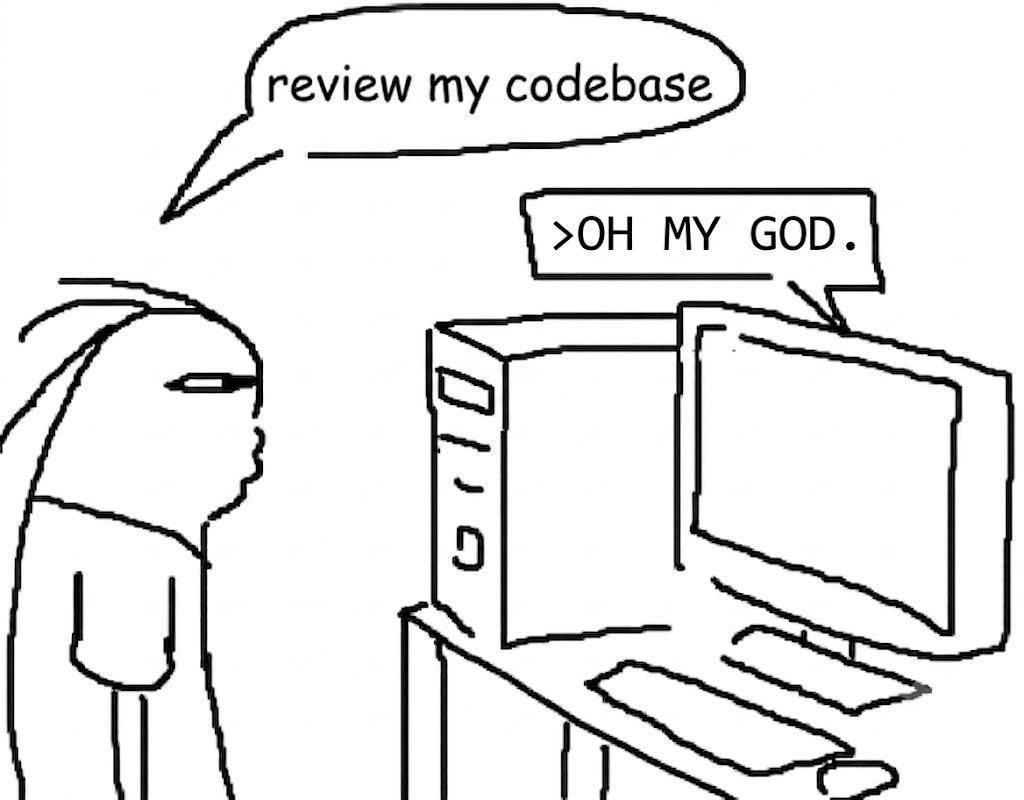
A stick figure calmly asks “review my codebase”; the monitor replies “>OH MY GOD.” The dive explains why whole-repo review is under-specified, what static analysis can and cannot settle, and how technical debt and entropy make the repository itself the highest-severity finding.
Level 1: The Messy Bedroom
It is like asking someone to check whether your entire bedroom is tidy when the toys, clothes, books, and cables have become one giant knot. Instead of pointing to the first sock, they stare at the whole room and shout, “Oh my God.” The joke is that the owner calmly asks for feedback while already knowing the mess is too big for a normal answer.
Level 2: Smells, Debt, and Tools
A codebase is the collection of source code, configuration, tests, and related files used to build and operate a piece of software. A code review is an examination of a proposed change, usually performed before that change is merged into the shared repository. Reviewers look for defects, security risks, confusing design, missing tests, and maintainability problems.
The person in the drawing asks for the much larger thing: review all of it. The screen responds as though it has emotions, and the terminal-style > makes “OH MY GOD.” look like program output. Instead of listing problems one by one, the computer reacts to the whole collection at once. That immediate jump from calm request to panic creates the humor.
A code smell is a warning sign, not automatically a bug. Examples include an enormous function, deeply nested conditions, duplicated logic, unclear names, or one class that knows too much about the rest of the system. A smell suggests that code may be difficult to understand or safely change. Context determines whether it actually needs repair.
Maintainability is how easily developers can understand, test, modify, and troubleshoot software. Maintainable code tends to have clear responsibilities, useful tests, predictable interfaces, and documentation for decisions that are not obvious. A complicated program can still be maintainable if its complexity is organized and tested. A short program can be unmaintainable if every line depends on a hidden assumption.
Technical debt is work postponed into the future. Imagine copying logic into three places to meet today's deadline. The feature ships, but the next correction must be made three times, and missing one copy creates inconsistent behavior. The shortcut saved time once and charges time on later changes. If enough of those debts collect, even a simple request becomes risky.
Static-analysis tools examine code for patterns without needing to perform every real-world workflow. They are good at consistent, repeatable checks and can catch problems humans overlook. Automated code-analysis tools also help reviewers avoid spending attention on formatting and basic mistakes. But they need focused rules and human interpretation. A warning does not know the product's priorities, and a clean report does not guarantee correct behavior.
Early-career developers often expect code review to be a final grade: good code passes, bad code fails. In a healthy team it is closer to collaborative risk reduction. Comments should explain what could go wrong and help improve the change, not merely announce disgust. The meme deliberately violates that ideal. >OH MY GOD. is emotionally clear but spectacularly unactionable; the author now knows the code has a vibe problem and nothing about which file to open first.
The practical way to make the request answerable is to shrink it. Ask for review of a particular change, module, bug, or architectural boundary. Provide the intended behavior and tests. For a large inherited system, choose one painful path, make its current behavior observable, then improve it in small steps. That turns “codebase chaos” from one terrifying object into a sequence of changes people can reason about.
Level 3: Repository as Root Cause
The machine's review contains no file name, line number, rule identifier, or suggested patch. It skips the entire diagnostic format and escalates directly to existential alarm:
review my codebase
>OH MY GOD.
That mismatch is the core joke. A code review is normally expected to turn a bounded change into specific, actionable feedback. “Review my codebase” provides no boundary at all: no pull request, intended behavior, architecture map, risk profile, or question to answer. The request effectively asks, “Please understand every decision we have ever made, including the ones nobody remembers, and summarize the consequences.” The monitor's instant horror is therefore the fastest possible honest response.
The leading > makes the reply look like terminal output, while the speech-box tail points toward the monitor and personifies the computer. It could represent a static-analysis tool, an automated code reviewer, or simply the codebase itself talking back. The image does not identify a particular product, which makes the reaction universal: whichever machine was brave enough to open the repository has seen sufficient evidence.
At senior level, reviewing an entire codebase is not merely large; it is under-specified. Code quality depends on purpose and constraints. A strange cache may be a crucial latency optimization. A duplicated branch may isolate regulated behavior. A tidy abstraction may be dangerously incorrect because two workflows that look alike evolve for different reasons. Without knowing the system's invariants—what must always remain true—a reviewer can identify suspicious shapes but cannot reliably distinguish accidental complexity from necessary complexity.
That is also the limit of static analysis. A tool can inspect source without running it and report detectable patterns such as unreachable code, unsafe type conversions, dependency problems, duplicated blocks, or paths with high cyclomatic complexity. It cannot automatically recover every unwritten business rule, production workaround, or organizational promise buried in the implementation.
| Review signal | What it can reveal | What it cannot settle alone |
|---|---|---|
| Linter warning | A rule or style violation | Whether the rule fits this context |
| Complexity metric | Many branches or hard-to-follow control flow | Whether the complexity is avoidable |
| Duplicate code | Similar implementation fragments | Whether those fragments should evolve together |
| Failing test | Observed behavior differs from an expectation | Whether the test or behavior is correct |
| Dependency alert | A component may carry known risk | Whether it is reachable or safely mitigated |
| Human comment | A concern grounded in context | Whether the reviewer knows every hidden constraint |
The computer saying only OH MY GOD. parodies tools that generate enormous reports without establishing priority. A thousand findings are not a thousand decisions. Teams still need to rank issues by exploitability, user impact, frequency of change, failure cost, and ease of remediation. Otherwise the “analysis” becomes a fresh layer of technical debt: a dashboard everyone knows is red and nobody can use.
Technical debt is the future cost created when a team takes a shortcut, preserves an obsolete design, or postpones necessary maintenance. Some debt is deliberate: shipping a narrow solution now can be rational if the team records the compromise and later pays it down. The horror story begins when temporary choices become permanent foundations while ownership, tests, and original context disappear. Interest is then paid as slower changes, fragile releases, longer onboarding, and the ritual sacrifice of one engineer's afternoon whenever a “small” feature crosses six supposedly independent modules.
Codebase entropy describes the tendency for structure to erode as many local changes accumulate. It is not a law that code spontaneously becomes evil. It is the predictable result of incentives:
- Delivery deadlines reward the visible feature more than the invisible simplification.
- Reviewers optimize for whether today's change works, not whether five years of changes still form a coherent design.
- Team boundaries shift while dependencies between their components remain.
- Emergency fixes bypass normal design work and quietly become permanent.
- Departing maintainers take undocumented reasoning with them.
- Large refactors carry concentrated short-term risk, while leaving the mess alone spreads smaller costs across future work.
Smart people can therefore produce a chaotic system without any single foolish decision. Each patch may be locally defensible; the aggregate becomes spaghetti code, where control flow and dependencies are so tangled that changing one area affects distant areas unpredictably. The image compresses that long institutional history into one machine-readable diagnosis: apparently the repository's highest-severity issue is the repository.
The legacy angle is subtler than “old code bad.” Legacy code often runs important, profitable systems and embodies years of edge-case knowledge. Its danger comes from low confidence: missing tests, unclear ownership, obsolete dependencies, hidden coupling, and deployment paths no one wants to disturb. The bulky desktop tower and thick monitor could visually reinforce that sense of inherited machinery, but they do not prove the unseen code is old. They mainly make the computer a physical character large enough to recoil from what it has been asked to inspect.
A useful review process reduces uncertainty instead of passing judgment on the author's soul. It starts with a small change and asks concrete questions:
- What behavior is intended to change?
- Which failure modes matter most?
- Do tests demonstrate both the new behavior and protected old behavior?
- Does the design increase coupling or duplicate knowledge?
- Are security, performance, operations, and rollback concerns addressed?
- Can a future maintainer understand why this choice exists?
For repository-wide improvement, the equivalent is not one heroic review. It is a sustained program: map high-risk boundaries, establish ownership, add characterization tests around current behavior, automate routine checks, remove dead paths, upgrade dependencies incrementally, and refactor along the routes where product work already happens. A rewrite may feel emotionally cleaner, but it discards encoded knowledge and creates a second system whose bugs have not yet earned names.
The human figure's narrow eye and motionless posture add a final layer of developer self-deprecation. The person seems less surprised than the computer. That is the posture of someone who did not request a review to learn whether the codebase was alarming; they requested independent confirmation. Somewhere, a pull request template is waiting for the field marked “brief description.”
The static analyzer found one issue with severity `existential`: the repository.