
Kernel AI Review Policy Meme Explained
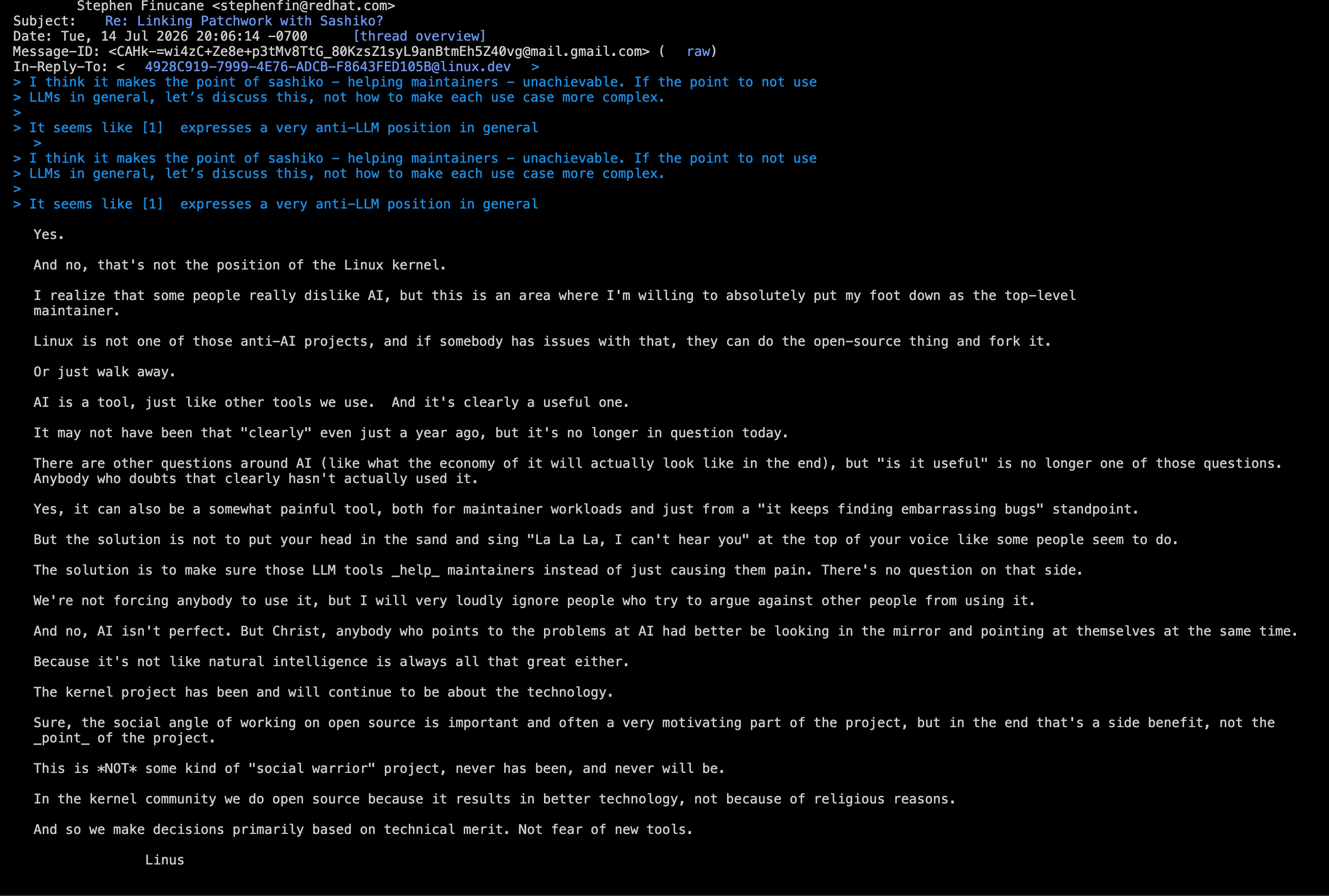
The meme is a mailing-list screenshot of Linus endorsing useful AI review tools for the kernel. The dive explains Sashiko, Patchwork, maintainer bandwidth, and why tools must reduce—not export—review cost.
Level 1: The New Wrench
It is like the head mechanic saying a new diagnostic wrench is allowed in the workshop: nobody has to use it, but nobody may ban another mechanic from trying it, and it only earns a place on the bench if it finds real problems without making everyone else clean up its mess.
Level 2: Patches, Bots, and Forks
A patch is a proposed source-code change. Linux contributors commonly send patches and review replies by email; the blue lines beginning with > are text quoted from earlier messages in that thread. Code review is the process of checking a patch for correctness, safety, style, and fit before it is merged. Patchwork helps track those emailed submissions and their review state. Sashiko is the AI-assisted review service under discussion, intended to surface findings alongside that workflow.
An LLM review tool is therefore an additional reviewer, not an automatic merge button. It can point at a possible bug, but a maintainer must decide whether the claim is correct and whether the proposed fix belongs in the kernel. “Fork it” means the source license permits dissenters to copy the project and maintain a separate version. That freedom is real, but sustaining a kernel fork requires contributors, infrastructure, releases, and users, so the line carries considerably more weight than “make your own copy.”
The terminal-like black background and dense monospaced email make the image look like ordinary project archaeology until the prose becomes a policy declaration. The humor comes from the contrast: a modern AI controversy arrives through an old-school mailing list, and the final answer is delivered with the familiar bluntness of a maintainer who has already reviewed enough arguments for one lifetime.
Level 3: Maintainer Bandwidth Wins
AI is a tool, just like other tools we use. And it's clearly a useful one.
The screenshot is funny because it captures Linus Torvalds resolving an abstract culture dispute in the most Linux-kernel way available: by converting it into a maintainer policy and stating the boundary without diplomatic padding. The quoted objection says an anti-LLM restriction would make Sashiko’s purpose—helping maintainers—unachievable. Linus answers “Yes. And no,” rejects anti-AI as the kernel’s position, and invokes his authority as top-level maintainer. The escalating sequence from technical disagreement to “fork it” or “walk away” is severe, but unmistakably consistent with an open-source project where disagreement has both a governance path and a source-code escape hatch.
The substantive issue is not whether an LLM can emit review comments. It is whether those comments improve the project’s scarcest resource: expert review attention. Kernel patches arrive through distributed, mailing-list-driven workflows. Patchwork records and organizes those patch series, while Sashiko can attach AI-generated findings to them. A useful integration might catch a missing check, a suspicious lifetime, or an inconsistent API use before a human spends time on it. A noisy integration can do the opposite: manufacture plausible false positives, duplicate known feedback, and force maintainers to disprove machine-generated claims. Automation that creates ten minutes of triage for every minute it saves is merely workload wearing a robot costume.
That is why the most operationally important sentence is not the broad endorsement of AI:
The solution is to make sure those LLM tools help maintainers instead of just causing them pain.
This makes technical merit the acceptance criterion. Findings need relevant context, reproducible reasoning, clear provenance, and a low enough noise rate that maintainers can act on them. The screenshot also acknowledges both “maintainer workloads” and AI “finding embarrassing bugs,” which exposes the uncomfortable symmetry: reviewers dislike wasted time, but they may also dislike a tool that successfully uncovers mistakes. Linus’s comparison with imperfect “natural intelligence” refuses to grant human review a mythical zero-error baseline. Neither human nor model gets a free Reviewed-by; the patch still has to survive evidence and engineering judgment.
The deeper community tension sits in his claim that open source is a means to better technology rather than a “social warrior” or religious project. That framing prioritizes output over objections to a tool’s broader economics or social meaning. It is intentionally provocative because those concerns do affect contributor trust and participation, even when they do not prove a particular review finding wrong. The durable policy hidden inside the rhetoric is narrower: nobody must use the tool, nobody gets to prohibit others merely because it is an LLM, and integration succeeds only if it reduces rather than exports maintenance cost.
The kernel now has two kinds of nondeterminism: schedulers and reviewers.