
Voice Note in Code Comments Meme Explained
The meme shows an IDE with a playable voice-note widget inside a Java comment above readMessages(). The dive explains why audio docs break code review, search, and maintainability—and what good comments should be instead.
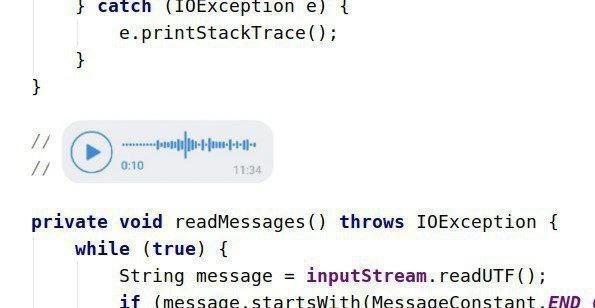
Level 1: When Code Talks
Imagine you’re reading a recipe in a cookbook, and instead of a note in the margin explaining a tricky step, there’s a little tape recorder icon. To understand that step, you have to press play and listen to an 11-minute voice message of the chef talking. Sounds silly, right? You’d probably think, “Why didn’t they just write down the instructions?”
That’s exactly why this picture is funny to programmers. Usually, when programmers leave notes for each other in the code (like why they did something or how a tricky part works), they write it out in text. It’s like leaving a short note in the margin of a book. In this case, someone found a really long voice note left inside the code instead of a written note. It’s as if the person who wrote the code said, “I don’t want to write out the explanation, I’ll just talk for 11 minutes and stick it here.”
For anyone else reading that code, it’s completely unexpected. It’s funny because it’s so absurd: it breaks the normal way things are done. It’s a bit like finding a voice message instead of a written message in a bottle. You’d laugh because it’s odd, and then realize it would be a pain if you actually had to hear the whole thing just to understand what’s going on. The core of the joke is a mix of surprise and “oh no!” — everyone knows instructions should be written down clearly, not hidden in a long recording. So this meme makes people laugh by showing an extreme, goofy example of how not to explain your work.
Level 2: Comments Out Loud
For those newer to coding, let’s break down why this scenario is both funny and alarming. In programming, a code comment is usually a note written alongside the code to explain what’s going on. In Java (the language shown here), you write a single-line comment with //. The computer ignores everything on that line after // when running the program. Comments are meant for other developers to read, not machines. They’re part of good Documentation and CodeQuality practices – ideally short, clear, and to the point. For example:
// Check if the user is logged in before proceeding
if (user.isAuthenticated()) {
    performSensitiveOperation();
}
That’s a normal comment. It gives a quick hint about the next line of code. Now, imagine you see:
// 🔊 Voice note explaining the logic (11:34 long)
// (Yes, someone embedded an audio player here)
private void readMessages() throws IOException {
    while (true) {
        String message = inputStream.readUTF();
        // ... more code ...
    }
}
This is what the meme shows: instead of a readable explanation, there’s an audio player widget inside the comment! The image looks like a screenshot from an IDE (likely IntelliJ IDEA or a similar Java editor) where the // comment line somehow contains a blue play icon, a waveform, and a timestamp (0:10 / 11:34). In real life, embedding an actual playable audio in a source code file is not standard (or basically impossible without some trickery). So this is probably a visual gag – maybe the developer copy-pasted something weird (like an HTML snippet or a chat log) and the IDE is rendering it as an audio player, or the image has been edited for comedic effect.
Why is this a code_documentation_failure? Because documentation is supposed to make things easier to understand. Here it’s done in the most inconvenient way imaginable. If you were a junior dev reading this code, you’d be puzzled: “Uh, do I… click play? Do I somehow listen to this explanation?” Code is usually text for a reason. You can scroll through it, search it, and read it quickly. A voice_note_in_code throws all that out the window. You can’t quickly extract info from an audio file without playing the whole thing. And heaven help you if the explanation is crucial – you’d have to transcribe it yourself or keep replaying it while pausing the code review. It’s like someone left a voice memo in the middle of a textbook.
Let’s touch on the Java snippet around this comment:
private void readMessages() throws IOException { ... }is a method definition in Java. It’s namedreadMessages, so it likely connects to some messaging feature (reading incoming messages from a server or file).- Inside, there’s a
while (true)loop. This means it will run indefinitely (forever) until something causes it to break out or an exception (error) occurs. In networking or chat programs, a loop like this is common to continuously listen for new messages. String message = inputStream.readUTF();suggests it reads a text message (UTF is a text encoding for characters) from an input stream. Perhaps each message is being read from a socket or file one by one in a loop.- There might be an
ifcondition (we see a hint:if (message.startsWith(MessageConstant.END ...)) likely checking if the message is a special "END" command or something to break out of the loop or stop reading. The screenshot is cropped, but it implies some condition to stop the loop when an "END" message is received.
Now, how could an audio_comment even end up in code? One theory: maybe the developer was discussing this code with someone on a chat app or project management tool. Suppose a colleague sent them a voice note explaining what to do. The dev might have dragged or copy-pasted that voice message icon into the code by accident. Or maybe they intentionally put a placeholder reminding themselves "I have a voice note explanation here." Some modern tools do allow attaching multimedia in comments (like documentation generators or certain rich text editors), but plain source code files (like .java files) are not meant to hold that. It’s also possible the image is just a meme edit – adding the voice player graphic on top of a screenshot for humor.
In any case, the reason developers are laughing (and cringing) at this is because it’s a spectacularly bad idea for CodeQuality:
- Maintainability: Future devs might not have any clue what that comment is supposed to be. If it’s an actual embedded file, it might not even show up outside that specific IDE.
- CodeReviewPainPoints: During code reviews, teammates check each other’s code for issues. If I saw this, I’d have a hard time even commenting on it: “Please replace this with text” is an understatement. Also, code review tools on GitHub or GitLab might not display an audio widget at all; it could just show a weird line or nothing.
- DocumentationHumor: It’s humorous because it’s a hyperbolic example of avoiding writing things down. Devs joke about how some colleagues hate writing docs or comments. This is like the ultimate expression of that — recording a rambling 11-minute voice explanation and plopping it into the code. It pokes fun at how burdensome proper documentation can feel, and how far someone might go to avoid typing out an explanation.
Think of CodeReviews from a junior dev’s standpoint: they’re told to comment their code, write clear documentation, etc. Now imagine in your first job you open a file and see a voice message from a developer explaining the code. You’d probably first check if someone is pranking you. It’s just so out-of-band with everything you expect in code. This meme highlights that contrast for comedic effect. Everyone, junior or senior, can recognize this is wrong. But a junior might not immediately see all the implications – they might just find it silly. A senior sees the implications (unsearchable, unmaintainable, etc.) and experiences a mix of laughter and dread.
In summary, at this level:
- What’s the joke? A developer apparently put an audio voice note inside a Java code comment. That’s bizarre because comments are supposed to be written text.
- Why is it bad? Because no one can quickly read or search an audio note; it breaks all norms of sharing code information. It’s like having a secret verbal handshake in a place meant for written records.
- Relatable experience? Many of us have seen “weird comments” or poor documentation in code. Usually it’s something like obsolete comment text or confusing explanations, not this. But the feeling of “What was this person thinking?” is definitely relatable. It’s exaggerating a real frustration with bad documentation practices, turning it into a ridiculous scenario to get a laugh out of developers.
Level 3: Audible Documentation
Imagine opening a Java file in your IDE and finding a 11-minute voice note literally embedded as a // comment. Yes, an actual audio waveform widget with a play button and timestamp (0:10 / 11:34) sitting in the code. This isn’t science fiction or some new Javadoc feature — it’s a catastrophic documentation practice on full display. As a seasoned dev, I’ve seen plenty of CodeQuality horrors, but a comment that doubles as a podcast episode? That’s a new high (or low). It’s like the coder said, “Writing comments is hard, so here’s my audiobook explaining this logic.”
From a senior engineer’s perspective, the humor (and horror) comes from how many software engineering rules are being flamboyantly broken at once. Documentation is supposed to make understanding code easier, not require plug-in speakers and 11 minutes of your time. In a code review, this would be the ultimate WTF moment:
- CodeReviews rely on text diffs and quick reading. A voice note can’t be diffed or skimmed. You can’t
git blamean MP3 for who said what. - Comments should be terse, focused explanations of tricky parts. Here we have a monologue that probably drones on longer than a sprint planning meeting.
- Future maintainers expect comments to be searchable. Good luck grepping a waveform for that one critical detail. It’s effectively invisible to any static analysis or search tool.
- And mixing UI elements with source control? That’s just begging for trouble. If this widget is some IDE-specific feature (perhaps a weird IntelliJ plugin or an accidental paste from a messenger app), anyone viewing the code in a plain text editor or on GitHub might see gibberish or nothing at all. Source control isn’t meant to track binary blobs living inside text files.
Consider the production implications: this gem made it past all checkpoints into live code. Maybe the original developer was in a rush, hit record on a voice message to explain a complex bit of logic, and then copy-pasted it in. Or maybe it started as a joke that accidentally got committed. Either way, it speaks (pun intended) to a breakdown in process. No linters or code quality checks screamed, “Dude, what is this?” Not a single colleague commented, “Interesting choice of documentation medium… care to transcribe that?” In corporate settings, we talk about knowledge sharing and bus factors (“what if the only person who knows this quits?”). Here the knowledge is technically “shared,” but only if you’re willing to press play and listen to an 11-minute rant. 😅
Let’s not ignore the code around this fiasco: private void readMessages() throws IOException { while(true) { ... } }. An infinite loop reading from an InputStream via readUTF() suggests this is part of some message-processing system (maybe a chat or messenger service). The irony is palpable: the code is literally reading messages, and the dev left a message inside the code. A voice_message, no less! Perhaps they were debugging a chat and ended up pasting a chat widget’s audio element into the source. Seasoned devs have war stories of weird comments (entire emails copy-pasted, absurd ASCII art, passwords in comments), but an actual voice note takes the cake. It’s the director’s commentary version of code documentation that nobody asked for.
In terms of CodeQuality, this is an abomination. It violates the principle of self-documenting code and the expectation that comments are plain text explanations or TODOs. Think about the next poor soul diffing this file: “Why did this diff add 5 MB? Oh, it’s an embedded .wav file in a comment…” It’s both hilarious and horrifying. The humor lies in the absurdity (DocumentationHumor at its finest), but it’s also a cautionary tale. The RelatableDevExperience here is the facepalm of finding something in code that makes you question all your life choices leading to this debugging session. As a cynical veteran, I half-expect the next step will be commit messages delivered via interpretive dance videos. CodeReviews already require patience; one with an audio commentary would require popcorn.
In summary (since brevity clearly isn’t this developer’s forte): this meme is pointing out, with dark humor, the worst_comment_ever scenario. It exaggerates a real pain point: documentation and comments in code can be bad, unclear, or downright ridiculous. Usually it’s cryptic one-liners or outdated comments — here it’s a full-blown audio_comment. It’s so over-the-top that every experienced engineer immediately cringes and laughs. We laugh because it’s absurd, and we cringe because deep down we fear one day stumbling upon something just as insane in legacy code.
Imagine the diff: +11MB binary blob, −0 lines of actual documentation
That audio waveform perfectly captures what the CPU sounds like when this while(true) loop hits production - a continuous scream lasting exactly 11 minutes and 34 seconds before someone notices the service is at 100% CPU and the on-call engineer gets paged at 3 AM
When your exception handling strategy is literally just 'printStackTrace()' and a 10-second voice memo explaining why the production server is on fire - because nothing says 'enterprise-grade error recovery' quite like dumping stack traces to stdout and hoping someone's tailing the logs. Bonus points for the infinite while(true) loop reading messages until 'END' - because who needs graceful shutdowns when you can just throw IOException all the way up the call stack?
If your PR ships an 11:34 voice memo between // comments, the while(true) reader and e.printStackTrace() aren’t the only anti‑patterns - your documentation just forked into a podcast
If your PR needs an 11:34 voice memo and still ships while(true) with e.printStackTrace(), you’ve implemented Docs-as-a-Podcast and Alerting-by-Playback
printStackTrace in prod: Because EOFExceptions deserve a verbose obituary before the JVM joins the void
excuse me?
*cough* *cough* *sssshshshshhs* YEAH TODO REMOVE HUHA *cough* *cough*
https://youtrack.jetbrains.com/issue/IDEA-332604 THIS IS REAL OMFG
this one is better
whoever made this, burn in a hell!👿🔥🔥🔥
And Полина the chad coming in clutch to actually deliver the cursed implementation
When TempleOS does this (full blown sprites inside code), no one bats an eye
i think TempleOS batted many eyes
More accurate
how the hell?
Introducing: do-if block.
What name was channel before?
How is it different from current name?
It looks the same for me