
Tech Interview Gauntlet Meme Explained
A Chad-vs-Wojak comic shows a job seeker rejecting a seven-step interview loop for a company that hired after one round. The dive covers assessments overload, multi-stage loops, and how slow hiring loses talent.
Level 1: Jumping Through Hoops
Imagine you want to play on a soccer team. You go to the first coach, and he says, “Sure, you can join, but first you have to run 5 laps, solve two puzzles about soccer rules, do 50 push-ups, and then maybe I’ll let you on the team.” That’s a lot of work just to start playing! Then you meet a second coach of another team, and she says, “Oh, you want to play? Great, we have one quick tryout game today. If you play well, you’re on the team.” You only have to show up once and do the thing you’re actually there to do (play soccer). Naturally, you join the second coach’s team after that single tryout because it’s simple and fair. Now imagine the first coach finds out and starts yelling, “Nooo! You were supposed to do all my challenges to prove you really wanted to be on my team!” It’s pretty funny, right? The first coach expected you to jump through all those hoops (do a bunch of unnecessary tasks) to “earn” your spot, but you took an easier and faster offer instead. The first coach is acting like a kid throwing a tantrum because his complicated plan didn’t work. In the same way, the meme is joking that some companies make getting a job way too hard, and then they’re shocked and upset when a good player (the developer) chooses a team that treats them better. It’s like saying: why do ten difficult things to get a prize when someone else will give you the prize after just one fair try? The silly anger of the first coach (or company) is what makes us laugh, because they had a chance to keep a great person, but they messed it up by demanding too much.
Level 2: Interview Loops & Hoops
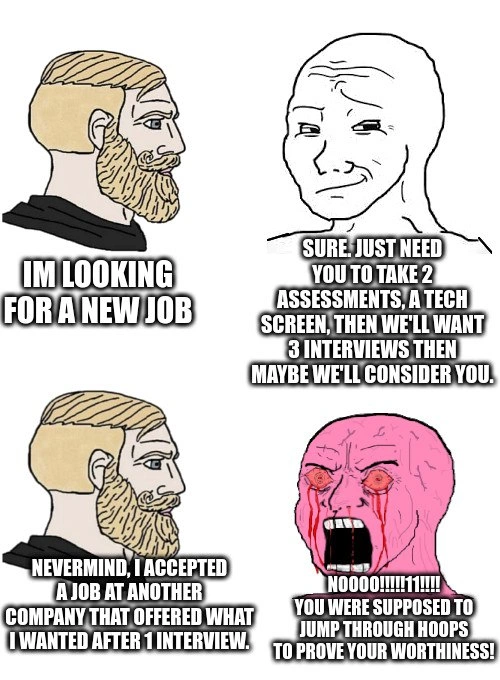
This four-panel comic uses the popular Chad vs. Wojak meme characters to poke fun at overly long interview processes. Let’s break down what’s happening in each part and explain the terms:
Panel 1 (Top-Left): We see a drawn profile of a blonde, bearded developer (the “Chad” character). He confidently says, “I’m looking for a new job.” This sets the scene: a developer is on the job hunt. The Chad meme figure typically represents someone who is confident, capable, and straightforward – here it’s the job-seeking developer who knows his worth.
Panel 2 (Top-Right): A pale faceless recruiter (a variation of the Wojak character) responds with a long list of requirements: “Sure. Just need you to take 2 assessments, a tech screen, then we’ll want 3 interviews then maybe we’ll consider you.” This is a caricature of a typical TechnicalInterviewProcess at some companies. Let’s clarify those terms:
- Assessment: In hiring, an assessment is a test or assignment given to candidates. The recruiter is asking for 2 assessments, which likely means the candidate must complete two separate tests. For example, a company might send a coding quiz on a platform like HackerRank as the first assessment, and then maybe a more involved take-home project as the second. It’s basically homework or exams for the job application. Two assessments back-to-back is quite a lot – hence it feels like an assessments overload.
- Tech screen: Short for technical screening, this is usually a short initial interview (often via phone or video call) with a technical person. In a tech screen, an engineer or technical recruiter will ask the candidate basic questions or have them solve a simple coding problem live, just to verify the candidate actually has the skills they claim. It’s like a preliminary filter before the longer interviews. So after the two tests, the recruiter wants a live technical Q&A session.
- 3 interviews: After the tests and the screening, the recruiter is saying they want the candidate to go through three more interviews. In many companies, that could mean a series of meetings possibly all on one “on-site” interview day (even if remote). For instance: one interview might be a deeper coding or algorithm challenge, the second could be a system design or architecture discussion, and the third might be a behavioral or culture-fit interview with a manager or HR. Three interviews in addition to everything prior means the candidate would meet multiple people and answer questions for hours. It’s a multi_stage_interview_loop indeed – jumping from one interviewer to the next.
The kicker is the phrase “then maybe we’ll consider you.” After all those steps, the recruiter isn’t even promising a job offer – only that maybe the company will consider the candidate for the position. This indicates a very selective or cautious hiring approach. For the candidate, that’s a lot of hoops to jump through without any guarantee.
Panel 3 (Bottom-Left): The same developer (Chad) responds calmly: “Nevermind, I accepted a job at another company that offered what I wanted after 1 interview.” This is the twist and the punchline of the story. Instead of agreeing to the long process, the developer basically says, “No thanks, I’ve already got a better deal elsewhere.” He had another company in his pipeline that moved much faster – just one interview and they gave him what he wanted (likely the role, salary, or benefits he was looking for). So this other company’s HiringProcess was swift and efficient: one and done. The developer’s reply highlights that he values his time and knows he has options. It also subtly implies that the second company respected him more by not making him go through a marathon. After a single interview, they were confident enough to hire him (and presumably meet his conditions, like a good salary or remote work or whatever he wanted). This is a stark contrast to the first company’s drawn-out approach.
Panel 4 (Bottom-Right): Here we see a pink, screaming Wojak face, mouth agape and tears flying – basically a tantrum. This character represents the first company’s reaction (the recruiter or hiring manager) to the developer’s decision. The character screams: “NOOOO!!!!!!!!! YOU WERE SUPPOSED TO JUMP THROUGH HOOPS TO PROVE YOUR WORTHINESS!” This line is deliberately over-the-top, sounding like an entitled, angry outburst. It’s as if the company is saying, “How dare you, the candidate, not go through our tough process! You’re supposed to show us you deserve this job!” The phrasing “prove your worthiness” makes it feel like the company thought it was doing the candidate a favor by even considering them, and that the candidate should submit to whatever challenges they set. This exaggerated reaction is meant to be funny because it’s like a child throwing a fit when they don’t get their way. The company expected the developer to patiently jump through all their hoops, but reality didn’t match that expectation.
The overall humor and message of the meme becomes clear: some hiring processes are so excessive that they drive candidates away. The company in the comic created an obstacle course (lots of interviews and tests) expecting any serious candidate to endure it to “prove” themselves. But the developer exercised his choice to go elsewhere, to a place that didn’t make him go through an ordeal. The first company’s anger is ironic – they’re upset at their own loss, but it’s a situation they caused by being too slow and putting up too many hurdles.
For a junior developer or someone new to tech interviews, this meme is highlighting a real issue in the industry. Many companies, especially in tech, have what we call “interview loops” or “interview gauntlets.” These are multi-step processes where you might:
- Start with an online coding assessment (a test of your programming skills, usually timed).
- Then do a technical phone screen (a call where you answer technical questions or solve a simple problem live).
- Then proceed to a series of in-person or video interviews (often 2-5 rounds back-to-back) with various team members. Each round might focus on something: one on algorithms/coding, one on system design, one on past experience or behavioral questions, etc.
Companies do this to evaluate candidates thoroughly on different aspects. However, from the candidate’s perspective, it can be exhausting and time-consuming. If you’re interviewing at multiple places, the one that has 5+ rounds might start feeling like a slog, especially if another company is quicker to decide. The term “jump through hoops” is key here: it’s an idiom meaning going through lots of challenges or tedious procedures to reach a goal. It comes from circus or dog-training imagery—think of animals literally jumping through hoops as a trick to get a reward. In job terms, “jumping through hoops” means doing many tests, interviews, or tasks just to get hired.
This meme resonates with DeveloperFrustration because many developers feel that some companies make you do too much to prove yourself. It has a bit of CareerHumor and HiringHumor: we laugh because we recognize it’s true to life. The candidate_experience mentioned here refers to how the job seeker experiences the hiring process. In the meme, Company #1 offers a poor candidate experience (lots of steps, slow timeline) while Company #2 offers a good candidate experience (one-and-done, fast offer). The developer naturally chose the better experience.
Why is the recruiter in the last panel so upset, yelling “Nooo!”? It’s poking fun at a certain attitude: some companies or recruiters act as if candidates should be grateful for the opportunity and willing to endure anything to get the job. They might believe their job opening is highly coveted, so they can demand extra proof and time from applicants. When a candidate walks away, it shatters that belief. The meme exaggerates this shock. The pink screaming Wojak is essentially the recruiter realizing, “Oh no, our lengthy process scared off a great candidate!” But instead of self-reflection, the character is depicted as blaming the candidate for not complying. It’s a satire of badly managed recruitment, where the fault lies in the process, not the person, yet the gatekeepers don’t see it.
In simpler terms, the meme is a commentary on InterviewProcess expectations:
- Company: “We require a lot from you before we decide anything.”
- Candidate: “I found someone who doesn’t make me do all that.”
- Company: “That’s not fair! You were supposed to do what we asked!”
The reason this is funny (especially to developers) is because it flips the script. Usually, job seekers feel at the mercy of companies. But here the job seeker had the upper hand. It’s both humorous and satisfying to see the company’s demanding approach lead to them losing out. It highlights the reality that a HiringProcess should balance evaluating the candidate and impressing the candidate. If you make it too much of a one-sided trial, good people may just leave – which is exactly what happens in the meme.
Level 3: Overengineered Hiring Pipeline
The meme captures a painfully familiar scenario in tech hiring: an overengineered hiring pipeline that ends up defeating its own purpose. In the first two panels, a confident developer (the blonde bearded "Chad" Wojak known for his no-nonsense attitude) announces “I’m looking for a new job.” The recruiter’s response is essentially a multi-stage interview loop: “Sure. Just need you to take 2 assessments, a tech screen, then we’ll want 3 interviews then maybe we’ll consider you.” This laundry list of steps is the seven-step interview gauntlet—a drawn-out TechnicalInterviewProcess many companies impose, supposedly to ensure they hire the “best.” It’s a satirical take on what senior devs recognize as an assessments overload. The company is piling on coding tests (likely timed algorithm quizzes or take-home projects), an initial technical screening call, and then three separate interviews (perhaps coding interviews, system design discussions, and a final HR or “culture fit” round). It’s a HiringProcess so elaborate it resembles an enterprise software pipeline with too many stages.
From an experienced developer’s perspective, this is hiring overkill. We’ve seen it: companies that treat recruiting like a marathon of hoops, as if adding more interviews automatically filters for quality. The humor here is that this approach often backfires. The comic literally shows the candidate balking—he immediately opts out in panel 3: “Nevermind, I accepted a job at another company that offered what I wanted after 1 interview.” 👏 This one line reveals the punchline: a rival employer had a streamlined process (just one interview!) and gave the dev exactly what he wanted (likely a solid offer with the role/salary he asked for). The candidate experience there was positive and efficient. By contrast, the first company’s lengthy process created so much recruiting friction that they lost their candidate before the real interviews even began.
This speaks to a known industry truth: in a hot market for developers, the balance of power shifts towards the candidate. Skilled engineers often have multiple options, and they won’t patiently endure an arduous InterviewProcess unless the company is extremely compelling. The meme exaggerates it to great effect: the recruiter (depicted as the pink screaming Wojak in the final panel) is furious, yelling “NOOOO!!!! You were supposed to jump through hoops to prove your worthiness!” This melodramatic outburst personifies the company’s shock – they expected the candidate would dutifully comply with their epic interview saga, as if he should feel grateful for the opportunity. Instead, the candidate exercised his leverage and walked away, leaving the company empty-handed and indignant. It’s a comedic reversal of the usual dynamic: typically, it’s candidates who feel anxiety or frustration at these UnrealisticExpectations, but here the company is shown having a full-blown meltdown when their complex vetting ritual is snubbed.
Why is this so relatable, especially to veteran developers? Because it satirizes a real anti-pattern in hiring. Many of us have encountered job listings or recruiters with unrealistic expectations: expecting candidates to invest hours (even days) into coding assignments, multiple rounds of whiteboard challenges, and panel interviews — all before maybe getting an offer (or sometimes not even a rejection, just ghosting). The meme distills that frustration. The Chad developer embodies the ideal scenario where a candidate knows their value and doesn’t tolerate being strung along. Meanwhile, the company’s reaction highlights the absurd entitlement of some hiring processes that haven’t caught up with reality.
In real-world terms, the InterviewHumor here points out a broken system. Adding more steps is like adding more microservices to an architecture: it sounds efficient in theory, but each integration point (each interview stage) introduces latency and points of failure. Here, each interview “stage” is a chance for the candidate to drop out or get soured on the experience. A savvy recruiter or engineering manager knows that time-to-hire is crucial – too slow, and your ideal candidate vanishes (just like a user might abandon a slow, clunky app). The developer in the meme literally did that: he “timed out” the process and went with a faster competitor. It’s a classic case of candidate drop-off due to process friction. Consider a tongue-in-cheek pseudo-code representation of the situation:
steps = ["Assessment 1", "Assessment 2", "Tech Screen", "Interview 1", "Interview 2", "Interview 3"]
candidate_continues = True

for step in steps:
    print(f"Performing {step}...")
    # Candidate decides to drop out if another offer comes through
    if step == "Tech Screen":
        candidate_continues = False
        print("Candidate: 'Actually, I accepted another offer. Goodbye!'")
        break

if candidate_continues:
    print("Candidate completed all steps - now we can consider giving an offer.")
else:
    print("Candidate left during the process - lost opportunity for us.")
In this mock scenario, as soon as the candidate hits the third step ("Tech Screen"), he bails because he got a better offer. The loop breaks, and the company loses their chance. This is exactly what the meme depicts in human terms. Every additional hoop or interview round is a risk: the probability of retaining a busy candidate drops with each new demand. Recruiting_friction isn’t just a buzzword – it’s the idea that every extra form, test, or delay in hiring increases the chance a candidate will give up or go elsewhere.
The satire hits home because tech companies often pride themselves on optimizing everything with data and Algorithms, yet sometimes fail to optimize their HiringProcess for a good candidate_experience. Imagine designing a user sign-up flow with seven mandatory steps – conversion rates would plummet. Yet, some hiring managers still assume serious candidates will endure a gauntlet of interviews. The final panel’s screaming recruiter is essentially that hiring manager stunned by reality: talented developers have choices. Making a candidate prove their worthiness through excessive screening is an outdated mindset, a relic from when jobs were scarce. By 2021 (when this meme was posted, amid a tech talent shortage and the “Great Resignation” era), it was increasingly clear that companies needed to sell themselves to candidates, not the other way around. The meme humorously delivers this lesson: if you make the hiring process a nightmare, your dream hire might just walk away and never look back – leaving you, the employer, to throw a tantrum alone.
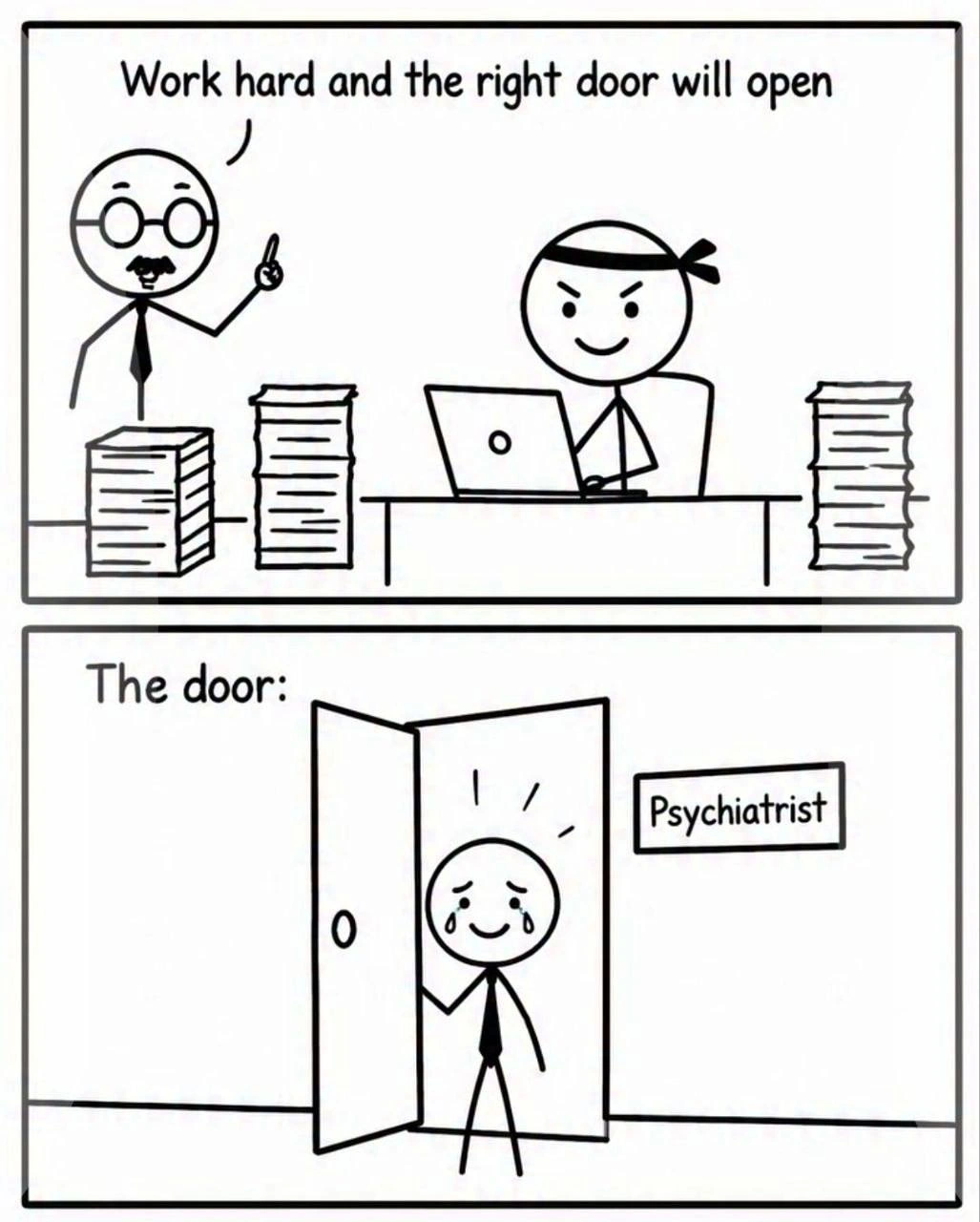
Some companies have a hiring process longer than their sprint cycle. It's a great way to filter for candidates who enjoy meetings that could have been an email
Your seven-round interview is just a saga pattern without a compensation step - every senior dev rolls back long before you try to commit
The best debugging tool for a broken hiring process is having another offer letter - it immediately fixes all those 'mandatory' assessment requirements and suddenly makes you a 'culture fit' without the seventh round panel interview
Senior engineers in 2024 have realized they're interviewing the company just as much as being interviewed - and companies with 5-round processes are failing the technical screen on 'respects developer time' and showing O(n²) complexity in their hiring pipeline
20 YOE scaling petabyte clusters, yet recruiters demand LeetCode marathons to 'prove basics' - peak tech absurdity
Design your hiring pipeline like a distributed system - too many synchronous stages without a fast-path create backpressure, so seniors time out and commit to a lower-latency employer
If your hiring pipeline has more hops than our service mesh, don’t be surprised when senior candidates trigger a circuit breaker and fail over to the company with a single, low-latency interview
Жыза, буквально на прошлой неделе было
Wage slavery: >:( Wage slavery, cool company: :D
true story, and It's sometimes depends on your experience and projects that you have had worked
yeah. DEFINITELY not english. it's one of the worst languages in existence.
every natural language has disadvantages, every constructed language is either bad or abandoned
You guys just never thought of what makes you you. Try to think about what would happen if you were born in a different environment