
Developer Burnout Hero Culture Meme Explained
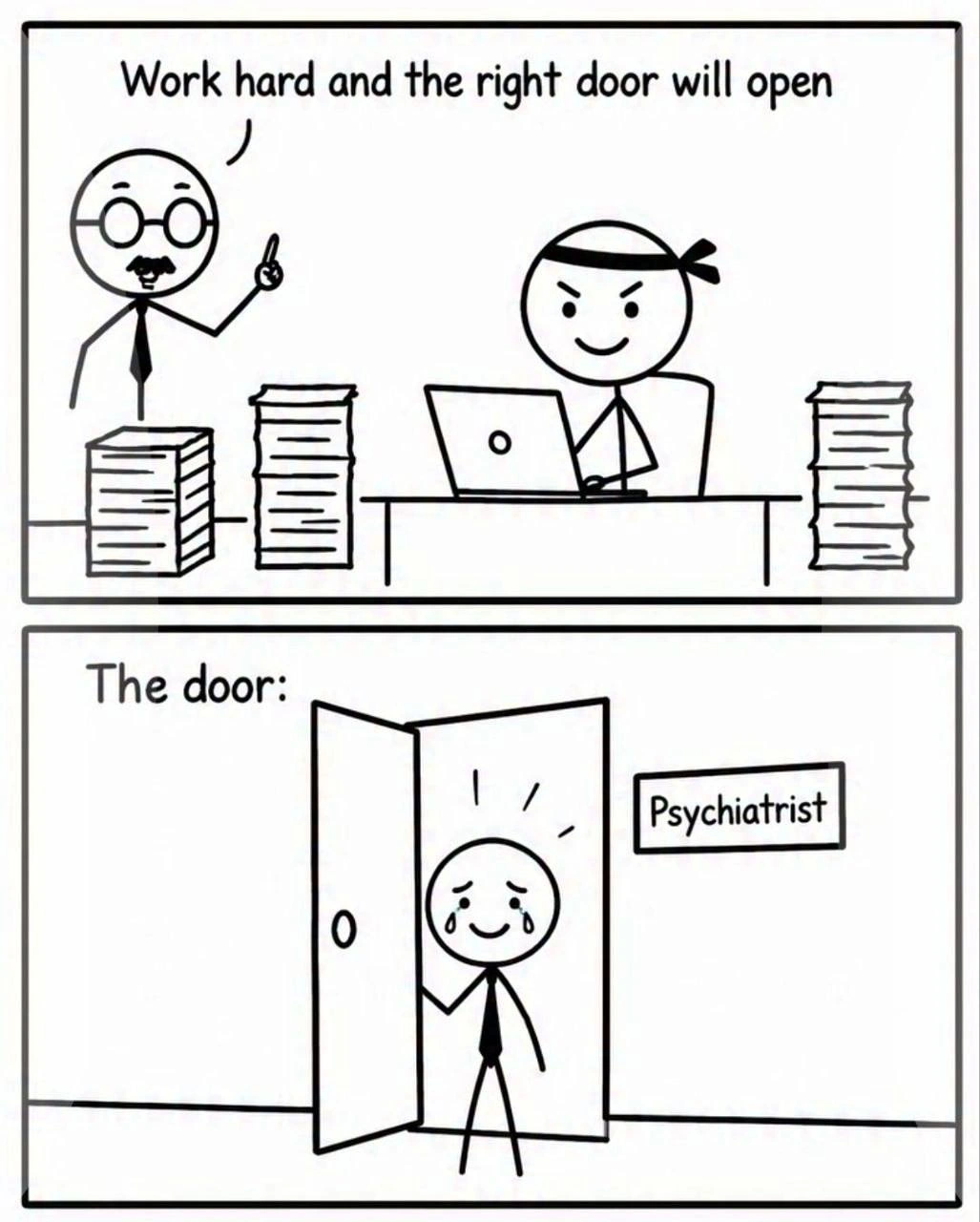
A manager promises that hard work opens the right door; the door turns out to be a psychiatrist’s office. The dive explains burnout, hero culture, and why systemic overwork cannot be fixed by personal grit alone.
Level 1: The Engine’s Right Door
It is like telling someone to keep a car’s engine at full speed because hard driving will take it somewhere wonderful. The door that finally opens is the repair shop’s. The joke is that the worker really does reach a new door, but only because the endless work wore him down instead of delivering the promised prize.
Level 2: When Hard Becomes Harmful
Job stress occurs when work demands do not match a worker’s available resources, capabilities, or needs. Some short-term stress can accompany learning or an urgent incident. Trouble grows when pressure is intense, chronic, difficult to control, and unsupported by recovery.
Several ordinary software practices can become stressors:
| Work Pattern | Reasonable Version | Harmful Version |
|---|---|---|
| Deadline | A clear priority with negotiable scope | A fixed date, fixed scope, and routine overtime |
| On-call | Shared rotation with useful alerts and recovery | Constant interruption and blame |
| Ownership | Authority to improve a service | Responsibility without staffing or control |
| Learning | Protected time to gain a skill | New technology added without time or guidance |
| Commitment | Occasional extra effort in a real emergency | Permanent emergency mode |
Fatigue also affects engineering quality. A tired developer may miss edge cases, misunderstand review comments, choose the first workable design, or create defects that demand more late work. This is not a character flaw; complex reasoning needs attention and recovery. Overwork can therefore reduce total useful output even while increasing hours recorded.
A psychiatrist is a physician specializing in mental health. The sign is deliberately specific because it makes the promised “door” concrete and serious. In reality, people may seek support from different qualified professionals depending on their needs, and not every stressful period implies a disorder or psychiatric treatment. The meme’s point is organizational irony, not a clinical pathway.
For a junior developer, “work hard” is incomplete advice. Effort helps when it is attached to feedback, learning, priorities, and a sustainable pace. If every task is urgent, no trade-off is allowed, and the reward for finishing early is another stack, the problem is not a missing time-management trick. It is the design of the work.
The manager’s slogan promises a simple input-output function:
more effort -> more opportunity
The lower panel supplies the omitted variables:
more effort
+ unbounded workload
+ insufficient recovery
+ low control
-> distress
Level 3: Promotion Track to Treatment
The upper panel presents the classic managerial promise:
Work hard and the right door will open
A bespectacled, mustached authority figure raises one instructive finger while the worker smiles at a laptop, wearing a headband like office labor is an endurance sport. Three tall stacks of paperwork surround the desk. In the lower panel, The door: is no longer a metaphor. The same worker, now in a tie and crying, walks through an actual doorway beside a sign marked Psychiatrist.
The bait-and-switch is exact. “The right door” is supposed to mean promotion, opportunity, wealth, or recognition. Instead, relentless effort opens access to mental-health care after the work has taken its toll. The worker did follow the advice; the manager merely neglected to specify the destination.
The target is not psychiatry, and seeking help is not the failure being mocked. The failure is a workplace treating sustained overwork as a reliable career-development system, then allowing the worker to absorb the consequences privately. The psychiatrist’s door represents care becoming necessary; it is funny because it is radically different from the reward the motivational slogan implied.
In software, hard work is especially easy to romanticize because output is difficult to measure. Lines of code reward verbosity. Tickets reward small slicing. Story points are estimates, not units of human worth. When management cannot observe reasoning, prevention, mentoring, or risk reduction, it may substitute visible intensity: long hours, instant replies, heroic incident recovery, and a calendar with no unclaimed pixels.
That produces the hero culture loop:
- A team is under-staffed or commits beyond its capacity.
- Developers work nights to meet the target.
- The release succeeds, so leadership sees the target as achievable.
- Exceptional effort becomes the next baseline.
- Exhaustion increases mistakes, turnover, and dependency on a few heroes.
- The remaining people work harder to cover the damage.
The stacks in the drawing never shrink; they frame the worker on both sides. That detail matters. No amount of personal discipline can complete an intake queue that is replenished faster than one person can process it. A headband, a positive attitude, and another productivity system cannot repair a capacity equation.
Burnout has a more specific meaning than simply feeling tired after a difficult week. The World Health Organization describes it as an occupational phenomenon resulting from chronic workplace stress that has not been successfully managed, characterized by exhaustion, greater mental distance or cynicism toward the job, and reduced professional efficacy. It is not classified there as a medical condition, and its signs can overlap with health conditions that require individual assessment. The cartoon does not diagnose its stick figure; it uses tears and the clinic sign as compressed visual shorthand for serious psychological strain.
The organizational satire lies in converting a systemic problem into an individual appointment. Counseling, medical care, time off, and employee assistance can be genuinely valuable. They do not make an impossible workload possible. If the piles, deadlines, low control, and reward structure remain untouched, offering resilience training alone is like improving the smoke alarm while keeping the office on fire.
Smart managers can still value effort without worshipping depletion. Sustainable systems align workload with capacity, make priorities explicit, give people control over how they work, staff on-call rotations safely, plan recovery after crunch, and reward prevention rather than only rescue. Otherwise the “right door” is just the company’s most dependable referral pipeline.

The employee passed every performance review and still failed the liveness probe.