
Frontier AI vs B2B SaaS Meme Explained
Karpathy expects frontier AI research; Amodei with a rifle demands B2B SaaS sales. The dive unpacks research-versus-revenue time horizons, pre-training costs, and why enterprise checklists outlive benchmark charts.
Level 1: The Rocket Has Sponsors
It is like hiring a famous scientist to design the fastest rocket ever, then having the company owner demand that he spend his day selling tickets. The scientist feels tricked, but rockets are expensive and ticket money pays for the next one. The picture is funny because it replaces that awkward business conversation with a ridiculous threat: build the future, certainly—right after somebody buys it.
Level 2: Models Need Customers
A frontier model is a model near the leading edge of general capability at the time it is built. Pre-training is the large initial training phase in which a model learns statistical patterns from broad data by repeatedly predicting missing or next elements and updating its parameters. It consumes substantial computation and creates the general capabilities later adapted and delivered through products.
Business-to-business, or B2B, means selling to organizations rather than primarily to individual consumers. Software as a service, or SaaS, means customers access centrally operated software, usually through a recurring subscription or usage charge. For an AI lab, the product may expose a model through an application or API, but enterprise customers purchase more than raw intelligence: they purchase dependable access, administrative control, integration, and someone accountable when production fails.
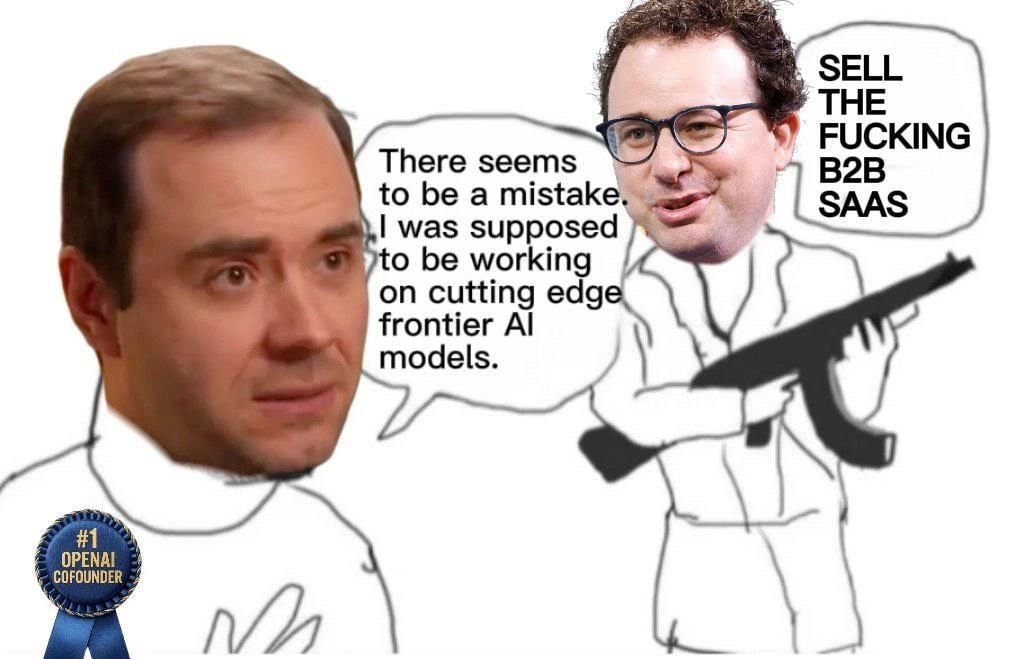
That explains every visual role. Karpathy’s oversized photographic head and ribbon embody the career expectation that an elite researcher should pursue technically novel model training. Amodei’s head, commanding speech bubble, and rifle embody corporate pressure stripped of polite planning language. The kneeling posture supplies the developer-expectations-versus-reality punchline: “join a frontier lab” sounded like pure R&D until the revenue roadmap entered the room.
Level 3: Research Meets Revenue
“There seems to be a mistake. I was supposed to be working on cutting edge frontier AI models.”
“SELL THE FUCKING B2B SAAS”
The hostage cartoon turns a normal corporate dependency into armed coercion. Andrej Karpathy, marked by the absurdly competitive #1 OPENAI COFOUNDER ribbon, represents prestigious frontier AI research. Anthropic CEO Dario Amodei, pasted onto the rifleman, represents the institution that must convert expensive research into a sustainable business. The weapon makes the commercial priority literal: whatever the researcher imagined his mandate to be, the company needs customers who sign contracts.
The factual setup sharpens the satire. Karpathy did join Anthropic’s pre-training organization to return to research and development, so the image is not evidence that he was actually reassigned to sales. It deliberately invents that bait-and-switch. The joke works because even genuine frontier work lives inside a company whose compute bills, salaries, and future training runs require revenue. A celebrated researcher may optimize model capability; the organization must also optimize whether anyone will reliably pay for it.
B2B SaaS is especially funny here because enterprise success depends on work that looks painfully ordinary beside a new model architecture. Corporate buyers ask about identity federation, access controls, audit logs, data retention, regional processing, uptime commitments, procurement terms, support, and predictable billing. None makes a dramatic benchmark chart. All can decide whether a pilot becomes a contract. The meme collapses that entire go-to-market machine into one shouted instruction, as if Karpathy’s next research objective were:
minimize(training_loss)
subject to: annual_contract_value > 0
The deeper management-versus-engineering tension is a conflict of time horizons and success metrics. Researchers are rewarded for capability advances, novel methods, and knowledge that may pay off later. Product and sales teams are rewarded for adoption, retention, contract value, and delivery this quarter. Neither side is irrational. A laboratory that ignores commercialization can run out of resources; a company that diverts every technical decision toward today’s customer requests can lose the frontier that made its product valuable. The hard managerial task is portfolio allocation, not choosing “research” or “revenue” as if one can survive without the other.
There is also an industry-wide irony. AI companies market models as software that will transform every business, yet they must themselves perform the familiar enterprise-software ritual: integrations, security questionnaires, deployment support, and long procurement cycles. The frontier may move weekly; the customer’s vendor review spreadsheet remains immortal. The crude rifle captures the gravitational pull of that reality more efficiently than a hundred slides titled Research-to-Revenue Synergies.
The loss function now includes quarterly recurring revenue.