
Vendor Lock-In Irony Meme Explained
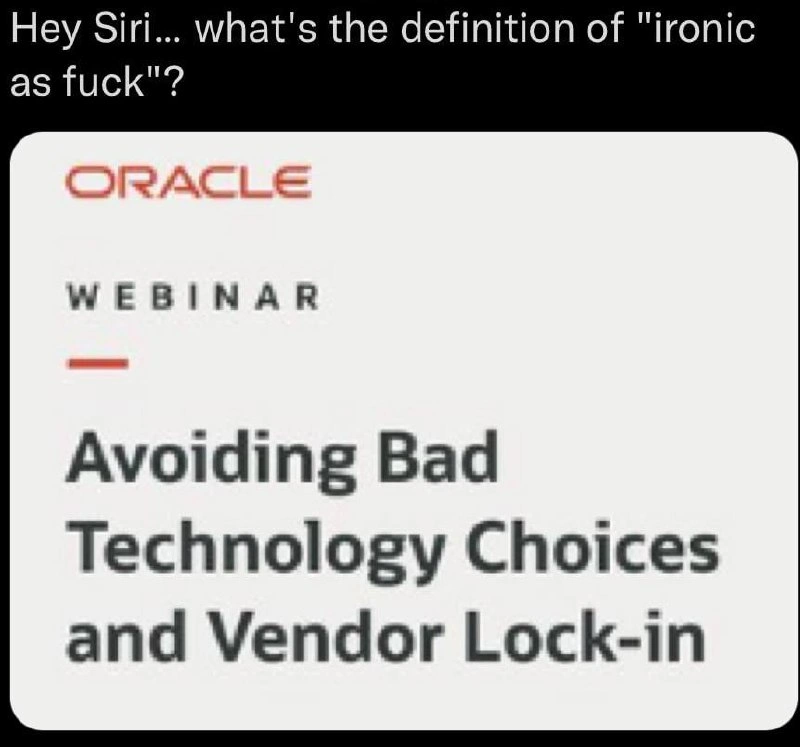
A caption asks Siri for the definition of extreme irony, then shows Oracle advertising a webinar on avoiding bad tech choices and vendor lock-in. The article explains what lock-in means, why Oracle is the usual example, and why architects find the pitch darkly funny.
Level 1: Cookie Monster’s Diet Tips
Imagine the Cookie Monster from Sesame Street, who just loves cookies, announcing a class on how to avoid eating cookies. You’d probably giggle, right? The idea is so ironic: the one character famous for gobbling cookies is now giving advice on not gobbling them. This Oracle meme is funny for the same reason. Oracle is like that Cookie Monster in the tech world – known for making products that companies get totally hooked on. So when Oracle offers tips on not getting hooked on a single product (avoiding vendor lock-in), it feels as silly as Cookie Monster teaching a healthy diet class. It’s a simple “practice what you preach” kind of joke. We laugh because the expert giving the advice is the biggest example of doing the opposite, and even a kid can see the irony in that!
Level 2: The Vendor Trap
Oracle’s webinar title "Avoiding Bad Technology Choices and Vendor Lock-in" sounds helpful on the surface, but knowing Oracle’s reputation gives it a funny twist. First, who is Oracle? Oracle is one of the biggest enterprise database and software companies in the world. Their flagship product, the Oracle Database, runs many large corporations’ data. Oracle’s tech is powerful, but it’s proprietary – meaning it’s owned by Oracle, not open-source. Companies pay big money for Oracle’s database licenses and support, and they often sign long contracts.
Now, vendor lock-in is a term every junior developer should learn. Lock-in means you’re stuck with a vendor’s technology because switching to something else is extremely hard, expensive, or risky. Imagine you built all your company’s systems using Oracle’s database features and Oracle’s cloud services. If one day you wanted to move to a different database (say PostgreSQL or another platform), you’d have to rewrite a ton of database queries, maybe re-architect your applications, and train your team on the new system. That’s a huge effort! The cost and difficulty basically lock you into continuing with Oracle. In an enterprise setting, this happens a lot: a business makes a technology choice (like choosing Oracle’s stack), and later they find it’s not easy to change direction. This is why picking tech can be scary for architects – a bad technology choice can trap you for years.
So why is Oracle’s webinar title ironic? Because Oracle is exactly the kind of vendor that people worry about getting locked into. Oracle’s database has unique features (like specific SQL extensions and management tools) that don’t work elsewhere, which means once you depend on them, leaving Oracle is painful. It’s the classic example used when discussing EnterpriseSoftwareChallenges: “Be careful or you’ll end up stuck with a single vendor.” Oracle’s long-term customers sometimes joke that they have “Oracle handcuffs” on — they rely so much on Oracle’s product that they can’t operate without it.
In the meme image, Oracle is advertising a webinar (an online seminar or presentation) about avoiding exactly the scenario they’re famous for causing. It’s as if they’re positioning themselves as experts on escaping a trap that, historically, they love to set. Of course, the likely reality is that Oracle’s webinar would focus on avoiding other companies’ traps and tout Oracle’s “flexible” solutions. It’s a bit of TechHumor in the industry: the idea that Oracle might say, “Watch out for vendors who lock you in… by the way, have you tried our all-in-one Oracle Cloud package?” Seasoned devs and even many new engineers find that contrast funny. It’s a prime example of industry irony – a company teaching about a pitfall that it is known to create. Once you understand who Oracle is and what vendor lock-in means, you can see why this webinar announcement would get a lot of knowing laughs.
Level 3: Fox Guards the Henhouse
"Hey Siri... what's the definition of 'ironic as fuck'?"
Siri: Oracle, the king of vendor lock-in, hosting a webinar on avoiding vendor lock-in.
This meme sets off every irony alarm in a seasoned architect's mind. Oracle is practically the textbook definition of VendorLockIn in enterprise tech: its entire business model thrives on locking customers into its proprietary database and long-term support contracts. Seeing the bold red ORACLE logo above the webinar title "Avoiding Bad Technology Choices and Vendor Lock-in" is a laugh-out-loud case of CorporateIrony – truly peak enterprise irony. It's the ultimate "do as I say, not as I do" moment from a company notorious for multi-year deals, proprietary features, and EnterpriseSoftwareChallenges that make it painfully hard to switch away. In other words, we've got a fox giving a henhouse safety seminar here. Seasoned developers who’ve wrestled with Oracle’s licenses or migrated away from Oracle databases know this situation all too well. The humor comes from that shared industry memory of how sticky Oracle’s products can be, and now Oracle is teaching about not getting stuck. You can practically hear the collective giggle (or groan) from battle-scarred database admins everywhere.
Let's decode what this Oracle webinar title really sounds like to jaded tech folks:
| Oracle’s Webinar Pitch | Cynical Translation |
|---|---|
| Avoiding Bad Technology Choices | “All choices except choosing Oracle are bad.” |
| …and Avoiding Vendor Lock-in | “Lock yourself in with Oracle instead (we promise it’s different)”. |
It’s blatant IndustryIrony. Oracle warning about vendor lock-in is like the cigarette company sponsoring a quit-smoking campaign – you know there’s an ulterior motive. The experienced engineers and architects reading this invite immediately suspect that “avoid bad choices” really means “use Oracle everywhere”. After all, Oracle’s idea of freedom often sounds like, “sure, you can leave our platform anytime… after paying a hefty exit fee and rewriting half your system.”
This pattern is as old as enterprise software sales. Big vendors create fear around a problem and position themselves as the hero to solve it – even when they are the problem. Long-time IT folks have joked for years that "no one ever got fired for buying Oracle," meaning it’s the safe enterprise choice, but that safe choice comes with golden handcuffs. Once your data and logic live inside Oracle’s ecosystem (say you’ve written tons of PL/SQL stored procedures and tuned your systems to Oracle's quirks), escaping is a massive, expensive project. It’s the classic vendor trap: Oracle’s database is top-tier technology, but it’s a roach motel for your data – data checks in, but it never checks out without a fight. The meme nails this absurdity: Oracle, of all companies, offering advice on not getting stuck with a single vendor. For those of us who’ve been on 3 AM calls trying to untangle an Oracle-only system or negotiating an eye-watering license renewal, this scenario is equal parts hilarious and painfully relatable. It’s tech humor drawing on years of hard-earned cynicism: the ultimate irony of a lock-in specialist preaching about openness.
I tried to join Oracle's webinar on avoiding vendor lock-in, but the registration required a 10-year, non-cancellable enterprise license agreement just to view the landing page
Oracle explaining how to dodge vendor lock-in feels like SQL*Plus suggesting you migrate to Postgres - before the last slide loads, you’ve already received a licensing audit invite
The only thing more expensive than migrating away from Oracle is staying with Oracle - but at least their webinar on avoiding vendor lock-in is free, unlike literally everything else they've ever touched
Oracle hosting a webinar on avoiding vendor lock-in is like a casino offering seminars on responsible gambling - technically possible, but the house always wins. Any architect who's tried migrating off Oracle Database or navigating their Byzantine licensing models knows this is the enterprise software equivalent of a wolf teaching sheep about predator avoidance. The real kicker? They probably charge for the webinar recording
Oracle presenting “avoid vendor lock-in” is the ADR where Context: per-core licensing and support uplifts; Decision: stay put; Consequence: seven‑figure exit cost
Oracle on avoiding vendor lock-in: like their DBA teaching you to escape a PL/SQL infinite loop with 'just rewrite in NoSQL'
Oracle teaching 'avoid vendor lock-in' is like a CSP explaining multi-cloud - the sample architecture ends with proprietary extensions, egress fees, and a license audit as the exit API
nu proprietary i proprietary
Oracle is our God, this is allowed for him
Why do not you like java?
Asking cz i dont like it too
Tried to create exe with sqlite db …
Very bad exp
Virtual Box is GPL though and that's the only Oracle product I use