
AI Regulation Ask and Reality Meme Explained
A stick figure with merged Anthropic and OpenAI logos asks for regulation, then panics when a U.S. flag monitor says it is already happening. The dive explains the gap between voluntary Responsible AI values and enforceable compliance—and the risks of regulatory capture.
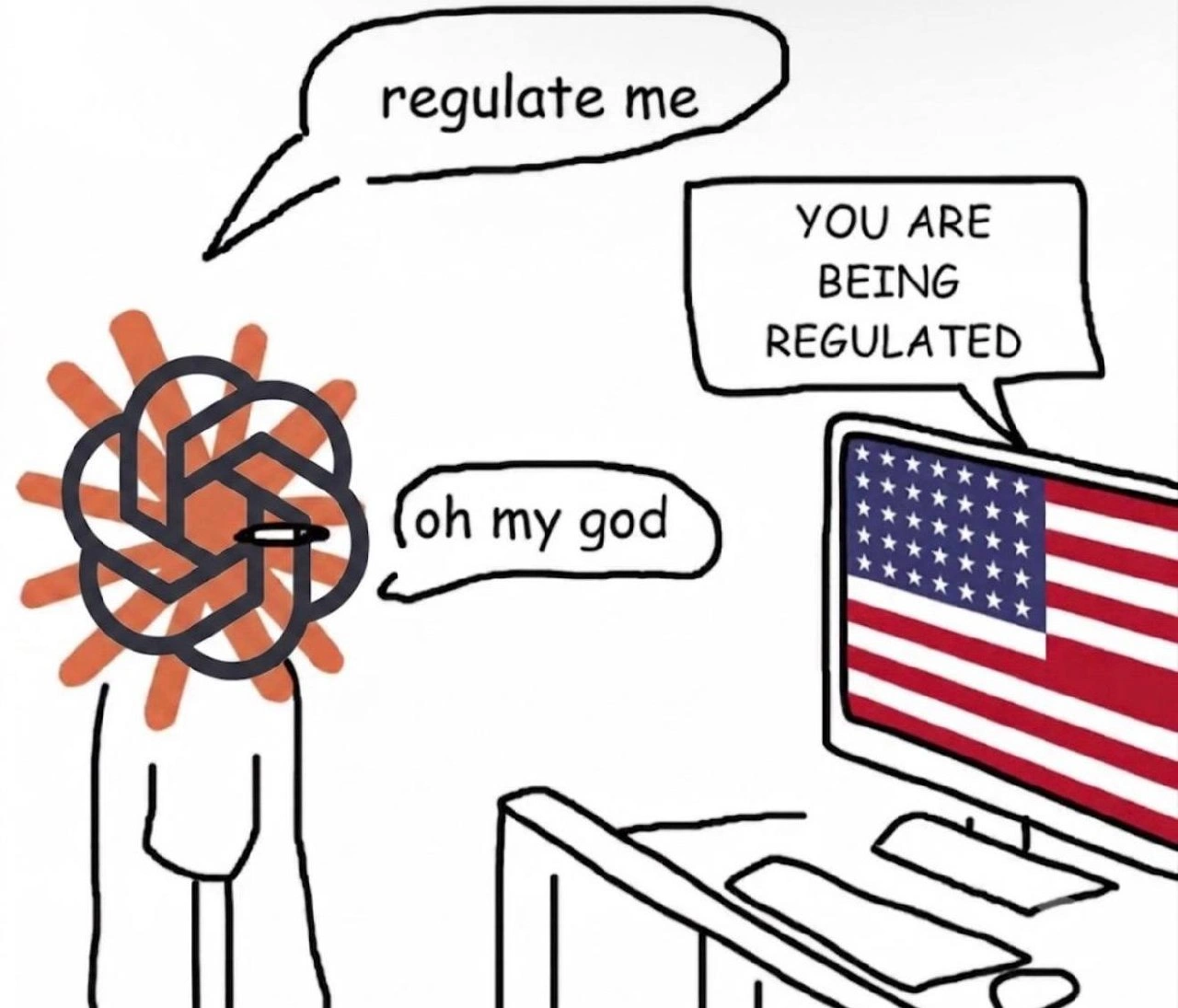
Level 1: Asking for a Referee
It is like two star players demanding a referee so the game will be fair, then gasping when the referee blows the whistle on them. The picture is funny because they wanted rules as a grand idea but seem shocked when rules actually limit what they can do.
Level 2: Policy Meets Production
AI regulation means enforceable rules governing how AI is developed or used. Compliance is the work of proving that an organization follows those rules. A voluntary safety promise says what a company intends to do; a legal requirement defines what it must do and may attach audits, restrictions, or penalties.
Frontier AI is difficult to regulate for several reasons:
- Capabilities can change faster than legislation.
- The most important evidence is often technical and held by the labs themselves.
- Some risks emerge only after deployment or through combinations of tools.
- Strict rules can reduce harm but also limit research, competition, and beneficial access.
- Weak rules can become public-relations paperwork with no meaningful enforcement.
A common risk-based approach applies stronger requirements as systems become more capable or are deployed in higher-impact settings. For a frontier lab, that might mean evaluating cyber or biological misuse, testing safeguards, securing model weights, reporting severe incidents, and allowing outside review. The hard questions are where thresholds sit, who performs the test, what evidence is public, and who can block a release.
The merged logos matter because OpenAI and Anthropic both publish safety frameworks and policy proposals, even though they differ on individual rules and commercial strategy. The meme turns them into one person because, from the public’s perspective, the recurring pattern is shared: leading firms warn that frontier AI needs oversight, participate in designing that oversight, and object when government action constrains their preferred operations.
For a junior developer, the practical analogy is a team asking for stricter code review. The request sounds excellent until the new reviewer rejects Friday’s release, requires threat-model documentation, and asks who approved the production credential. The process is annoying precisely because an independent check can change the outcome rather than merely applaud it.
Level 3: The Guardrail Has Teeth
regulate me
YOU ARE BEING REGULATED
oh my god
The stick figure’s head merges Anthropic’s orange burst with OpenAI’s dark knot, so the target is not one executive or policy dispute. It is the frontier-lab archetype: companies that publicly ask governments to create rules for powerful AI, then discover that a regulator is not merely an independent validation service for the rules they already wrote.
The United States flag displayed on the monitor makes government itself the second character. The computer’s block capitals turn an abstract policy preference into an active process. “Regulate me” is aspirational and comfortably vague; “YOU ARE BEING REGULATED” implies deadlines, disclosures, audits, access restrictions, legal interpretation, and somebody outside the company with authority to say no. The tiny “oh my god” is the sound of a policy paper becoming a compliance ticket.
The timing gave the stock format a concrete edge. In mid-2026, both OpenAI and Anthropic were advocating federal governance for frontier systems while recent U.S. interventions had also affected how their most capable models could be released and who could access them. The companies’ proposals emphasized testing, incident reporting, security standards, independent scrutiny, and government capacity. Actual intervention also introduced customer vetting, model-access constraints, and review processes that could slow deployment. The meme compresses that gap between preferred oversight in principle and government discretion in practice.
Calling this pure hypocrisy would be satisfying but incomplete. A company can coherently support well-designed regulation and oppose a particular rule that it believes is arbitrary, insecure, protectionist, or badly scoped. “Regulation” is not one boolean:
| Regulatory Tool | What It Can Change |
|---|---|
| Predeployment evaluation | Whether a model may launch |
| Incident reporting | What must be disclosed and when |
| Independent audit | Who can inspect internal evidence |
| Security requirements | How weights, systems, and credentials are protected |
| Access controls | Which customers or countries may use a model |
| Liability rules | Who pays when deployment causes harm |
| Competition policy | Whether incumbents can control the market |
| Data and copyright rules | What training and product use are permissible |
The corporate irony appears when a lab’s enthusiasm tracks how closely the rule resembles its own governance framework. Frontier companies possess vital technical knowledge, but they also have commercial incentives. They may prefer one national standard to fifty state regimes, capability thresholds that exclude smaller models, or compliance processes they already have staff to satisfy. Such preferences can be reasonable and still create a regulatory moat: a burden that the largest firms absorb more easily than new competitors.
That is why regulatory capture is a concern. If government relies too heavily on the companies being regulated for expertise, the resulting rules can protect incumbents, encode their assumptions, or treat their private evaluation methods as public truth. The opposite failure is uninformed regulation that freezes obsolete technical details into law or gives officials broad discretionary power without adequate review. Good governance needs independent technical capacity, transparent rulemaking, appeal mechanisms, and requirements tied to observable risks rather than whichever model name is currently frightening the news cycle.
For engineers, being regulated becomes a systems problem long before it becomes courtroom drama. Compliance may require:
- An inventory of models, training runs, weights, datasets, and deployment surfaces.
- A documented risk framework with measurable release thresholds.
- Reproducible evaluations and retained evidence.
- Role-based access to sensitive models and infrastructure.
- Tamper-resistant audit logs and clear ownership.
- Incident classification, notification clocks, and response exercises.
- Vendor and customer due diligence.
- Change management when a model, safeguard, or tool configuration is updated.
- Export-control checks that follow both users and organizational ownership.
None of those controls fits in the speech bubble “regulate me,” which is precisely the joke. Corporate support often lives at the level of Responsible AI values—safety, accountability, transparency, fairness—while enforcement lives at the level of schemas, signatures, reviewers, rejected releases, and penalties. Ethics becomes compliance when failure has a due date.
There is also a deeper accountability problem. Frontier labs argue that their models may create risks too large for voluntary self-governance, which is a strong reason for democratic oversight. But asking the government to act means accepting that public institutions represent interests beyond the lab’s preferred balance of safety, growth, national competition, and product access. The regulator is not aligned to the company; that is rather the point.
The sparse drawing makes this institutional conflict look like a chatbot conversation. The labs send POST /regulate; the United States returns 200 OK with side effects. Apparently nobody tested the endpoint outside staging.
They exposed `POST /regulate` and are shocked the endpoint wasn't a dry run.