
Linux Desktop Fragmentation Meme Explained
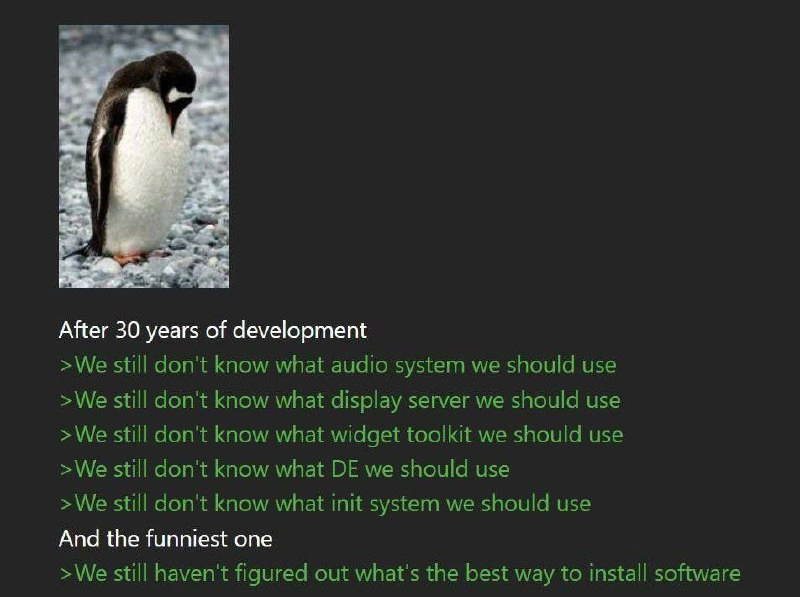
A somber penguin sits above a terminal-style list of Linux desktop debates that never settled—audio, display server, widget toolkit, DE, init, and package install paths. The dive maps each layer and why “because it depends” is both culture and pain.
Level 1: Too Many Remotes
This is like buying a very powerful TV that can do almost anything, but the sound uses one remote, the picture uses another, the apps use a third, and every person in the house insists their remote is the correct one. The funny part is that the TV really is impressive, but after decades nobody can agree on the simplest question: which button should a normal person press to install the thing they want?
Level 2: Choose Your Stack
For newer developers, the terms in the meme are the pieces that make a desktop operating system feel usable. A display server is the system that lets windows appear, move, resize, and receive input. A desktop environment, or DE, is the full graphical workspace: panels, settings, file manager, notifications, login flow, and the overall “feel” of the machine. A widget toolkit is what app developers use to draw buttons, menus, text boxes, and windows; GTK and Qt are two famous Linux examples.
An init system is the first major userspace process that starts services after the kernel boots. The systemd debate became legendary because init is not just startup anymore; it touches logging, timers, service supervision, networking hooks, and the daily rituals of debugging. Package management is how software gets installed, updated, verified, removed, and integrated with the system. That sounds boring until your app exists in three package formats, one works on your distro, one has old dependencies, and one technically launches but cannot see your home directory.
So the meme is not saying Linux is bad because it has options. It is saying every option becomes a compatibility surface. The first time you follow a tutorial and realize the command works on Ubuntu but not Arch, or the screen recorder works on Xorg but not Wayland, you understand why the green terminal text reads like a bug report filed by history itself.
Level 3: Fragmentation Forever
The meme shows a small penguin photo above terminal-styled text, so the Linux target is not subtle. The green prompt lines read like a weary shell session:
After 30 years of development
We still don't know what audio system we should use We still don't know what display server we should use We still don't know what widget toolkit we should use We still don't know what DE we should use We still don't know what init system we should use And the funniest one We still haven't figured out what's the best way to install software
The joke works because each listed layer is a real fault line in the Linux desktop ecosystem. Audio had OSS, ALSA, PulseAudio, JACK, and now PipeWire trying to reconcile pro audio, consumer audio, sandboxed apps, Bluetooth, and latency without making everyone relive 2009. Display servers moved from X11/Xorg toward Wayland, which is technically cleaner but also forced every compositor, driver, screen-sharing tool, accessibility stack, and window-manager habit to renegotiate its contract. Widget toolkits split the world into GTK applications, Qt applications, and everything that ships its own opinions in a browser engine.
The sharpest line is software installation. A Linux veteran can defend apt, dnf, pacman, source builds, AppImage, Flatpak, Snap, Nix, containers, and vendor .sh installers depending on the sentence they just finished saying. The post message, “Because it depends!”, is exactly the punchline: Linux culture often treats choice as a virtue, but users experience the same choice as a decision tree with missing labels and a support forum at the end. The grim little penguin looking down makes the whole thing feel less like triumphal open-source freedom and more like a mascot quietly reviewing a 30-year architecture meeting that never adjourned.
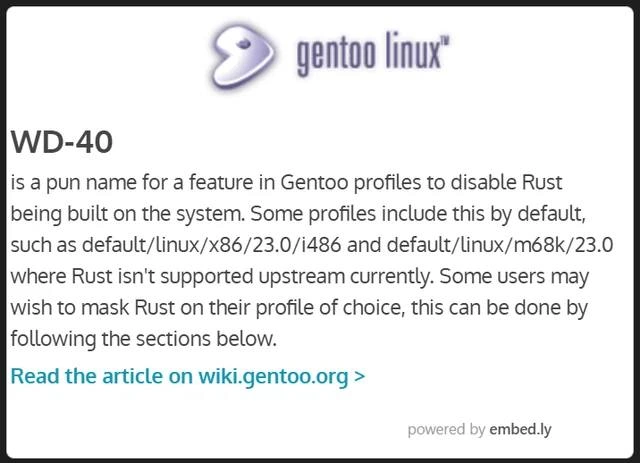

Linux has a thousand package managers because consensus is clearly a proprietary feature.
Wanting one way to do a thing is how you get regulation. Do you want regulation?
Even os
Being a developer is like constantly making terrible choices
The penalty of choice. If you want to regulate, you will have less choice. But the cost will be freedom. You'd have to live with what authority will provide. Ubuntu tried it with snap. Now everyone hates snap.
There is the only way — just use windows🤷♂️
1. ALSA
I like 'em
didn't expect to see a Dark Souls weapon together with a cheesy instagram emoji
the best ones are recursive backronyms though
not sure who invented these jolly pancakes tbh, ios emoji then
After 30 years of development, we still don't know what {userspace subsystem} we should use. That's because Linux is the kernel, not a userland! 🤓
Meanwhile Android: "Calculator app needs System Administrator privilege". 🤡
Linux way: Run the package manager which always demand full root privileges. And this package manager WILL run configuration scripts with root privileges. The package will be installed into: /usr/bin /usr/lib /usr/local /usr/local/bin /usr/share /home/username/.something /opt /etc /var /var/lib /var/lib/snapd But wait, there's more. You'll get a bonus round of dependencies scattered like graffiti all over your system. And if you're diving into private repositories? Oh boy...
pacman best package manager 💪
well, yes. I mean it does have downsides, but it's better than apt I think. Can't say much about other package managers though
So, Windows is the worst operating system ever, except for all the others.
I know what the menu looks like. And even this is only after disabling the godawful grid
Anyway, duty calls for this corporate minion. I've exhausted my corporate quota for propaganda and agitation today. Time start working - have to do my bit to tighten Microsoft's monopoly grip. So, have a good night (if you have this feature on Linux, ofc).