
Flipper One Linux Mainline Meme Explained
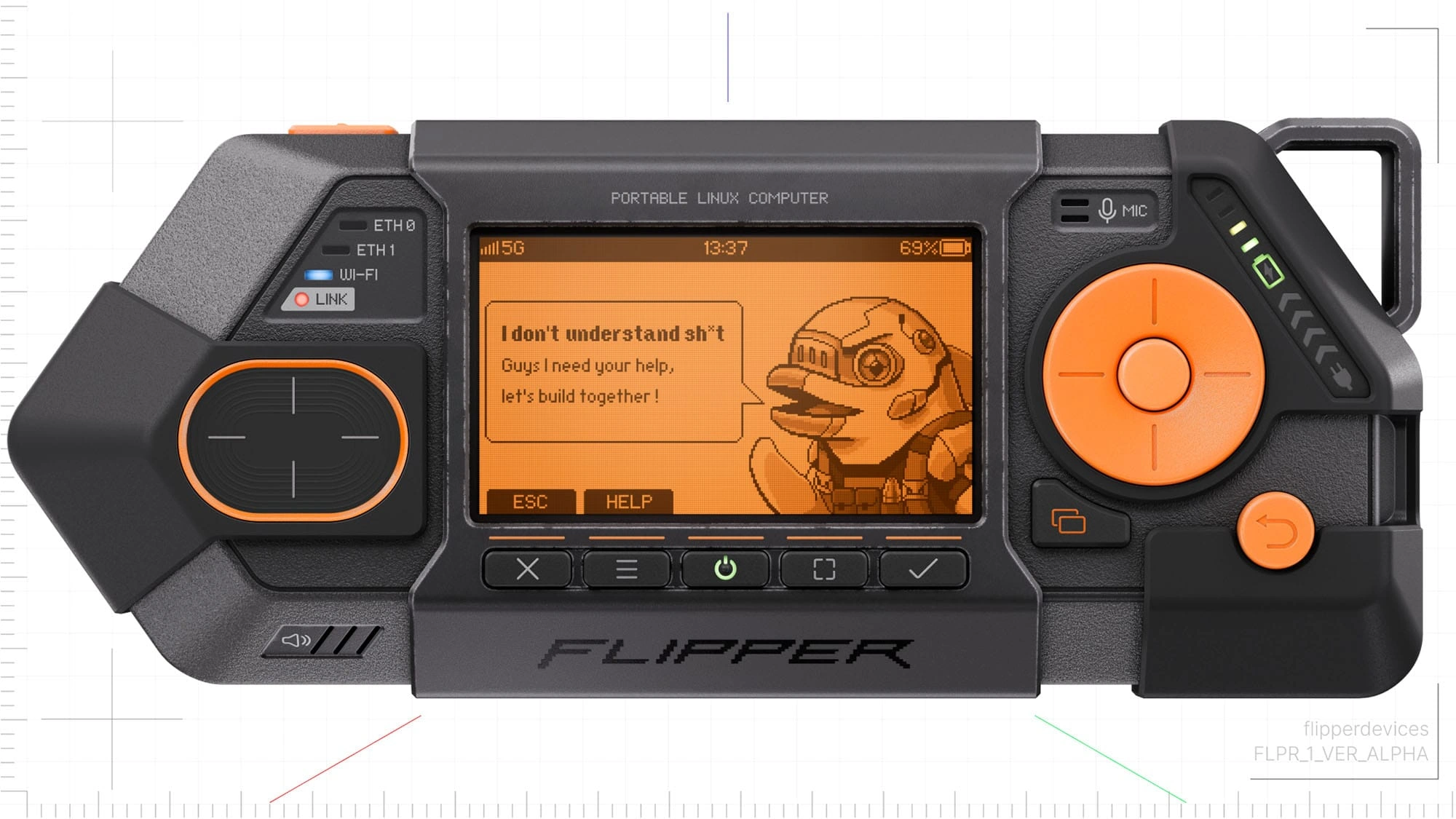
A glossy Flipper One cyberdeck render shows the dolphin admitting it does not understand the stack and needs community help. The dive explains mainline Linux on custom ARM hardware, embedded boot chains, networking interfaces, and why open development is honest alpha engineering.
Level 1: Fancy Remote Needs Help
Imagine someone shows you a powerful remote control with lots of buttons, lights, and ports, but the little screen says, "I am confused, please help me." That is the joke: the device looks ready for expert missions, yet it honestly admits that building a tiny open computer is hard and needs many people working together.
Level 2: Tiny Linux Box
Linux is an operating system used everywhere from servers to phones to tiny embedded boards. A portable Linux computer is a small device that can run Linux tools without needing a laptop. The image shows that idea through labels like ETH0, ETH1, WI-FI, 5G, MIC, ESC, and HELP.
Embedded systems are computers built into specific devices. They usually have tighter limits than desktops: smaller screens, limited battery, unusual buttons, special hardware chips, and more custom drivers. That is why the device can look simple on the outside while being complicated inside.
The phrase I don't understand sh*t is the emotional center. The project wants to be useful for developers, network engineers, security researchers, and hardware tinkerers, but the screen admits that the design is still uncertain. The follow-up, Guys I need your help, let's build together !, turns that confusion into an open-source invitation.
The funny part for early-career developers is recognizing that "just put Linux on it" is never just putting Linux on it. You need bootloaders, kernel support, drivers, networking, storage, updates, user interface, documentation, and a way to recover when a user breaks the system. The picture looks like a finished gadget, but the message says the hard engineering is still alive and arguing in the issue tracker.
Level 3: Help Button Architecture
The senior-developer humor is that the HELP button is not a feature; it is a project-management state. The device has rugged industrial styling, a D-pad, status indicators, a microphone label, a blue WI-FI light, and a big orange control surface, yet its screen says it does not understand what is going on. That is painfully accurate for ambitious hardware: the render can be complete long before the last kernel driver, power bug, module pinout, or UI framework question is resolved.
This is also a joke about open development. Most companies hide messy architecture debates until the launch video is polished. The post context says the Flipper team is opening the development process and asking for help, including documentation, kernel work, hardware feedback, and UI ideas. That makes the on-screen speech bubble almost honest release engineering: "here is the prototype, here are the hard parts, please bring expertise."
The visible phrase FLPR1_VER_ALPHA in the corner matters. Alpha hardware is where optimism meets oscilloscope traces. You discover that a connector fits mechanically but hates the signal integrity budget, a driver works until suspend/resume, a UI flow looks fine in Figma but not on a small monochrome screen, and a "simple wrapper around existing CLI tools" becomes a framework because ping, nmap, traceroute, network profiles, logs, permissions, and error states all need to fit behind a few physical buttons.
There is a security-culture angle too. The device aesthetics scream hacker tooling, but responsible security hardware has to do more than look tactical. If it has network interfaces and can operate as a bridge, gateway, analyzer, or wireless tool, then update mechanisms, permissions, default configurations, auditability, and safe recovery matter. Otherwise the cyberdeck becomes a very stylish way to create an incident report.
Level 4: Mainline Or Panic
PORTABLE LINUX COMPUTER
I don't understand sh*t
Guys I need your help,
let's build together !
The image is a glossy hardware render pretending to be a product shot, but the funniest technical detail is that the device itself is asking for architectural help. The casing says PORTABLE LINUX COMPUTER, the bottom says FLIPPER, the left panel advertises ETH0, ETH1, WI-FI, and LINK, and the screen shows a tiny UI begging the community to build together. That is not just a cute prompt. It is an embedded Linux project looking directly at the mountain and saying, accurately, "yes, we are scared."
The deeper engineering problem is mainline Linux support on custom ARM hardware. A normal single-board-computer product can ship a vendor board support package: patched kernel, binary boot components, closed firmware, and drivers that work just well enough until the vendor loses interest. An open Linux appliance that wants to remain useful has a harder goal: upstream the SoC support, avoid proprietary blobs where possible, get drivers reviewed, document the hardware, and make future kernel updates boring. Boring is the premium feature. Ask anyone who has tried to revive a vendor kernel from four years ago.
The Flipper One context makes the visible UI more pointed. It is not merely a handheld shell with orange buttons. It is described as a Linux cyberdeck-style platform with an ARM CPU, a low-power microcontroller, networking interfaces, expansion modules, and a small-screen control layer. That means the architecture has to coordinate boot control, display output, buttons, power management, networking, storage, kernel drivers, userspace tools, and recovery states. The product fantasy is "portable hacker computer." The implementation reality is "please make SPI, I2C, UART, GPIO, power rails, display timing, and upstream review all agree before the battery dies."
The labels 13:37 and 69% tell you the render knows its audience, but the labels ETH0 and ETH1 are doing the real work. eth0 and eth1 are conventional Linux network interface names, and putting two Ethernet indicators on a handheld device implies gateway, bridge, analyzer, router, or inline network tooling use cases. Add 5G, WI-FI, and expansion hardware and suddenly this is not a toy. It is a pocket-sized networking lab with a user interface strapped to it and a kernel-porting project underneath.
Nice product render:
buttons, screen, ports, cyberdeck vibes

Actual embedded Linux work:
boot chain, kernel drivers, power states, firmware, UI framework,
networking, recovery, docs, thermal limits, and community review

Screen summary:
"I don't understand sh*t"


It has ETH0, ETH1, Wi-Fi, and still the most realistic interface is a modal asking the community to explain the requirements.
The first honest boot splash: no binary blobs, just a dolphin asking the community to finish the drivers.
Are fr rn
Looks really hope, I sure hope it won't cost a shitload of money
Whatever happened to no ads zawg 😒
20% ai slop 😒
Fuck them Flippers are tools for assholes to fuck up people around them
You can use them to target individuals Someone was using a flipper to broadcast mass Bluetooth pair requests and crashing devices which shouldn't filter them out Someone at a furry convention had an insulin pump controller crash because of this and it could have caused them to go into diabetic shock
Holy sh.. hard is hard respect
I wonder if they'll actually have a community, feels like they're basically going "build the thing for us please", but idk. This will depend on the price heavily
so how much would it be?
Idk what to think about FOne - it's would be really expensive device (I would imagine $600-$800 if not more) with terrible built-in GUI (menu-based my ass) and too much things attached to it permanently at this point smth like a GPD device with linux dual-boot would be more handy?
ew, russians 🤮
Missed opportunity to call it Flopper Zero
flipper devs are from ruzzia and should not be sponsored by any circumstances
Odessa is occupied with ethnical russians, unfortunately moreover, war started at 2014, earlier than flipper zero invented
So you're hating on ethnicity or what? I don't see that they're supporting Russia
only way to survive if you live in east europe
but you can't understand the hate because you live in comfortable place
I remember MH-17, do you remember?