
Crypto Wallet CAPTCHA Auth Satire Meme Explained
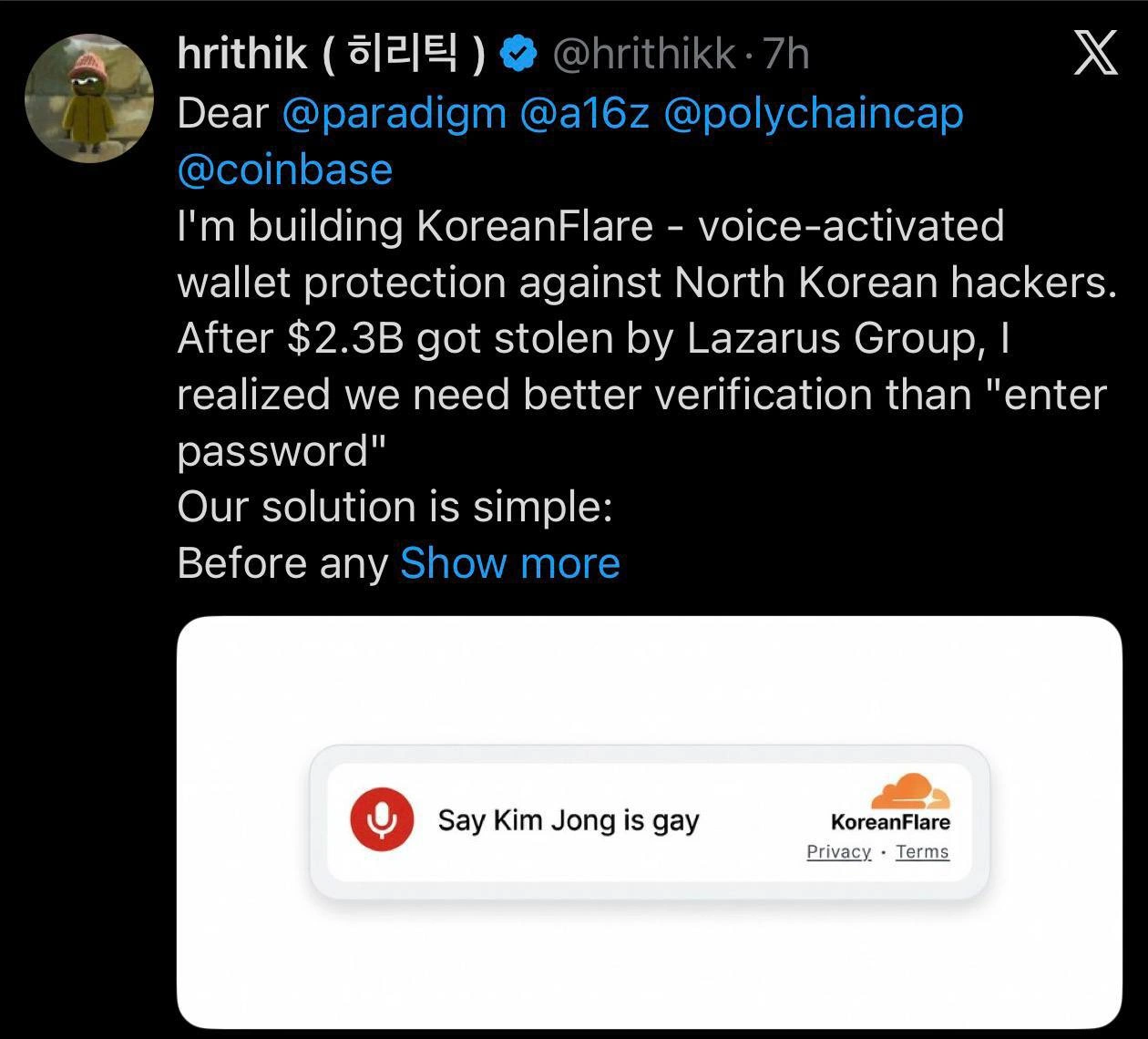
A VC-tagged pitch for “KoreanFlare” shows a Cloudflare-style widget that asks users to say a regime-insulting phrase before wallet access. The deep dive unpacks CAPTCHA parody, Lazarus crypto thefts, authentication factors, and why nation-state threats get mocked as password-plus-widget startups.
Level 1: The Secret Password the Villain Can't Say
Imagine a clubhouse that keeps getting robbed by one specific bully's gang. The kids install a new lock — but instead of a key, the door asks you to shout an insult about the bully's boss before it opens. Any normal kid can say it and walk in. But the gang members can't — their boss would be furious — so they just stand outside, stuck. The joke is that instead of building a stronger lock, someone built a door that runs on embarrassment, then asked rich grown-ups to pay for it like it's a serious invention.
Level 2: The Parts Being Parodied
- CAPTCHA / Turnstile: those "verify you are human" boxes on websites. Cloudflare's Turnstile is the modern checkbox version — the meme clones its exact visual design, which is why it reads as instantly legitimate.
- Lazarus Group: North Korea's state-sponsored hacking unit, responsible for the largest cryptocurrency thefts in history. They fund a government with stolen tokens, which is why "North Korean hackers" is a real line item in every exchange's threat model.
- Voice authentication: verifying identity by voice. Real versions check voiceprints (biometrics); the joke version checks willingness, which is not a biometric but arguably more robust against this one specific adversary.
- Wallet protection: crypto wallets are guarded by keys and passwords; steal the key, own the funds — irreversibly. That irreversibility is why exchange hacks are catastrophic and why "better verification than enter password" lands as a real need.
- The VC tag-storm: opening a tweet by @-ing four famous crypto investors is the format of someone performing a pitch for an audience, not making one — the modern "investors hate this one trick."
Level 3: Something You Know, Something You Have, Something You Cannot Say
The post is a pitch-deck-shaped joke aimed squarely at crypto VCs — opening "Dear @paradigm @a16z @polychaincap @coinbase" — for a fictional product called KoreanFlare: "voice-activated wallet protection against North Korean hackers." The hook cites real carnage: "After $2.3B got stolen by Lazarus Group, I realized we need better verification than 'enter password'." Below sits the punchline, a pixel-faithful parody of a Cloudflare Turnstile verification widget — rounded card, privacy/terms links, orange cloud logo restyled as "KoreanFlare" — except the challenge next to the red microphone icon reads:
Say Kim Jong is gay
The security-nerd brilliance here is that it's a parody of the authentication factor taxonomy. Classic auth rests on something you know (password), something you have (hardware key), something you are (biometrics). KoreanFlare proposes a fourth factor: something your threat model is ideologically forbidden from uttering. It's a shibboleth — the ancient trick of filtering enemies by what they cannot say — re-skinned as a SaaS widget. And it's funnier because it inverts how CAPTCHAs actually work: Turnstile and reCAPTCHA distinguish humans from bots via behavioral signals; this distinguishes loyal operatives from everyone else via a statement that would be career-limiting (in the most literal sense) for a state-sponsored employee of a regime built on leader-worship. The attacker isn't blocked by cryptography; he's blocked by HR.
The satire has real teeth because the Lazarus Group problem is genuinely unsolved. North Korea's state hacking apparatus has lifted billions from exchanges and bridges — the Bybit-scale "$2.3B" figure referenced is barely an exaggeration of their cumulative haul — using social engineering, fake job interviews, compromised developer laptops, and supply-chain implants. The industry's actual response has been the security equivalent of "enter password" with extra steps: more multisig ceremonies, more compliance PDFs, more wallet-drainer warnings. So when the joke startup promises to fix nation-state threats with one HTML widget, it's mocking two targets simultaneously: the absurd asymmetry of crypto security (billions in assets behind a browser extension), and the VC pitch genre itself — the "After [disaster], I realized [trivial insight]" formula that has funded a thousand real security startups whose products are roughly this rigorous. The fake widget's Privacy · Terms footer is the chef's kiss: even satire knows you need legal links to look fundable. The obvious bypass — Lazarus outsourcing the voice line to literally any non-North-Korean contractor — is left as an exercise for the Series A.
Finally, an auth factor that's truly something-you-cannot-say - though the real vulnerability is Lazarus just outsourcing the CAPTCHA to a Mechanical Turk in Seoul
Lazarus is defeated—right up until `play insult.wav` passes the voice check.
Show more. Please.
what if the group contacts our leader to say it
What if kim jong is gay
Some context
Chinaflare be like: Say Taiwan is not a country