
Cybersecurity Final Exam Grades Meme Explained
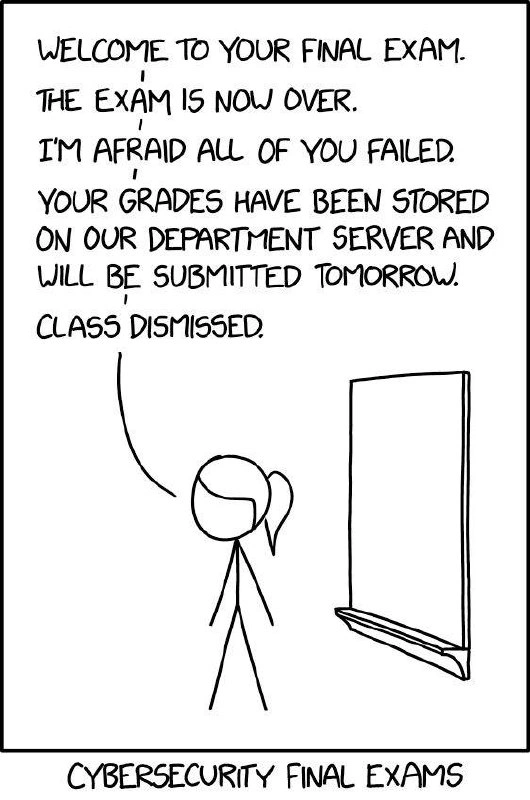
A stick-figure instructor ends class by announcing universal failure and grades stored on the department server until tomorrow. The dive reads it as a threat model—asset, integrity, adversaries, deadline—and contrasts comic implication with real rules of engagement.
Level 1: The Locked Cookie Jar
Imagine a teacher saying, “Everyone loses, and I put the real score inside a locked cookie jar until tomorrow,” then walking away. The children suddenly understand that opening the jar without being caught might be the test. That delayed realization is the funny part: the exam seems unfair and finished, but the teacher has really announced a secret challenge—and, outside a pretend classroom game, opening someone else's locked jar would still need permission.
Level 2: Scope, Servers, and Scores
A server is a computer or software service that provides data or functions to other computers. In this case, the dialogue says the grades are stored on a department server. That might mean a grade application keeps records in a database behind a web interface. The meme never shows the system itself; it shows only the instructor revealing where the important data lives and when it will be used.
The central security concept is data integrity. Cybersecurity is often explained through three goals:
- Confidentiality: unauthorized people cannot read the grades.
- Integrity: unauthorized people cannot change the grades.
- Availability: authorized people can reach the grades when needed.
The joke focuses on integrity. A student does not merely want to see a failing grade; the implied challenge is to replace it before tomorrow. Proper access control mechanisms should separate actions by role:
student  -> read own grade
teacher  -> enter or revise grades
registrar -> approve and submit records
Logging in proves an identity through authentication. Deciding what that identity may do is authorization. Confusing the two is a classic early-career lesson: “the user has an account” does not mean “the user may update every row.” Least privilege means giving each account only the minimum access required. A student account should therefore lack grade-writing permission even if it can legitimately use the same application.
Privilege escalation happens when someone with limited access gains stronger powers, such as turning a normal student session into an administrator session. Penetration testing is an authorized attempt to find weaknesses like that before a real attacker does. Security testing also includes defensive checks: verifying permission rules, trying invalid inputs, confirming logs capture changes, and ensuring backups can restore trusted data. Server hardening is the preparation that removes easy openings and limits the damage of any one mistake.
This is also why a real class needs a controlled target. In an ethical-hacking lab, the instructor might create fake grades on an intentionally vulnerable machine and tell students exactly what is in scope. They can learn reconnaissance, access control, and defensive repair without damaging real records or exposing anyone else's information. The visible instructor supplies only an implication, which is perfect comic timing and terrible authorization paperwork.
For a student encountering cybersecurity for the first time, the visual joke is a reversal of the usual exam. Instead of answering questions about defenses, the class must apparently demonstrate whether those defenses hold. Everyone initially receives the same failing result because the true answer is not on the blank board; it is hidden in the audience's realization that the server, the deadline, and the threat of failure form the actual question.
Level 3: The Real Threat Model
The exam does not truly end when the instructor says it does. It merely moves from the obvious interface—the classroom—to the implied attack surface: the department server. The visible speech quietly hands the students everything a threat model needs:
- Asset: the grade records
- Security property at risk: their integrity, meaning whether the records remain accurate and unaltered
- Target: “OUR DEPARTMENT SERVER”
- Adversaries: everyone just told “ALL OF YOU FAILED”
- Time window: before the grades “WILL BE SUBMITTED TOMORROW”
- Business motivation: unusually enthusiastic
That is why the plain stick figure and empty rectangular board are enough. No terminal, hoodie, or green cascade of fake code is necessary; the operational intelligence is already written across the top of the panel. The caption, CYBERSECURITY FINAL EXAMS, turns the teacher's apparently nonsensical announcement into an unstated practical assignment: discover whether the students can change the outcome before the deadline.
WELCOME TO YOUR FINAL EXAM. THE EXAM IS NOW OVER. I'M AFRAID ALL OF YOU FAILED. YOUR GRADES HAVE BEEN STORED ON OUR DEPARTMENT SERVER AND WILL BE SUBMITTED TOMORROW. CLASS DISMISSED.
The humor depends on two readings arriving a beat apart. On the literal reading, this is an absurd final in which failure is instantaneous and universal. On the cybersecurity reading, the instructor has announced the objective and started the clock. “Class dismissed” is effectively the starting pistol.
For an experienced security practitioner, however, the most realistic joke may be the missing rules of engagement. Ethical hacking is not made ethical by a theatrical wink; it requires explicit authorization, a defined target, permitted techniques, safety constraints, and a plan for restoring affected systems. A responsible version of this exam would run in a cyber range—an isolated, resettable environment containing synthetic student records—not on a department's actual administrative infrastructure. Otherwise the first lesson is apparently “commit an offense and hope ambiguity is a valid permission model,” which tends to produce exciting meetings with people outside the engineering department.
The implied exercise also exposes the difference between merely getting into a system and achieving an objective:
- Initial access would establish some foothold, perhaps through a weak account or vulnerable service.
- Privilege escalation would turn limited access into authority capable of changing protected records.
- Authorization bypass would defeat the rule that students may view, but not edit, their own grades.
- Persistence or evasion could keep the alteration in place until submission.
- Audit-log and backup reconciliation could still reveal or reverse the change even if the live database briefly showed a passing mark.
None of those attack paths is visible, so the meme does not claim which one works. That uncertainty is part of the challenge. A penetration test searches for exploitable weaknesses under a defined scope; a red-team exercise more broadly tests whether people, processes, and technology can detect and contain a realistic adversary. The meme borrows the objective-driven flavor of both, but its compact “change the grades by tomorrow” setup is closest to a mischievous capture-the-flag challenge.
On defense, server hardening would mean reducing unnecessary services, patching exposed software, enforcing strong authentication, separating the grade application from unrelated departmental systems, and granting each account only the permissions it needs. Yet prevention alone is not enough. Grade changes should be attributable, logged, reviewed, and recoverable. A student who somehow reaches the application database should not automatically inherit the ability to rewrite academic history; layers of role-based access, approval workflows, immutable audit trails, and protected backups make a single failure less decisive.
That layered design explains why “just hack the server” is both funny and technically incomplete. A mature system can assume that one control may fail without assuming the entire institution must fail with it. The students' apparent goal is a modified value; the defender's real goal is to prevent, detect, and recover from unauthorized modification. Even a successful edit could therefore be only the first half of a failed attack—rather like receiving full marks in the database and zero marks in the incident report.

The syllabus said closed-book, not closed-port.