
GitHub Team Mention Spam Meme Explained
A PR comment tags huge GitHub teams and gets piled with thumbs-down; a reply notes 398,463 members were notified. The dive covers team mentions, code-review etiquette, and why mass pings are the version-control reply-all.
Level 1: Accidental Fire Drill
Imagine a kid who wants to show their friend a cool drawing, but instead of just whispering to their friend, they accidentally pull the school's fire alarm. 🚨 Suddenly, the entire school – hundreds of students and teachers – stops what they're doing and rushes outside, thinking there's a real emergency. But it was just a small request that got way too loud by mistake! Everyone is annoyed and the kid feels really embarrassed. This meme is like that: the programmer wanted a quick check on their work, but they ended up alerting everyone at the company by accident. It's funny because something small turned into a huge commotion – a little oops that set off a big false alarm. 😅
Level 2: Team Mentions 101
Let's break down what's happening in simpler terms. GitHub is a platform where developers collaborate on code using a system called version control. In GitHub, you can propose changes to the code via something known as a Pull Request (PR). Think of a PR as asking, "I made some updates, can someone review these changes and add them to the main project?" Other developers then look at those changes, comment on them, and eventually approve or request modifications. This review process is what we call a code review.
In a pull request discussion, people often want certain teammates to see their comments, so they use @-mentions. Normally, you might tag an individual like @alice so Alice gets a notification and comes to take a look. But GitHub also allows tagging entire teams. The format is @Organization/TeamName. Here, the developer wrote @EpicGames/developers (and also tagged @EpicGames/artv2-admin and @EpicTeamAdmin). Within the EpicGames organization on GitHub, "developers" is likely a team that includes all developers. So mentioning @EpicGames/developers sends a notification to every single developer in that org. It's like sending a group text or email CC to thousands of people at once!
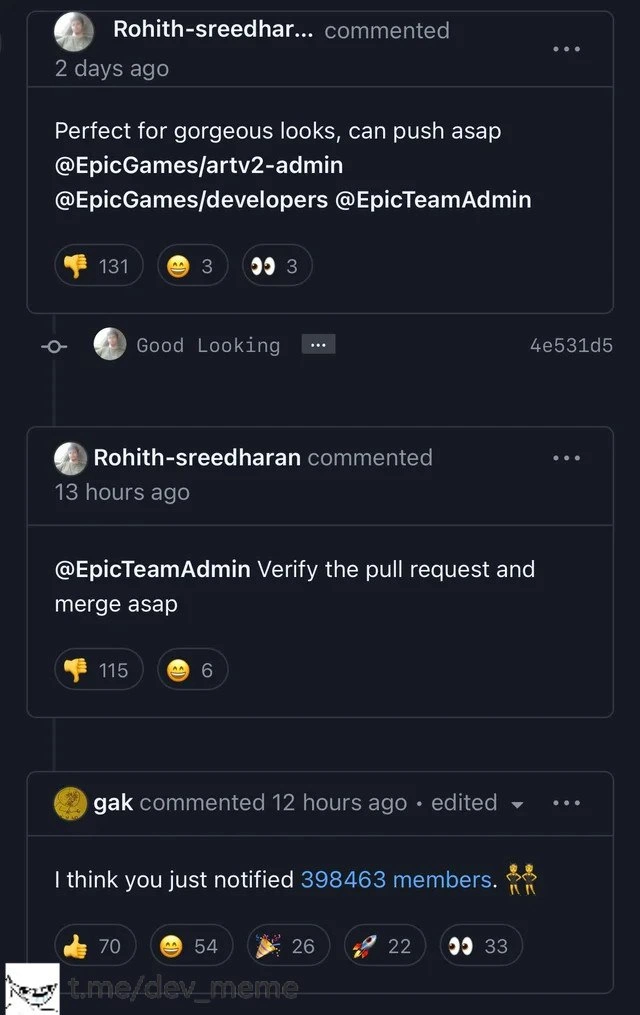
Now, imagine being one of those people. You're working on your own task and suddenly you get a notification for a pull request that you have nothing to do with. The comment says something like, "Perfect for gorgeous looks, can push asap." This isn't a critical alert or a server-down emergency; it's basically someone excited about their code change and saying it looks good and should be merged quickly. If you're one of the 398,463 developers who got pinged, you'd probably be confused: Why am I being tagged here? Then you'd feel a bit annoyed: I really didn't need to be bothered with this. That's why, in the screenshot, you see 131 thumbs-down reactions on that comment. On GitHub, instead of replying, people can react with emojis to express their feelings. A thumbs-down (👎) means they disapprove. Over a hundred people essentially said "please don't do that again" without writing a single word. A few did find it a tad amusing (there were some 😄 grins among the reactions) because it's such an over-the-top mistake, but mostly it was people saying "No, not cool."
The reply from user gak – "I think you just notified 398463 members." – is basically pointing out what happened in plain numbers. If you're new to a big company, you might not realize that those team names represent huge groups of people. This kind of mistake is a common newbie blunder in communication. It's similar to someone new in a Slack or Discord channel using @everyone without knowing it will ping all 500+ people in that channel. They usually get a swift education when lots of folks respond with, "Hey, please don't do that." In a development team, the rule of thumb is to notify only the people who actually need to see something. For a code review, that might be the specific project team or a designated reviewer – not the entire organization.
So what did we learn here? The developer in the meme was likely very eager to get his code merged ("merge asap" literally means please include my changes as soon as possible). He tried to get attention by tagging large groups, perhaps thinking it would reach whoever is in charge faster. Instead, he ended up spamming a massive audience that didn't need to be involved. It turned into a bit of an internal joke. The flood of 👎 reactions was a polite (if public) way of saying "That's not how we do things around here." In short, if you're working on a team and using tools like GitHub, remember: just because you can ping everyone doesn't mean you should. Good communication is about reaching the right people without annoying the rest. That saves you from a lot of embarrassed apologies later on!
Level 3: Org-Wide Ping Pandemonium
This meme captures the chaos of accidentally notifying an entire organization during a code review. It's a screenshot from GitHub showing a developer who commented on a pull request and used the '@' symbol to tag multiple teams: @EpicGames/artv2-admin, @EpicGames/developers, and @EpicTeamAdmin. On GitHub, if you mention a whole team like that, every member of that team (potentially thousands of people) gets a notification. So by tagging these groups, the user effectively blasted nearly 400,000 people (398,463 to be exact) with his message. It was essentially an accidental "good morning" alarm to the entire organization, delivered via GitHub notifications.
For experienced developers, this is a cringeworthy scenario. It's the CodeReviews equivalent of hitting Reply All on a company-wide email for something trivial – a cardinal sin of team communication. Tagging huge groups in a routine PR is massive overkill. Usually you only ping relevant individuals or maybe a small team responsible for that code, not the entire company (unless the building is on fire!). Using such a broad mention for a non-urgent request breaks the unwritten etiquette of code reviews. It's like using a global broadcast for a local announcement. The humor here comes from how absurdly disproportionate the action was: a simple "looks good, let's push it" comment got turned into a company-wide alert. Everyone immediately recognized this as a blunder.
The reactions from colleagues in the screenshot say it all. Over 131 people reacted with a thumbs-down emoji (👎) on that first comment – a strong collective sign of disapproval. In a professional context, that's basically hundreds of engineers going "No, please don't do that." Some also reacted with a grinning face (😄) and the eyes emoji (👀), meaning they found it funny or were just watching this spectacle unfold. By the time of the second comment (where the same person tagged @EpicTeamAdmin again to urge "merge asap"), there were still over 115 thumbs-down reactions. Then another developer, gak, responded wryly: "I think you just notified 398463 members." That remark got mixed reactions too: many found it hilarious (54 gave a laughing emoji, and even 26 threw in a 🎉 party popper to celebrate the absurdity), while 70 others still gave it a thumbs-down – probably expressing frustration that the situation happened at all. The combination of annoyance and amusement in those reactions perfectly captures the team's feelings: it's both aggravating and darkly funny.
In terms of VersionControl workflow, this incident completely overshadowed the actual code changes being discussed. Instead of focusing on the code, everyone ended up talking about the notification flood. It's a classic DeveloperHumor situation now, but also a teachable moment. Large tech organizations often have guidelines (or even restrictions) around mass notifications. For example, not everyone can use @everyone or big team tags in some company chat systems, specifically to prevent this kind of spam. A new developer might not realize how powerful a team mention is until they see something like this firsthand. This story likely became an instant cautionary tale at the company: "Remember when that dev pinged the entire org over a cosmetic update?" It's the kind of miscommunication that causes a temporary uproar and then turns into folklore. Underneath the laughter, it's a reminder that in code reviews (and any work communication), you should target your message to the right audience. Otherwise, you'll wake up the whole office for something that could have waited — and yes, everyone will know about it!
One stray @mention and the PR went from cosmetic change to Sev0 - org-wide notification DDoS on the only resource we can’t autoscale: human attention
Nothing says 'I'm ready for production' quite like accidentally DDoSing 400,000 developers' notification systems while trying to merge code for 'gorgeous looks.' This is why we can't have nice things like @everyone in Slack - imagine if GitHub had that feature
When you accidentally @mention the entire Epic Games organization in a PR comment, you don't just break the build - you break 398,463 notification badges, several Slack integrations, and any remaining goodwill with the platform team. This is the distributed systems equivalent of a reply-all email chain, except instead of annoying Karen from accounting, you've just paged every engineer, PM, and probably the CEO. The 131 thumbs-down reactions aren't just disapproval - they're a distributed consensus algorithm reaching Byzantine fault tolerance on the decision that you need better GitHub permissions training
Scaling pub/sub the Epic way: one @admin ping fans out to 398k subscribers, turning PR approval into a full-blown notification DDoS
Nothing like a ‘merge asap’ that fans out to 398,463 @mentions - a textbook layer-8 broadcast storm disguised as code review
Next time, use CODEOWNERS; @-mentioning 398,463 people turns ‘merge asap’ into a distributed denial-of-review - scaling only your email bill
zeroth
Loool
https://github.com/EpicGames/Signup/pull/24
you wont belive how much fucking spam this caused
There were 2 other PRs with the same idea after that, but they were removed in minutes
But the one in the post caused approximately 61 millions of emails
Thanks for the explanation
So it was more than 7 years until one 18 y.o. kid slammed it