
Python Multiprocessing Meme Explained
A Python docs snippet stresses that a parent only attempts to terminate daemonic children. The dive explains why process shutdown is best-effort across signals, locks, I/O, and OS process models—not a guaranteed clean exit.
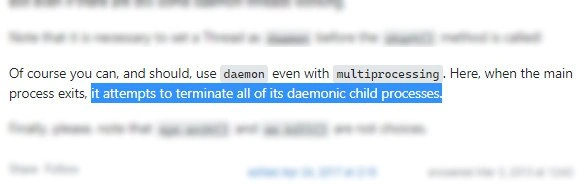
Level 1: Closing Time
Imagine a teacher says, "When class ends, I attempt to get all the students out of the room." That sounds less comforting than "everyone leaves." Some students may be stuck, hiding, or still holding the scissors. The meme is funny because the documentation uses one careful word that tells programmers, "This usually works, except when it becomes your problem."
Level 2: Child Processes Behaving Badly
multiprocessing is a Python feature for running work in separate processes. A process is like a separate running copy of a program with its own memory. A child process is started by another process, called its parent.
A daemon child process is meant to be background work that should not keep the main program alive forever. When the main process exits, Python tries to stop those daemonic children too. The meme focuses on the word attempts because "tries to stop" is weaker than "definitely stops safely." If a child process is busy, stuck, or holding something important, ending it can create SubtleBugs.
For a junior developer, this is the lesson: concurrency is not just "run more things at the same time." It also means deciding who owns shutdown, who waits for whom, what happens to unfinished work, and how errors are reported. A program with multiple processes needs an exit plan, not just a start button.
Level 3: Best-Effort Cleanup
The screenshot is funny because it looks like reassuring technical documentation until the highlighted phrase quietly opens a trapdoor:
it attempts to terminate all of its daemonic child processes.
Experienced developers know that "attempts" in docs is not filler. It means someone filed bugs. It means there are edge cases where the simple mental model failed badly enough that the wording had to become legally and technically precise. The sentence promises a best-effort cleanup strategy, not a deterministic guarantee that every child process will stop cleanly, immediately, and with all resources in a wholesome little basket.
This is exactly the kind of phrase that makes Backend and SystemsProgramming developers stare at the wall for a moment. A multiprocessing worker might be consuming from a queue, holding a database connection, writing a file, or waiting on a subprocess of its own. If the parent exits and the runtime terminates that worker, the work may stop mid-operation. Maybe that is acceptable because the worker is disposable. Maybe it means a lock remains held, a temp file survives, or half a job gets committed. The difference is architecture, not vibes.
The post's #OutOfContext label heightens the joke because the sentence is mundane in context and ominous when isolated. Technical documentation often has this flavor: one calm line that encodes years of failure modes. daemon, multiprocessing, and ProcessManagement are powerful precisely because they let programs do multiple things at once. They are also powerful in the other historical sense: they can hurt you from far away.
Level 4: SIGTERM Has Conditions
Of course you can, and should, use
daemoneven withmultiprocessing. Here, when the main process exits,it attempts to terminate all of its daemonic child processes.
The highlighted word attempts is doing a lot of systems-programming damage control. Process termination is not a pure language-level operation; it crosses into the operating system's process model, signal delivery, scheduler timing, inherited resources, file descriptors, pipes, locks, and whatever the child process was doing at the exact moment the parent decided the show was over. Python can request cleanup, but the OS and the child process still get votes, and they vote in the traditional distributed way: inconsistently, under pressure, and with logs that arrive after you needed them.
In Python's multiprocessing, a daemon process is not the same thing as a Unix daemon service. It is a lifecycle flag that says the child should not outlive the parent in the normal managed sense. That sounds tidy until reality enters. A child may be blocked in I/O, holding a lock, flushing a queue, writing to a pipe, running C extension code, or sitting between two states the parent cannot introspect safely. On POSIX-like systems, termination often involves signals such as SIGTERM, which can be handled or delayed. A harsher kill can stop the process, but it does not politely unwind Python stack frames, run finally blocks, or release application-level invariants. On Windows, process termination has different mechanics but the same emotional message: "clean shutdown" and "process no longer exists" are not synonyms.
That is why the documentation says attempts instead of "guarantees." A parent can try to terminate daemonic children, but it may not be able to ensure graceful completion, cleanup ordering, successful buffer flushing, or the fate of anything the child spawned indirectly. If the main process itself is killed abruptly, crashes, or exits during interpreter shutdown, the neat parent-child story can degrade into resource leaks, orphaned work, corrupted partial output, or a test suite that only fails when nobody is watching.



Nothing says deterministic shutdown like documentation quietly downgrading it to a best-effort syscall fanfic.
hmm let's rephrase that "it attempts to kill all of its daemonic children" based christian thread
демон != даемон
I still don't understand why darmon is used
Unless the OS can do that with a Push Notification service