
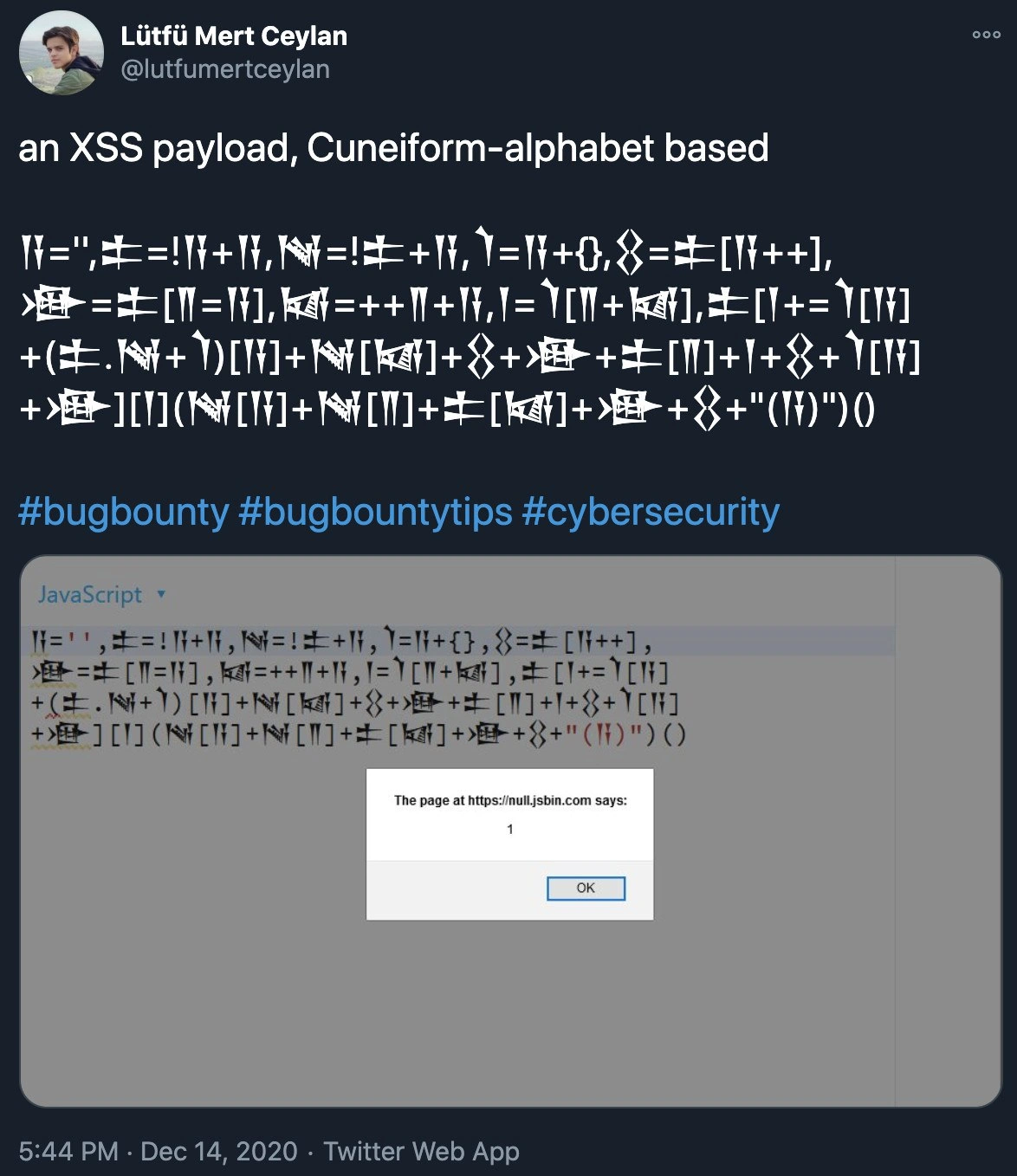
Obfuscation Level: Ancient Sumerian
Description
This is a screenshot of a tweet from user Lütfü Mert Ceylan (@lutfumertceylan). The tweet presents 'an XSS payload, Cuneiform-alphabet based,' followed by a block of code-like text composed of symbols resembling ancient Cuneiform script. Below the main tweet, an image shows the same payload within a JavaScript environment, which, when executed, triggers a browser alert box from 'null.jsbin.com' displaying the number '1'. The humor is highly technical, showcasing an extreme form of code obfuscation. It demonstrates that by using obscure but valid Unicode characters for variable names, one can create a functional, malicious JavaScript payload that is unreadable to humans and could potentially bypass security filters (WAFs) that rely on simple text-based pattern matching. This is deeply amusing to security professionals and senior developers who appreciate the cleverness of the attack vector and the esoteric knowledge of JavaScript's parser required to create it

Comments
10Comment deleted
Your WAF might block 'alert(1)', but it probably doesn't have a Rosetta Stone plugin to decode a vulnerability that was first inscribed on a clay tablet
Ten layers of CSP, a next-gen WAF, and a red teamer pops alert(1) with Neo-Assyrian variable names - turns out our entire security posture collapses if the attacker has a minor in archaeology
When your XSS payload looks like ancient Mesopotamian tax records, you know you've reached peak obfuscation - because nothing says 'harmless user input' quite like 4000-year-old accounting symbols that just happen to execute JavaScript
When your WAF blocks every known XSS pattern, so you reach back 5,000 years to Mesopotamian scribes for inspiration. Nothing says 'modern web security' quite like exploiting Unicode normalization with cuneiform wedges - because apparently, input sanitization wasn't on the Code of Hammurabi. The real question: did the security team's threat model account for attacks written in the world's oldest writing system, or did they assume attackers would stick to ASCII like civilized people?
When your WAF masters JS but folds to 5000-year-old wedges - Unicode normalization remains the unsung hero of web sec
Your CSP and sanitizer both passed audits - right up until someone wrote alert(1) in cuneiform and every ASCII‑only regex waved it through
Blocked <script>, forgot UTS#39; attacker used JSFuck‑style cuneiform confusables to pop alert(1). Nothing like a P1 from 3200 BCE to modernize your CSP
Too bad copypasting that cuneiform code into Telegram results in this: 𒀀='',𒉺=!𒀀+𒀀,𒀃=!𒉺+𒀀,𒇺=𒀀+{},𒌐=𒉺[𒀀++], 𒀟=𒉺[𒈫=𒀀],𒀆=++𒈫+𒀀,𒁹=𒇺[𒈫+𒀆],𒉺[𒁹+=𒇺[𒀀] +(𒉺.𒀃+𒇺)[𒀀]+𒀃[𒀆]+𒌐+𒀟+𒉺[𒈫]+𒁹+𒌐+𒇺[𒀀] +𒀟][𒁹](𒀃[𒀀]+𒀃[𒈫]+𒉺[𒀆]+𒀟+𒌐+"(𒀀)")() Comment deleted
But hey, at least you can copy-paste this text above into a browser console and will still work there. Comment deleted
Well once you are in JavaScript context, XSS is quite easy, the real issue is how to get there, isn't it? Comment deleted