Programming Jokes vs. Actual Programming
Why is this MentalHealth meme funny?
Level 1: Comics vs Homework
Imagine you’re reading a funny comic about a kid who has to do homework. In the comic, the kid is making silly jokes and you’re laughing at how goofy it is. That’s like the first part of the meme – having fun with jokes about something hard. Now think about what happens when you put the comic down and actually have to do your own homework. Suddenly, it’s not funny anymore, right? You’re sitting there with your math book or chores, and your smile disappears. The work is frustrating and you’d rather be laughing at the comic.
That’s exactly what this meme is showing with coding. Laughing at programming jokes is the fun part – like enjoying a cartoon making fun of homework. But programming for real is like doing the actual homework: it can be difficult and wipe the smile off your face. The meme is funny because everyone understands that feeling of going from a happy, laughing mood to an “uh-oh, now I have to actually do it” mood. It’s the difference between having fun and doing hard work, all captured in two simple pictures.
Level 2: Meme Hangover
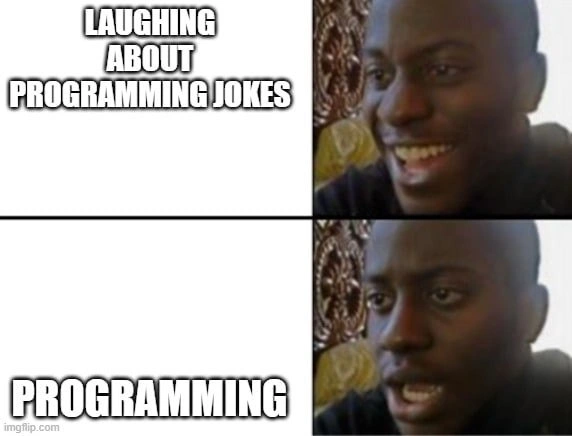
This meme uses a popular expectation_vs_reality format to highlight a common developer experience: having fun with programming jokes, then facing real programming. In the image, a man’s expression goes from very happy in the top frame to utterly disappointed in the bottom frame. The top caption, “LAUGHING ABOUT PROGRAMMING JOKES,” represents the expectation – how enjoyable it is to read and laugh at coding memes. The bottom caption, “PROGRAMMING,” represents the reality – the moment you actually start coding and encounter frustration. It’s like the meme is saying: “Joking about code is fun, but writing code is a different story.” That sudden mood change is the punch line every coder can relate to.
Let’s break down why this hits home for developers, even those early in their career. When you’re browsing DevCommunities (developer communities on Reddit, Twitter, or Slack groups), you find tons of DeveloperMemes filled with insider jokes. For example, someone might post a joke about JavaScript quirks (0 == "0" is true, but 0 == [] is also true – weird, right?). You laugh because it’s absurd and you’ve maybe seen it before. This is developer humor – jokes that poke fun at the oddities and pain points of coding. It feels good to laugh because it means you’re not alone; other developers struggle with the same issues. That’s what we call a relatable developer experience: shared situations that almost every programmer has encountered, like the infamous “missing semicolon” error or a server going down because of a single config mistake. These are developer in-jokes – if you code, you get it instantly.
Now compare that to actual programming work. When you switch from meme-browsing to your code editor, it’s a harsh wake-up call – a “meme hangover.” Instead of funny one-liners, you’re staring at real compiler errors or a failing unit test. Compiling is the process where your source code is translated into machine code; if there’s a mistake in your syntax, the compiler spits out error messages. Those messages are rarely fun to read – often they’re confusing or overly verbose. Debugging, another key term, is what you do when your program isn’t working correctly: you have to find the bug (the mistake or error in the code) and fix it. This can mean stepping through code line by line, or printing out values to see where things went wrong. It’s often a slow, painstaking process. For a newcomer, imagine hitting “run” and the program just crashes or prints nonsense – now you have to figure out why. Not so entertaining, right?
The meme’s second panel with just “PROGRAMMING” conveys that feeling of dread or tedium when you realize how much work coding can be. It brings to mind all those times something didn’t work and you had to slog through stack traces (the lists of function calls that show where a program error happened) to diagnose the issue. In real life, programming involves a lot of trial and error. You write code, it breaks, you Google the error (maybe end up on Stack Overflow, ironically the site known for both Q&A and plenty of humorous posts), and you try again. Even tasks you expect to be simple can turn into headaches due to developer pain points like environment setup issues (“It worked on my machine, why not on the server?”), version conflicts, or mysterious crashes.
DeveloperExperience (DX) is a term for how smooth or enjoyable a developer’s work process is. Funnily enough, memes emphasize when DX is poor – because that’s when we create jokes to cope. If compiling, debugging, and deploying were always seamless, we’d have fewer memes to laugh at. But reality often involves wrestling with code. “Shipping code” means delivering your finished program or feature to users (deploying it to production). That is often the tensest moment – you’re crossing fingers that everything works in real-world use. A popular meme might joke “I don’t always test my code, but when I do, I do it in production,” which makes us laugh. But no junior developer wants to be in the hot seat pushing untested code live – it’s terrifying! When the meme’s bottom says “PROGRAMMING,” it’s summing up that serious side: the responsibility, the complexity, and the frustration of actual coding tasks, which stand in stark contrast to the lighthearted jokes. In short, the meme is very relatable: it’s fun to laugh at our craft, but behind every joke is a barrage of real bugs and errors we’ve all had to face.
Level 3: Expectations vs Exceptions
The meme perfectly captures the whiplash every developer feels switching from enjoying DeveloperHumor to the reality of Programming. In the first panel, our guy is grinning ear-to-ear at some hilarious coding joke on a dev forum or Slack channel. That joy is short-lived. In the very next moment – the second panel – he’s staring in deadpan disappointment at the actual code editor, realizing he now has to tackle real programming problems. This expectation vs. reality gag is painfully accurate. One minute you’re chuckling at a witty meme about a NullPointerException, the next minute your own code throws one, and suddenly nobody’s laughing.
Seasoned engineers know this contrast all too well. We thrive on DevCommunities where people share inside jokes about common developer pain points, like naming things, off-by-one errors, or the classic “It works on my machine” excuse. These jokes are funny precisely because they’re true – they reflect everyday struggles in software development. Scrolling through a subreddit full of CodingHumor or poking fun at messy legacy code on Twitter can be a huge stress relief. It’s a quick dopamine hit: “Haha, I’ve been there. Production outage because of a missing semicolon – what a riot!” But then reality hits: you tab back into your IDE, and there it is – that bug you’ve been chasing for 3 hours, still unsolved, wiping the smile right off your face. The punch-line becomes a painful truth as you grapple with the messy grind of compiling, debugging, and shipping code.
Why is this so relatable? Because programming in practice is hard. Writing software means constantly encountering unexpected exceptions – both the thrown kind in code and the situational kind in life. You might laugh at a meme about Git merge conflicts, but when you actually have a tangled merge conflict destroying your Monday, it’s not comedic at all. The meme’s second panel just says “PROGRAMMING” in bold, as if that single word is enough to summon memories of all-nighters and coffee-fueled debugging sessions. It’s the blank, shell-shocked stare of someone who just realized the code that was supposed to run in `$O(n \log n)$ time is actually choking the server. The humor comes from truth: real programming often feels like firefighting, full of developer frustration.
This “laugh now, cry later” dynamic is a well-known relatable developer experience. Senior devs have a term for it: gallows humor. We joke about the absurdity of our work to stay sane. The meme nails it with a simple two-panel before-and-after. The left side (expectation) is all fun and games – the idealized moments where coding is just memes and high-fives. The right side (reality) is the war zone of production bugs, cryptic error messages, and technical debt that hits back. Every experienced engineer has lived this: you enjoy a quick XKCD comic about SQL injections, and minutes later you’re knee-deep sanitizing inputs because your app is throwing mysterious database errors. The contrast is hilariously brutal. As the Cynical Veteran coder in me would say: “Welcome to programming – where the jokes are funny because the reality isn’t.”
Description
A two-panel meme using the 'Disappointed Black Guy' or 'Smiling/Worried Black Guy' format. The top panel features the text 'LAUGHING ABOUT PROGRAMMING JOKES' next to an image of a man smiling brightly and looking amused. The bottom panel shows the same man, but his expression has changed dramatically to one of shock, concern, and distress, with the single word 'PROGRAMMING' next to him. A watermark for 'imgflip.com' is visible in the bottom left corner. The meme humorously captures the stark contrast between the fun of sharing jokes about the software development profession and the often stressful, frustrating, and difficult reality of the work itself. It's highly relatable to seasoned developers who understand that the humor is a coping mechanism for the daily struggles of debugging, system complexity, and pressure

Comments
8Comment deleted
Joking about programming is a pure, stateless function. Actually programming is a legacy distributed monolith with race conditions, intermittent memory leaks, and a surprisingly high rate of existential exceptions
Reading dev memes: “There are only two hard problems - cache invalidation and naming things.” Doing the actual work: discovering the undocumented third - explaining to finance why we spent six figures on Kafka for exactly-once semantics we still don’t have
The moment you realize those 'it works on my machine' jokes aren't jokes anymore - they're incident reports waiting to happen, and you're the one who approved the PR that shipped the containerized version of 'my machine' to production
We've all been there: upvoting Stack Overflow jokes about recursion while our own recursive function is still stack overflowing in production. It's easier to laugh at 'undefined is not a function' memes than to debug why your carefully architected microservice is returning undefined at 3 AM. The real irony? We spend more time curating our collection of programming memes than we do writing unit tests - and somehow both feel equally productive
We laugh at microservices memes, but those monolith merges at 2 AM? That's the real tearjerker
Memes are O(1) dopamine; programming is O(n) yak‑shaving where n equals your unpinned transitive dependencies plus flaky CI steps
Programming jokes are idempotent; programming is the side effect that pages you at 2 a.m. via PagerDuty
> else Heart.Break() Comment deleted