
The White House's Fleeting Endorsement of Memory-Safe Languages
Description
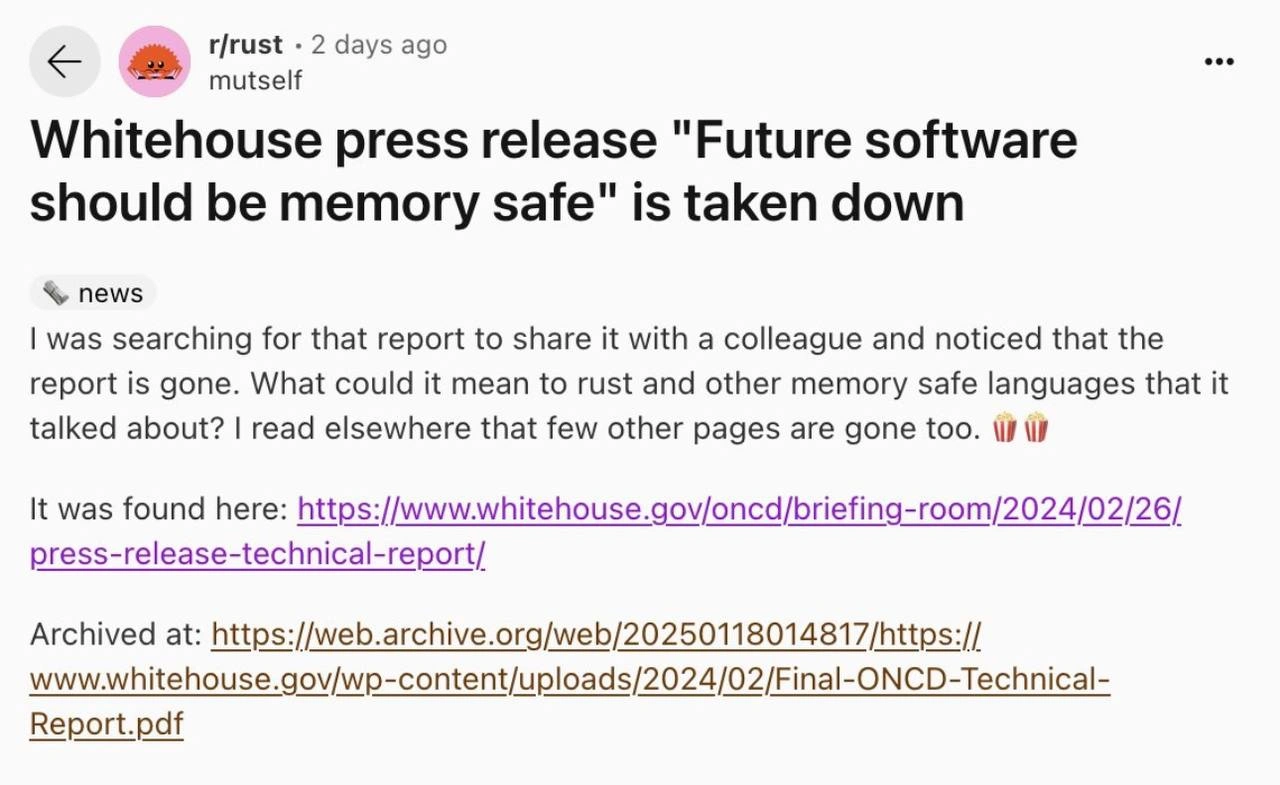
A screenshot of a Reddit post from the r/rust subreddit, titled 'Whitehouse press release "Future software should be memory safe" is taken down'. The post, flaired as 'news', expresses the user's confusion upon discovering that an official White House report advocating for memory-safe programming languages has been removed from the website. The user questions the implications for Rust and similar languages. To aid others, the post includes the original, now-broken whitehouse.gov URL and a working link to an archived version of the report on the Internet Archive's Wayback Machine. The technical relevance and humor come from the sudden, unexplained disappearance of a significant government endorsement for modern, memory-safe languages like Rust. For senior developers, this sparks immediate speculation about industry lobbying (e.g., from proponents of C/C++), political maneuvering, or simple bureaucratic incompetence, turning a piece of tech policy news into a minor conspiracy


Comments
50Comment deleted
Turns out the government's memory safety policy had a dangling pointer and was promptly deallocated
The White House free()’d the memory-safety PDF, instantly dereferencing every link; Rustaceans just wrapped it in an Arc<Wayback> and kept the program - er, policy - alive
The White House discovered that even government websites aren't immune to memory leaks - they just lost an entire document about memory safety. At least someone had the foresight to malloc() a copy on the Internet Archive before the garbage collector kicked in
Nothing says 'memory safe' quite like a government report that gets deallocated without proper cleanup. At least someone had the foresight to archive it before the URL became a dangling pointer - though I suspect the White House's version control strategy is still 'email attachments with timestamps in the filename.'
White House memory-safety report: allocated fanfare, then use-after-free on the hosting - dangling link detected
Nothing says “embrace memory safety” like free()’ing the press release and leaving the internet with a dangling pointer to policy - good thing the Wayback Machine runs a global GC
White House pulled the “memory‑safe software” page - textbook use‑after‑free: policy deallocated, link left dangling; good thing the Wayback Machine is the nation’s append‑only log
Lmao, fuck rust Comment deleted
yeah, ML-family/haskell and lisps are better Comment deleted
it's still there https://bidenwhitehouse.archives.gov/oncd/briefing-room/2024/02/26/press-release-technical-report/ Comment deleted
why didn't they mention their own language? imo ada is better than rust Comment deleted
it is nice in type restrictions but clunky at syntax level Comment deleted
i like its syntax more than rust's Comment deleted
verbosity is good when controlled, not to the Pascal or Zig extreme Comment deleted
i like pascal's syntax Comment deleted
survivorship bias Comment deleted
wdym? Comment deleted
zig is verbose? Comment deleted
in non-syntax way Comment deleted
okay, from implementation perspective? Comment deleted
bleeding edge software all the way Comment deleted
Use Holy C, my child Comment deleted
TempleOS Comment deleted
You have to be pure to use that Comment deleted
Sweet, back to C and dubious strcpys! Comment deleted
The report was archived because every administration restarts the WH's site, but it is still applicable until further notice. Comment deleted
Did Trump mean that Rust is gay? 🤔 Comment deleted
More like nay Comment deleted
You can totally write memory safe software in C. Right? Comment deleted
Can, didn't mean it's easy to Comment deleted
with workarounds like MISRA and formal verification, and almost no one does this. languages like rust do this for you with some easy checked rules that are hoped to be sound, languages like ats and f* make formal verification of low-level code built-in Comment deleted
Yes Comment deleted
you can but you won't Comment deleted
We don't increase cpu instructions anymore. Even we go opposite (RISC). Software will fill the gap. I think the C is the software RISC Ai+C will go through them all Simplicity is key for both human and mashine Comment deleted
it is called skill. if you have it you totally can Comment deleted
While it's theoretically possible to write memory safe programs in C, years of security vulnerabilities have proven that nobody has enough skill to do so for complex programs Comment deleted
C is just a little bit better assembly. There's no need for it to care about memory safety Comment deleted
eh, well… mabe not that low-level Comment deleted
C is neither portable nor assembly 😭 stop with this propaganda Comment deleted
so we pretend that embellishment of memory issues is not propaganda? Comment deleted
the CVE list speaks for itself Comment deleted
https://xeiaso.net/shitposts/no-way-to-prevent-this/CVE-2024-12084/ Comment deleted
It is right to mention these threats. But the proposal suggests to find a way to totally eliminate them in the future which is same as cutting off your arm Comment deleted
or, hear me out, using an approach that eliminates 99% of these threats without cutting off your arm Comment deleted
just use gayer language Comment deleted
you don't need to bury your head in the sand and ignore existing solutions Comment deleted
To brand the entirety of IT industry as a cult that secretly hides that 1% as a forbidden knowledge? Comment deleted
...literally what are you talking about Comment deleted
do I not know English? do you not know English? Comment deleted
it's not forbidden, just lost. reinventing the wheel is not an illusion and it's oftentimes related to lost tech known decades ago Comment deleted