
Memory Safe Software Policy Meme Explained
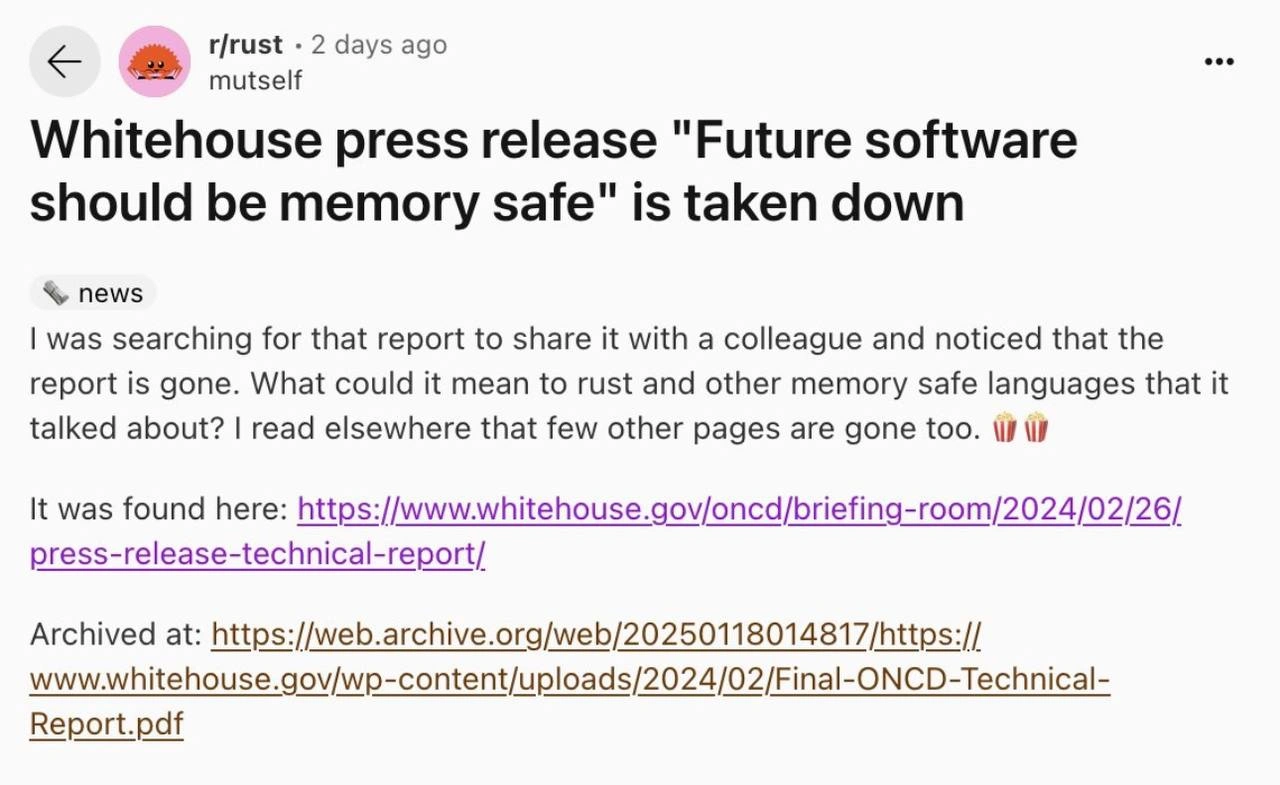
An r/rust post notes the White House “Future software should be memory safe” press release is gone, then links the Wayback snapshot. The dive explains memory safety, Rust’s borrow checker, and the ironic use-after-free of official security policy.
Level 1: The Missing Safety Sign
Imagine your school principal put up a big poster in the hallway saying, “From now on, everyone should use safety scissors so nobody gets hurt.” It’s a clear safety rule meant to protect everyone. All the kids who’ve been cut by sharp scissors before (let’s call them the experienced kids) nod and think, “Great idea! That’ll prevent a lot of accidents.” But the next day, that poster mysteriously disappears from the wall. Now everyone is whispering and curious: why was the safety sign taken down? Did someone not like the rule? Was it a mistake? The kids who really care about scissor safety are especially interested – they even saved a picture of the poster and are passing it around so people know what it said. They’re like, “We have the receipts! See, the principal did say this!” They’re also eating popcorn like they’re about to watch an exciting movie, because this little mystery is unfolding. In simple terms, the meme is funny because it’s like a important safety message went up and then vanished, and all the onlookers (in this case, programmers who care about safe code) are eagerly watching to see what happens next.
Level 2: Seatbelts for Software
Stepping back, let’s explain what all this means. Memory safety is a term in programming that means a language or program is designed so you can’t accidentally mess up how memory is used. Why does that matter? Because a huge number of software bugs and security holes come from memory misuse. For example, in languages like C or C++, a programmer manually manages memory: you can allocate space, use it, then free it. But if you’re not super careful, you might do things like write beyond the allotted space (buffer overflow), or keep using a piece of memory after you gave it up (use-after-free). These mistakes can lead to program crashes or, worse, hackers taking control of a system. It’s like not wearing a seatbelt – most of the time you might be fine, but if something goes wrong, it goes really wrong. MemoryManagement bugs have been responsible for many security nightmares (viruses exploiting them to run malicious code).
Memory-safe languages come with built-in “seatbelts.” Languages like Rust (and also Java, C#, Go, etc. in their own ways) prevent those mistakes by design. Rust, in particular, has a special system of rules (the ownership and borrowing system, enforced by the compiler’s famous borrow checker) that makes it nearly impossible to compile code with those risky errors. In safe Rust, if you try to do something like access memory that’s not valid, the code just won’t compile. Other languages might handle it by automatically cleaning up memory (garbage collection in Java or Go) so the programmer doesn’t accidentally misuse freed memory. All of this falls under SecureCodingPractices – writing code in a way that avoids known pitfalls. Using a memory-safe language is now considered a Security Best Practice because it removes an entire category of common vulnerabilities.
Now, what’s the deal with the White House and Rust here? Well, apparently the White House (specifically the Office of the National Cyber Director, ONCD) put out a press release or report saying something like “Future software should be memory safe.” That’s a pretty direct way of telling industries: “Hey, maybe use Rust or other safe languages for new projects, so we get fewer cyber attacks.” This made a lot of developers (especially fans of Rust) very happy and excited – it’s not often that the government acknowledges specific tech solutions like that. The post we see in the meme is from a user on the Rust subreddit (r/rust) who noticed that this press release page on the White House website suddenly went missing. They tried to find it to show a colleague, only to get a dead link. The body text of the Reddit post even provides the link where it “was found” and an archived copy. The popcorn emojis 🍿🍿 in their message mean they’re watching curiously, like it’s an entertaining mystery or drama. Essentially, the Rust community member is saying, “The White House said something great about memory-safe programming, and now it’s gone. Interesting... grab your popcorn.” They also quickly share the Web Archive link – a snapshot of the page from an earlier date – so others can read the content even though the official page is down. This is pretty common in developer circles: we use the Internet Archive as a backup when things disappear (whether accidentally or intentionally).
For a junior developer or someone new to this: it’s a mix of tech and a bit of politics. The government showing interest in a programming topic (memory safety) is noteworthy. Rust is a language celebrated for safety, so its community is naturally invested in the story. The disappearance of the report raises eyebrows – maybe it’s just a website reorganization or glitch, or maybe someone had second thoughts about how the message was delivered. In any case, the Rust folks are following it closely, half for serious reasons (it could influence industry trends) and half in good humor (the situation has a whiff of conspiracy, which is always intriguing). And now you know: memory safety is about preventing those nasty bugs, Rust is a champion of it, and a missing White House page can become prime popcorn material on Reddit.
Level 3: Use-After-Free Press Release
At a high level, the humor comes from just how on the nose this scenario is. The White House said “Future software should be memory safe” – a strong endorsement of what many senior devs have preached for years – only for that press release itself to vanish from the website. For seasoned developers, this is irony served on a silver platter. It’s like a classic use-after-free bug in real life: the pointer (URL) to that important document now leads to freed memory (a 404 page). And what do engineers do when a vital resource disappears? They check the web.archive.org backup faster than you can say Segmentation fault. In the meme, the Redditor provides an archived link immediately, which is our community’s equivalent of a safety net (or maybe a smart pointer?) to prevent total loss. The Rust subreddit crowd responded with 🍿 popcorn emojis – basically saying “We’re just here, watching this intriguing drama unfold.” It’s a form of lighthearted suspense, as if everyone’s waiting to see if this removal is a bureaucratic glitch, a policy backtrack, or some conspiracy involving Big C++ 😏.
From a senior developer’s perspective, there’s a mix of cynicism and validation here. On one hand, memory bugs (buffer overflows, null dereferences, heap corruptions) have caused countless security incidents – anyone who’s trudged through CVE lists knows that ~70% of critical vulnerabilities in systems like Windows or Chrome trace back to memory safety issues. The White House essentially acknowledged this reality, pushing for languages that eliminate these flaws by design (hello Rust, and also 🖐️ hello to others like Swift, Go, or even Java in some contexts). This felt like a long-awaited win for advocates of SecureCodingPractices: finally, an official mandate to stop writing million-dollar infrastructure in C with its perilous pointers. So the report’s disappearance is comically deflating. Cue the rustaceans grabbing popcorn – not because memory safety is a joke, but because they’re invested in it and find the situation darkly amusing. It’s relatable: in big organizations or governments, you sometimes see bold tech initiatives announced and then quietly retracted. Maybe some lobby or internal group hit the brakes, or an official version 2.0 is imminent. The Rust community’s glee (“Did they really memory-hole a memory safety memo?”) shows their mix of pride and amusement. Pride that their niche focus (like RustLanguageFeatures – the borrow checker, ownership) reached White House levels, and amusement that the rollout is hitting snags. It’s an inside joke about how change in tech, even when obviously for the better, often faces mysterious pushback.
There’s also a playful poke at government IT itself. Removing a page called “Future software should be memory safe” immediately triggers the thought: maybe someone forgot to allocate enough memory for the website, or a legacy script free()d the page because it was written in PHP (just kidding, PHP doesn’t exactly do that 😅). The situation exemplifies “we can have nice things, but hold on, maybe not yet.” And as any experienced dev knows, when something disappears, you check the logs (or in this case, the Wayback Machine log). The Rust subreddit turning up with archived proof is a bit like a QA team catching a bug red-handed. It’s communal accountability: “We saw you endorse memory safe languages, you can’t just quietly remove that without us noticing.” In essence, the meme satirizes both the enthusiasm around modern languages for security, and the chaos of policy execution – a combination that senior devs find both funny and frustratingly familiar.
Level 4: Borrow Checker Goes to Washington
At the most technical layer, this meme touches on the deep mechanics of memory safety and how it’s become a national concern. Think of the White House press release as an official nod to the kind of rigorous guarantees provided by languages like Rust. Rust’s core innovation – the borrow checker enforcing strict ownership and lifetimes – essentially performs a form of compile-time model checking to prevent memory errors. This is a big deal: it means certain classes of bugs (buffer overflows, use-after-free, double frees, data races) are mathematically ruled out in safe Rust code. Such bugs, often born from manual memory management in C/C++, have plagued software security for decades. In formal terms, Rust’s type system ensures spatial memory safety (no out-of-bounds access) and temporal memory safety (no use of freed memory) without a garbage collector. The White House report effectively elevates this CS theory to policy, implying future secure coding practices should leverage these advances in language design. It’s as if the US government said, “Our national Security strategy now involves better programming language semantics.” That’s huge: a recognition that SecureCodingPractices at the language level (like Rust’s ownership model or other MemoryManagement innovations) can mitigate real-world threats.
From a historical perspective, this moment echoes past efforts to eradicate entire bug classes through technology. The ONCD technical report (Office of the National Cyber Director) was advocating that developers and organizations move towards memory-safe languages – a conclusion drawn from countless exploits originating in memory-unsafe code. In academic circles, this aligns with decades of research in type safety and formal verification. It’s grounded in the idea that we can prove certain program properties (like memory safety) ahead of time. For example, Rust’s design was influenced by research on affine types and borrowed references – these ensure you can’t reference memory that’s gone out of scope (no dangling pointers). By pulling down the report, it’s as if someone hit the abort on an important thread. The context here hints at a clash between ideal technical policy and messy reality. One might mischievously compare the vanished report to a dangling pointer in policy memory: a reference to progress that suddenly doesn’t point anywhere on the official site. It underscores a theoretical truth – even outside of code, memory_safe_policy needs persistence or you risk a real-world "GC" (garbage collection) eliminating crucial guidance.
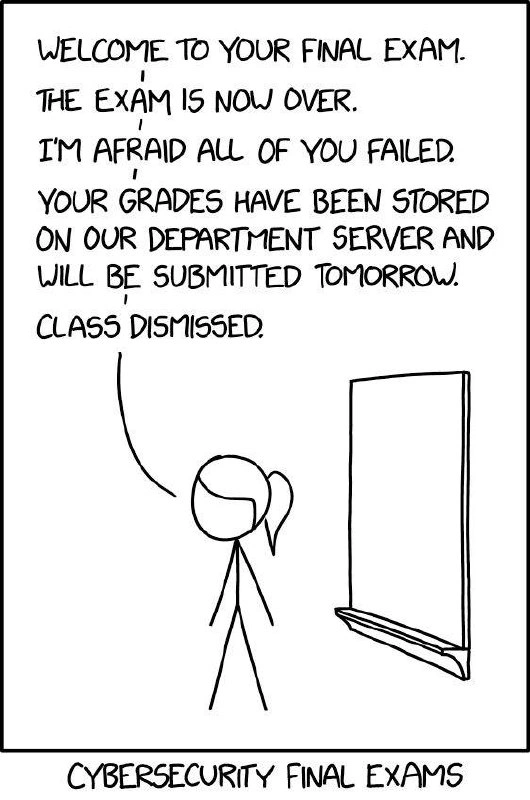
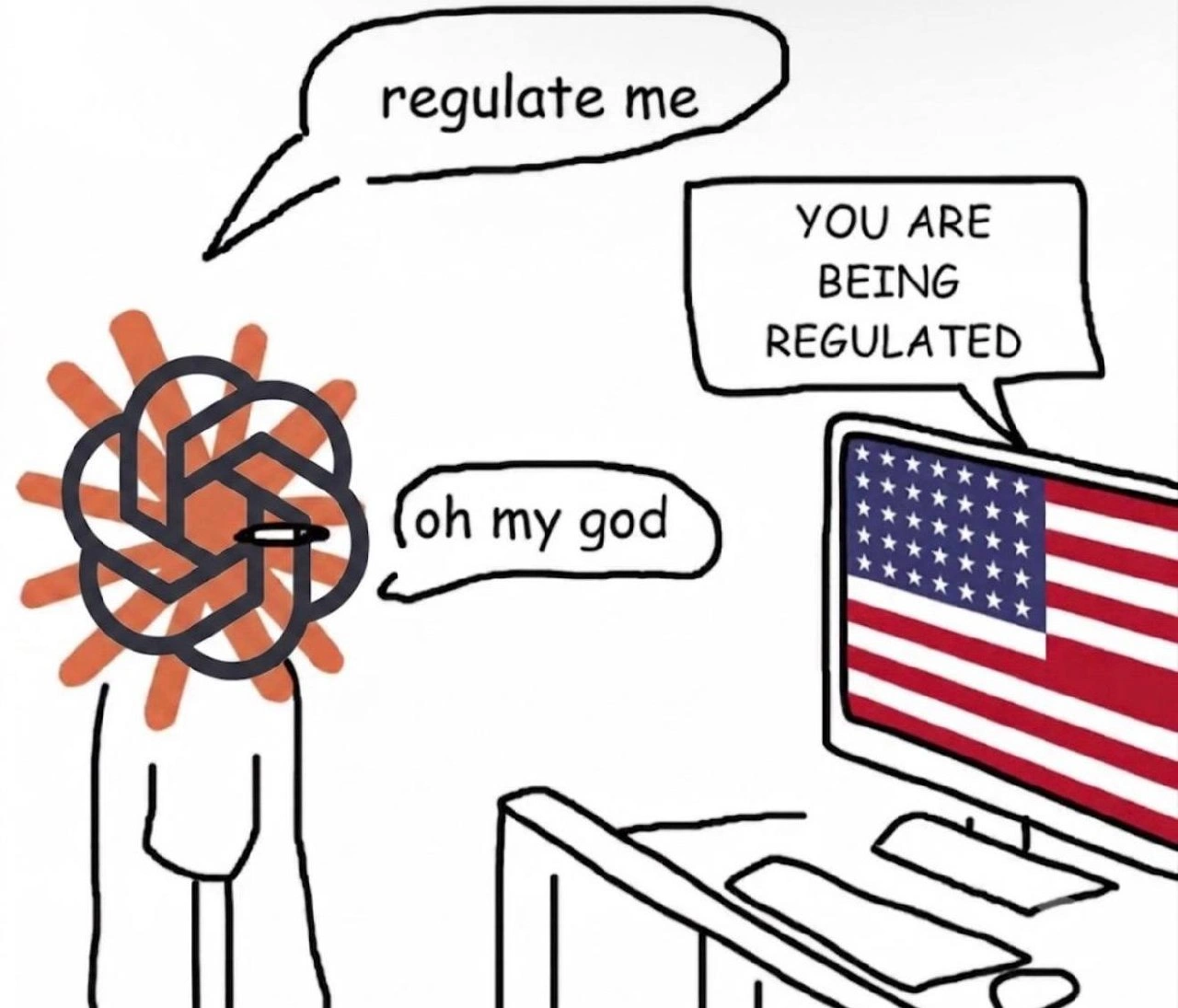

Turns out the government's memory safety policy had a dangling pointer and was promptly deallocated
The White House free()’d the memory-safety PDF, instantly dereferencing every link; Rustaceans just wrapped it in an Arc<Wayback> and kept the program - er, policy - alive
The White House discovered that even government websites aren't immune to memory leaks - they just lost an entire document about memory safety. At least someone had the foresight to malloc() a copy on the Internet Archive before the garbage collector kicked in
Nothing says 'memory safe' quite like a government report that gets deallocated without proper cleanup. At least someone had the foresight to archive it before the URL became a dangling pointer - though I suspect the White House's version control strategy is still 'email attachments with timestamps in the filename.'
White House memory-safety report: allocated fanfare, then use-after-free on the hosting - dangling link detected
Nothing says “embrace memory safety” like free()’ing the press release and leaving the internet with a dangling pointer to policy - good thing the Wayback Machine runs a global GC
White House pulled the “memory‑safe software” page - textbook use‑after‑free: policy deallocated, link left dangling; good thing the Wayback Machine is the nation’s append‑only log
Lmao, fuck rust
it's still there https://bidenwhitehouse.archives.gov/oncd/briefing-room/2024/02/26/press-release-technical-report/
bleeding edge software all the way
Use Holy C, my child
Sweet, back to C and dubious strcpys!
The report was archived because every administration restarts the WH's site, but it is still applicable until further notice.
Did Trump mean that Rust is gay? 🤔
You can totally write memory safe software in C. Right?
We don't increase cpu instructions anymore. Even we go opposite (RISC). Software will fill the gap. I think the C is the software RISC Ai+C will go through them all Simplicity is key for both human and mashine
it is called skill. if you have it you totally can
While it's theoretically possible to write memory safe programs in C, years of security vulnerabilities have proven that nobody has enough skill to do so for complex programs