
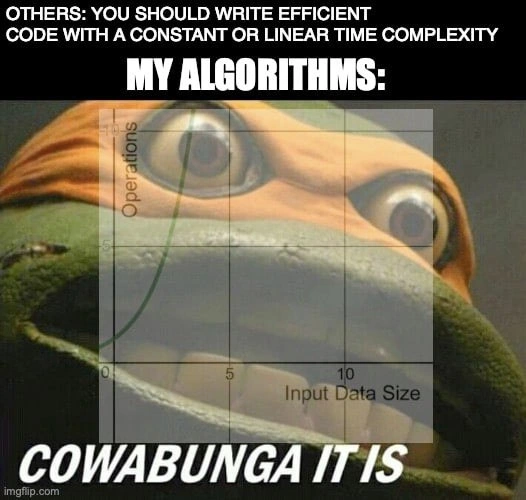
When Your Algorithm's Time Complexity is 'Cowabunga'
Description
This is a meme featuring a close-up, intense-looking face of Michelangelo from Teenage Mutant Ninja Turtles. The top text reads, 'OTHERS: YOU SHOULD WRITE EFFICIENT CODE WITH A CONSTANT OR LINEAR TIME COMPLEXITY'. Below this, 'MY ALGORITHMS:' is written. Superimposed over the turtle's face is a graph showing exponential growth, with the y-axis labeled 'Operations' and the x-axis 'Input Data Size'. The curve rises sharply, indicating a highly inefficient algorithm. The bottom text emphatically states, 'COWABUNGA IT IS'. The meme humorously contrasts the recommended best practice of writing efficient code (O(1) or O(n)) with the reckless reality of implementing an algorithm with terrible, exponential time complexity (like O(2^n) or O(n!)), embracing the resulting chaos with the turtle's signature catchphrase



Comments
12Comment deleted
Some developers aim for O(n log n). My latest creation is O(OMG), where the complexity is directly proportional to the amount of screaming from the SRE team
I told the team our new feature is O(2^n); product loved the roadmap, finance loved the n=5 demo, and now AWS loves us so much they’re sending personalized thank-you invoices
After 15 years of optimizing distributed systems, you finally achieve O(log n) complexity everywhere... then the junior's PR adds a recursive setTimeout inside a forEach loop, and suddenly you're explaining why the AWS bill looks like a phone number
When your algorithm's time complexity curve looks like a hockey stick and your production data just hit the inflection point, but the sprint's already over and you've moved on to the next feature. Sure, it works fine with the 10 test records in dev - who could have predicted users would actually *use* the system at scale?
I call it amortized exponential: O(1) during the demo, O(2^n) by Q4
Big-O: O(1) on the whiteboard, O(n^2) in the repo, O($$$) on the cloud bill
O(n) on whiteboard, O(2^n) in prod - the true ninja way to scale your tech debt exponentially
n^(e^e) Comment deleted
Write algorithms with complexity N! N!! N!!! Carl! Comment deleted
🌚🌚🌚 «N!»? Comment deleted
https://en.wikipedia.org/wiki/Factorial Comment deleted
gitlab.com/bit9tream/kfib Comment deleted