Skip to content
DevMeme
7193 of 7435
O(n²) That Works vs O(n log n) Nobody Can Maintain
CS Fundamentals Post #7888, on Apr 3, 2026 in TG

O(n²) That Works vs O(n log n) Nobody Can Maintain

Why is this CS Fundamentals meme funny?

Level 1: The Fancy Knot

Imagine two ways to tie your shoes. The first is the ordinary bunny-ears knot: a little slow, a little loose, but everyone in the family can untie it and retie it. The second is a magnificent sailor's knot your uncle learned overseas — stronger, faster, gorgeous — except he's the only person on Earth who can undo it, and he moved away. Now your shoe is technically better tied and practically welded shut. The joke is that programmers constantly choose the magnificent knot to show off, and the caption — "good luck maintaining it" — is everyone else in the family looking at the shoe.

Level 2: Decoding the Notation

  • Big O notation describes how an algorithm's cost grows as input size n grows. It ignores constants and machines — it's about the shape of growth.
  • O(n²) ("quadratic"): doubling the input quadruples the work. Classic source: a loop inside a loop — comparing every item against every other item. Easy to write, easy to read, brutally slow on large inputs.
  • O(n log n): dramatically better growth — it's the complexity of efficient sorting algorithms like merge sort. For a million items, n² is a trillion operations while n log n is around twenty million. Real difference, when n is actually a million.
  • Maintainability: how easily someone other than the author can read, fix, and extend the code. Industry reality: code is read perhaps ten times for every time it's written, so optimizing for readers usually beats optimizing for the CPU.
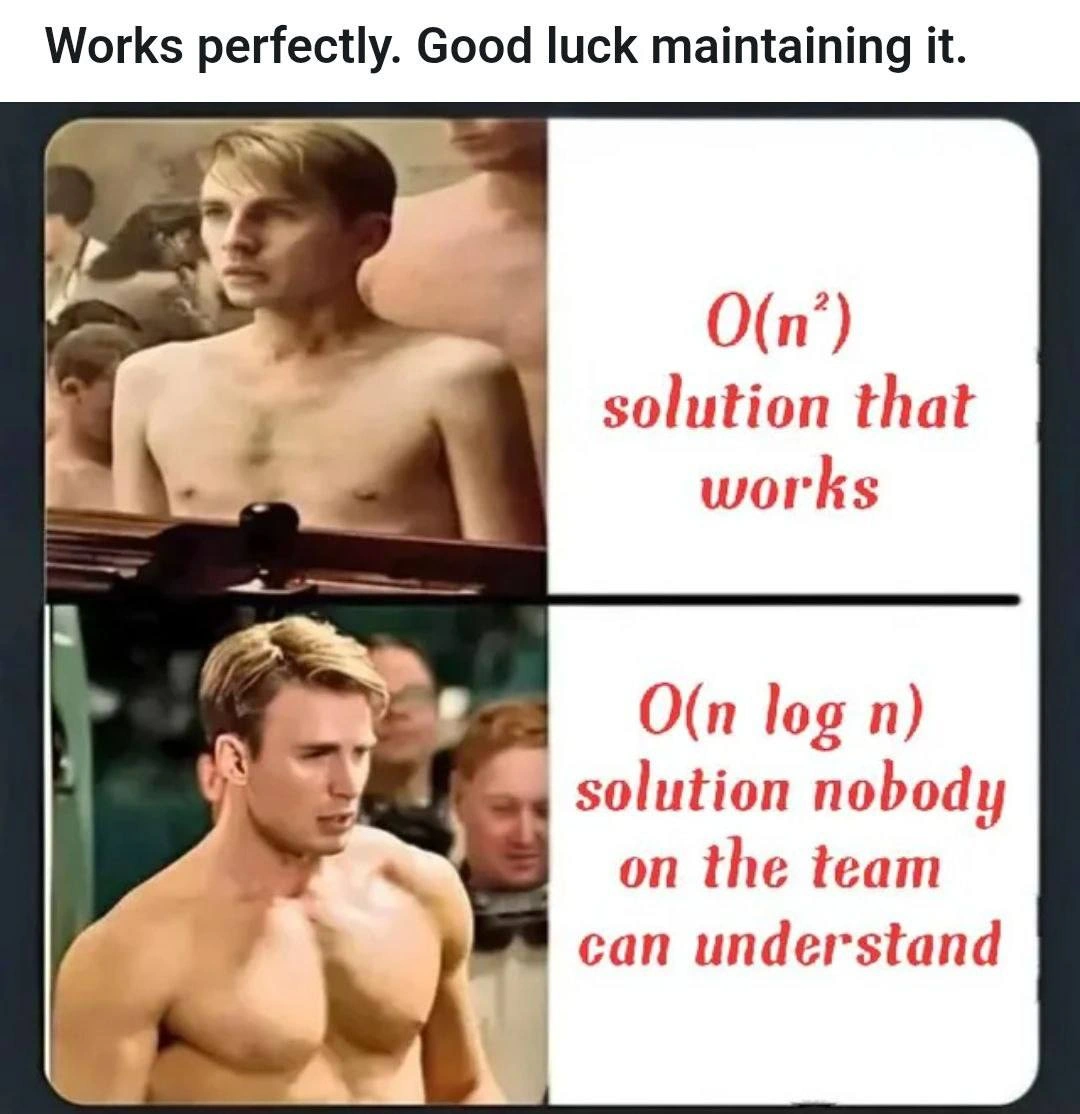
  • The meme format: pre-serum Steve Rogers (skinny, fragile) versus Captain America (peak performance) — repurposed so that "peak performance" is the thing your team dreads inheriting.

The junior rite of passage encoded here: you submit a clever, optimized solution feeling like a genius, and the senior reviewer responds with one devastating comment — "Can you simplify this? n is never more than 200." The day you understand why that comment is correct is the day panel one starts looking heroic.

Level 3: Bus Factor of One, Benchmark of None

The Captain America transformation template usually flatters the second panel: scrawny pre-serum Steve Rogers as "before," the post-serum specimen as "after." This meme keeps the bodies but poisons the glory. The weakling is labeled "O(n²) solution that works"; the super-soldier is "O(n log n) solution nobody on the team can understand" — and the headline above both delivers the verdict: "Works perfectly. Good luck maintaining it." The muscles are real. The muscles are the problem.

This is the maintainability heresy that every senior engineer eventually converts to. Asymptotic superiority is not a business metric. The quadratic version — three nested-loop-free lines anyone can read, or one ugly nested loop everyone can trace — has properties that never show up in Big O analysis: a new hire can modify it, a reviewer can verify it, and when it produces a wrong answer at 2 AM, the on-call can find the bug before sunrise. The optimized version — perhaps a hand-rolled sort-and-sweep with clever index arithmetic, a segment tree, or bit tricks borrowed from a competitive-programming submission — wins the benchmark and loses the team. Its author understood it, briefly, at the moment of writing. That author is the bus factor: when they leave (statistically, for somewhere paying more), the function becomes load-bearing folklore. People route new features around it the way medieval towns routed roads around a haunted forest.

The senior nuance the meme compresses: this is a function of n, and n has a habit of being small. If the list tops out at 500 items, $O(n^2)$ is 250,000 cheap operations — microseconds. The clever version saves time nobody was losing, at the cost of comprehension everybody needed. That's the precise definition of premature optimization: spending readability — the scarcest resource on a team — to buy performance that wasn't the bottleneck. The interview-industrial complex deserves a share of blame; years of algorithmic hazing train developers to reach for the impressive solution reflexively, then ship it into a codebase where impressiveness is a maintenance tax. The mature move, which the meme's caption smirks at, is documented surrender: write the simple version, add a comment saying // O(n²), fine for n < 10k, see ticket before optimizing, and let the profiler — not pride — decide when the serum is needed.

None of which means optimization is wrong. It means unexplained optimization is debt. The post-serum Steve in panel two isn't bad code — he's bad code review culture: nobody on the team can understand it, and it got merged anyway.

Description

A two-panel Captain America before/after meme captioned 'Works perfectly. Good luck maintaining it.' Top panel: scrawny pre-serum Steve Rogers (Chris Evans) next to red stylized text 'O(n²) solution that works'. Bottom panel: the muscular post-serum Captain America beside 'O(n log n) solution nobody on the team can understand'. The meme inverts the usual glorification of algorithmic optimization: the naive quadratic solution is the weakling, but the impressive optimized version is a maintainability liability - capturing the senior-engineer tension between Big O elegance and code the rest of the team can actually reason about, where premature optimization trades readability for benchmarks nobody asked for at the current data scale

Comments

5
Anonymous ★ Top Pick The O(n²) version has a bug you can find; the O(n log n) version has a bug only its author could find - and he left for a quant fund
  1. Anonymous ★ Top Pick

    The O(n²) version has a bug you can find; the O(n log n) version has a bug only its author could find - and he left for a quant fund

  2. @crysknight 3mo

    The O(n!) written by AI that doesn't work and nobody on the team can understand.

  3. 我が名はレギオン 3mo

    Sounds like skill issue, grind LeetCode harder

    1. @mrell 3mo

      codeforces bro

  4. @azizhakberdiev 3mo

    if it works don't touch it

Use J and K for navigation