
CodeQuality Post #4802 · source on Telegram
The Difference Between a Junior and Senior Developer's Code
Description
A two-panel meme comparing the code of a junior and senior developer. The top panel is labeled 'Junior Developer's Code' and shows a single, long, and winding road. The bottom panel is labeled 'Senior Developer's Code' and shows a complex and well-organized highway system, with multiple lanes, on-ramps, and off-ramps. The meme is a visual metaphor for the difference between the code written by a junior and a senior developer. A junior developer's code may be functional, but it's often linear and lacks structure. A senior developer's code, on the other hand, is more likely to be modular, scalable, and easy to maintain. The meme is a humorous way of illustrating the importance of good software architecture and design
More like this
More like this in CodeQuality →
Use J and K for navigation
Comments
7Comment deleted
A junior developer writes code that they can understand. A senior developer writes code that other senior developers can understand. A great developer writes code that a junior developer can understand
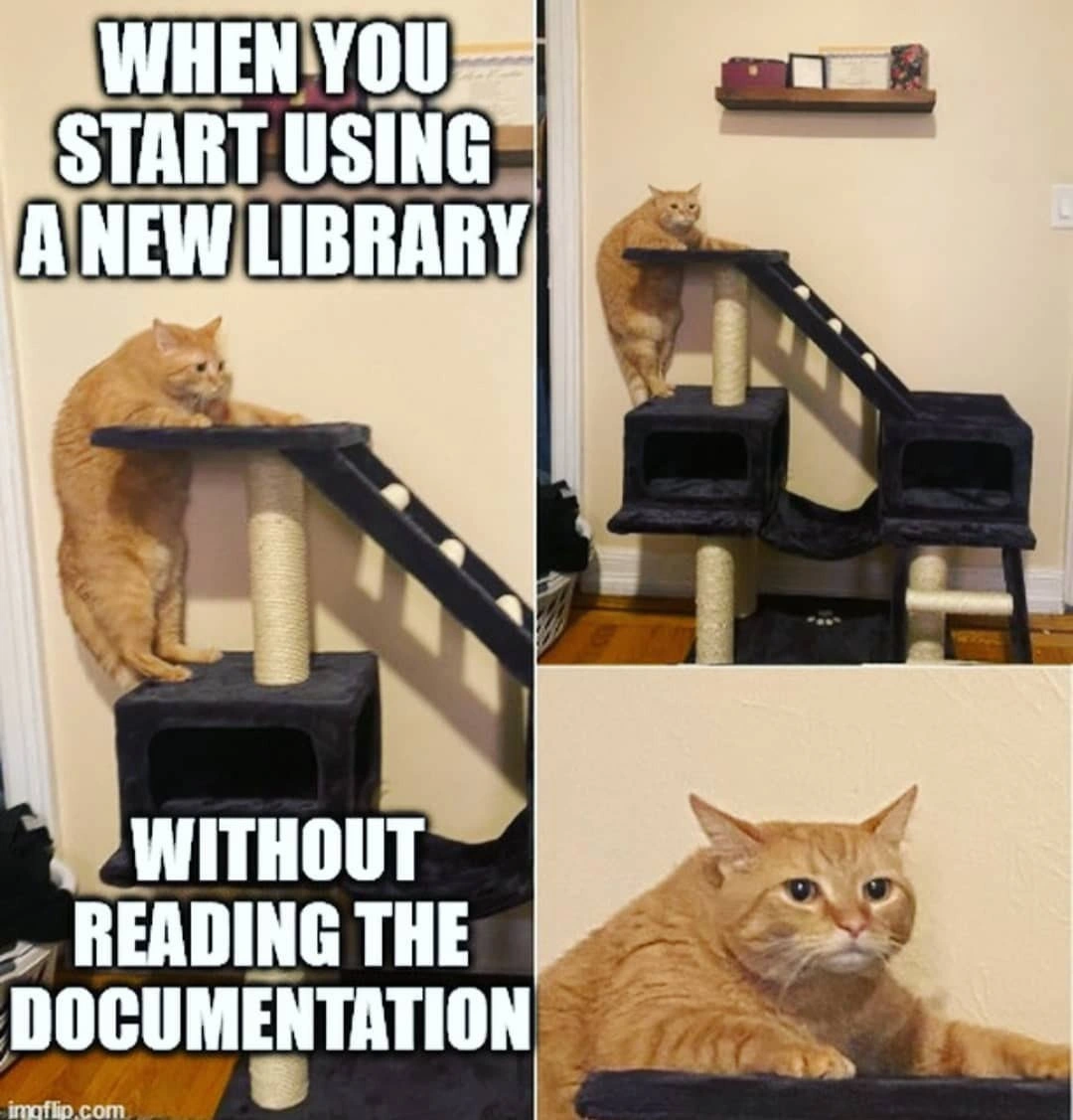
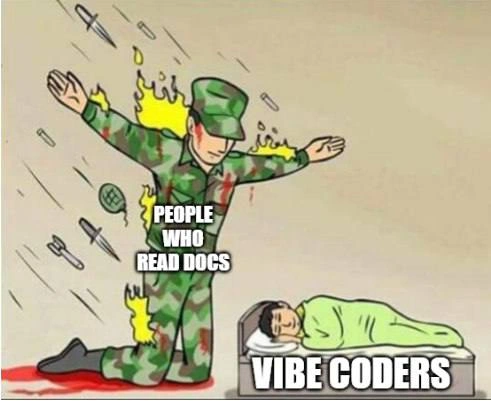
Adopting an undocumented library: you grab the first exposed API, monkey-patch your way to the top, and by the time you spot the proper ramp the CTO has informed you that you’re now its upstream maintainer
That moment when you realize the library's "simple" API has seventeen different lifecycle hooks, three competing state management patterns, and the maintainer's idea of backward compatibility is "just vendor lock everything."
This perfectly captures the hubris of every senior engineer who thinks 'I've used enough libraries, how different could this one be?' - right before discovering the library uses zero-indexed months, has breaking changes between minor versions, or implements its own novel interpretation of REST. The documentation exists for a reason, and that reason is usually buried in a GitHub issue from 2019 that explains why the obvious approach will silently corrupt your data in production
New library, no docs: you sprint up the “QuickStart” ramp, realize it’s the v2 migration path, cling to an @Internal API, and somehow the POC becomes production
Version 1.0: feature-complete. Documentation: 'Pull requests welcome.'
Importing a “tiny” helper without reading the docs is how you learn in prod that its zero‑config default registers a global singleton, monkey‑patches fetch, and pins a transitive peerDependency to 2019