
Google Translate for Programmers: Python to C++
Description
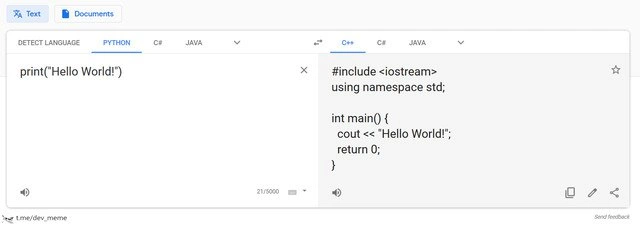
A screenshot of a web interface resembling Google Translate, repurposed to 'translate' between programming languages. The interface is split into two panels. The left panel has the source language set to 'PYTHON' and contains a single line of code: 'print("Hello World!")'. The right panel shows the 'translation' into 'C++', which is the significantly more verbose and complete C++ boilerplate code for the same task, including '#include <iostream>', 'using namespace std;', the 'main()' function, and 'cout << "Hello World!";'. A small watermark 't.me/dev_meme' is visible in the bottom left corner. The meme humorously highlights the stark contrast in verbosity and required ceremony between Python and C++, satirizing language design philosophies by framing the difference as a simple translation


Comments
7Comment deleted
The C++ translation forgot to include a newline character, so now your 'Hello World!' will ruin the shell prompt. It's not just verbose; it's actively hostile to your terminal
Google Translate nailed Python → C++; now if it could also write the 900-line CMakeLists.txt and convince Clang to locate <iostream>, we might actually ship “Hello World” before lunch
After 20 years in the industry, I've realized 'using namespace std;' in production code is like deploying on Friday afternoon - technically possible, but you're just asking for namespace collision incidents at 3 AM when std::distance suddenly isn't what you think it is
After 30 years of C++ evolution, we've finally achieved what Python developers call 'Tuesday morning' - though to be fair, C++ gives you the satisfaction of manually managing that return 0, just in case the universe needs explicit confirmation that printing a string succeeded
Google Translate for code: Python’s print becomes C++’s ritual of #include, using namespace std, and return 0 - proof that rewrites mostly convert developer velocity into an undefined behavior budget
Google Translate nailed Hello World; now only the other two million lines of async I/O, memory semantics, build scripts, and undefined behavior remain to auto-translate
C++ Hello World: five lines to print eleven characters, because even greetings need namespace diplomacy and explicit success signaling - like every vendor contract we've signed