

The Enthusiast's Random Number Generator vs. The Pragmatist's Nightmare
Description
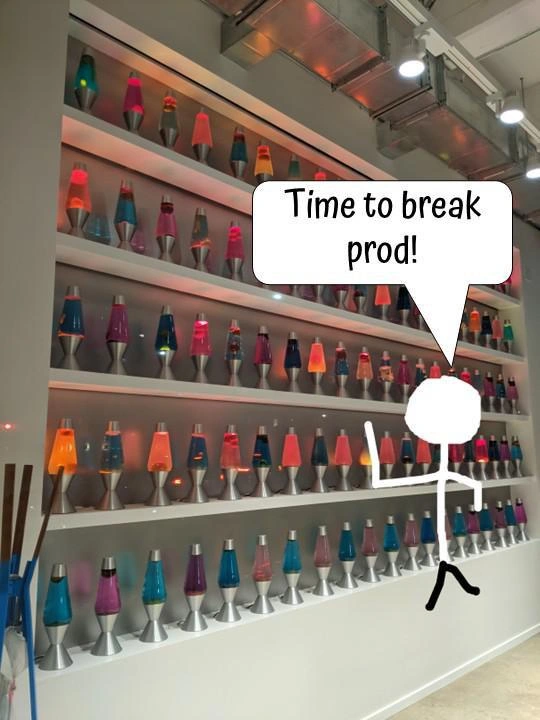
A four-panel comic meme format depicting a conversation between developers. In the first panel, a smiling character enthusiastically suggests, 'we need a random number generator'. The second panel shows another smiling character, with a thought bubble or background image displaying a real photograph of a large wall filled with dozens of colorful, glowing lava lamps. This is a direct reference to Cloudflare's 'Wall of Entropy,' which uses the chaotic patterns of lava lamps to generate cryptographic-grade random data. A vertical line separates these two panels from the last two, which show two other characters with expressions of horror, confusion, and despair. This meme humorously illustrates the classic engineering conflict between creating a technically 'cool' and novel solution versus a practical and maintainable one. While using lava lamps for entropy is a clever, real-world application of generating true randomness, the characters on the right represent the pragmatic viewpoint of senior engineers and SREs who foresee the immense operational and maintenance nightmare of such a physically-dependent system, when a simple call to a standard cryptographic library would suffice
Comments
39Comment deleted
It's all fun and games until you have to write the Terraform provider for 'cloudflare_lava_lamp_instance' and the acceptance tests have a 30-minute warm-up time
"Sure, we could just call /dev/urandom - but legal said FIPS likes its entropy with a side of mood lighting."
Somewhere a principal engineer is screaming 'Just use /dev/urandom!' while the infrastructure team is already calculating the TCO of a quantum entropy harvesting cluster with redundant cosmic ray detectors for 'true randomness at scale.'
When your junior dev suggests using blockchain for generating random numbers, and you realize they've been reading too many whitepapers. Sure, you could use Math.random() or /dev/urandom, but why not burn enough electricity to power a small city and contribute to global GPU shortages? At least the entropy is... distributed. The real random number here is how many months until the electricity bill bankrupts the project
If your RNG seed fits in a Terraform variable, it’s not entropy; point a webcam at a wall of lava lamps, hash it into the kernel pool, and call it FIPS-compliant office decor
After the VM’s entropy pool starved and TLS handshakes stalled, we fixed it the enterprise way: a webcam pointed at 100 lava lamps - finally, a microservice with literally good vibes
The original CSPRNG: perfectly reproducible across runs - dog-ear page 314159 and watch it never drift
hash from last comment Comment deleted
https://en.wikipedia.org/wiki/Hardware_random_number_generator Comment deleted
I'm actually sad by not seeing any mentions of RDRAND Comment deleted
rdrand can be shitty sometimes https://github.com/google/security-research/security/advisories/GHSA-4xq7-4mgh-gp6w Comment deleted
Yep, but the same applies to almost any other device when you need A LOT of random numbers This is a whole reasoning behind lava lamps :D Comment deleted
i know, i just wanted to mention that Comment deleted
Mainly that's the reasoning behind 1) mixing all the entropy sources and feeding it to CPRNG 2) actually measuring the entropy Comment deleted
Regarding point 1 - input is crucial part, it’s not separate from any CRNG but key part of the design for any Depending on context and how CRNG is being used, "measuring the entropy" might differ so this one is also unclear Comment deleted
Anyway Comment deleted
the RDRAND attack used 4: https://m.xkcd.com/221/ ;-) Comment deleted
I'm saddened by how much I had to scroll till I saw this classic Dilbert. Comment deleted
glorified uncalibrated clock Comment deleted
*cock Comment deleted
*uncalibratable If it could be calibrated it could be predicted. Comment deleted
Fluctuations in my shitty eastern European electricity network Comment deleted
keysmash from your local queer person :3 Comment deleted
:3 Comment deleted
A glass to cum into. When in need of the next value, it is calculated based on the current cumlings' position. Comment deleted
bruh Comment deleted
I hear Quantinuum thinks they can sell quantumly random numbers…. I guess when all your machine can do is make random numbers you have to make lemonade somehow Comment deleted
When life gives you random numbers 🤷♂️ Comment deleted
ask a lot of people what's the most random number 1-100, and pick most chosen. End up with 37, which must be really random if a lot of people agree 🌚 Comment deleted
This is cloudflare Comment deleted
finally, i had to scroll thru a lot of comments to find someone else who recognised it Comment deleted
It feels like people in the field burn out so fast that they do not remember events from 5 years ago Though I googled and it was in 2017. Maybe most of followers didn't even wrote their first line of the code 8 years ago? Comment deleted
Sad😭 Comment deleted
But I am still not sure how "random" this is. I mean I see how overcomplicated it is and I understand hashes but still. "What if someone models all atoms and predicts their behavior?" /s Comment deleted
You forgot camera's noise That little boy is a real banger Comment deleted
Yes I thought about it too Comment deleted
But then why use the lavalamps at all? Comment deleted
Digits of Pi but backwards Comment deleted
you mean based on this photo it will go to the next value? Comment deleted