Skip to content
DevMeme
7136 of 7435
Trail of Bits Ships Tarot-Powered Claude Skill: let-fate-decide
AI ML Post #7823, on Mar 15, 2026 in TG

Trail of Bits Ships Tarot-Powered Claude Skill: let-fate-decide

Why is this AI ML meme funny?

Level 1: Asking the Magic Cards

When a kid can't decide between chocolate and vanilla, sometimes they flip a coin — not because the coin is wise, but because any answer beats standing frozen at the counter. This is a famous, very serious computer-security company building a fancy coin flip for their robot assistant: when a request is too fuzzy to answer, the robot draws fortune-telling cards and goes with what they say. The laugh is the mismatch — the world's most careful engineers, solving indecision with a deck of magic cards, and doing it with absolutely perfect craftsmanship.

Level 2: The Pieces on the Table

  • Claude Code skill: a packaged extension for Anthropic's terminal coding agent — instructions plus scripts the model can invoke. Here the script shuffles cards; the model interprets them.
  • os.urandom(): Python's tap into the OS's high-quality randomness, the kind used for keys and tokens — deliberate overkill for a card game, and that's the point.
  • Fisher-Yates shuffle: the textbook fair-shuffle algorithm: walk the deck once, swapping each card with a randomly chosen remaining card. Fair, fast, and the first thing you get wrong in an interview.
  • Fuzzing: throwing semi-random inputs at software to find bugs — Trail of Bits' specialty, which makes "tarot for planning" an on-brand self-parody.
  • Balatro: a hit poker-roguelike about chasing absurd card synergies; "playing balatro with my fuzzer" means treating randomized tooling like a game you're addicted to.

If you're early-career, the relatable kernel is the vague ticket. "Make the dashboard better" has no correct decomposition, and the panic of choosing arbitrarily is universal. Seniors just hide the coin flip behind a confident architecture document.

Level 3: Divination-Driven Development

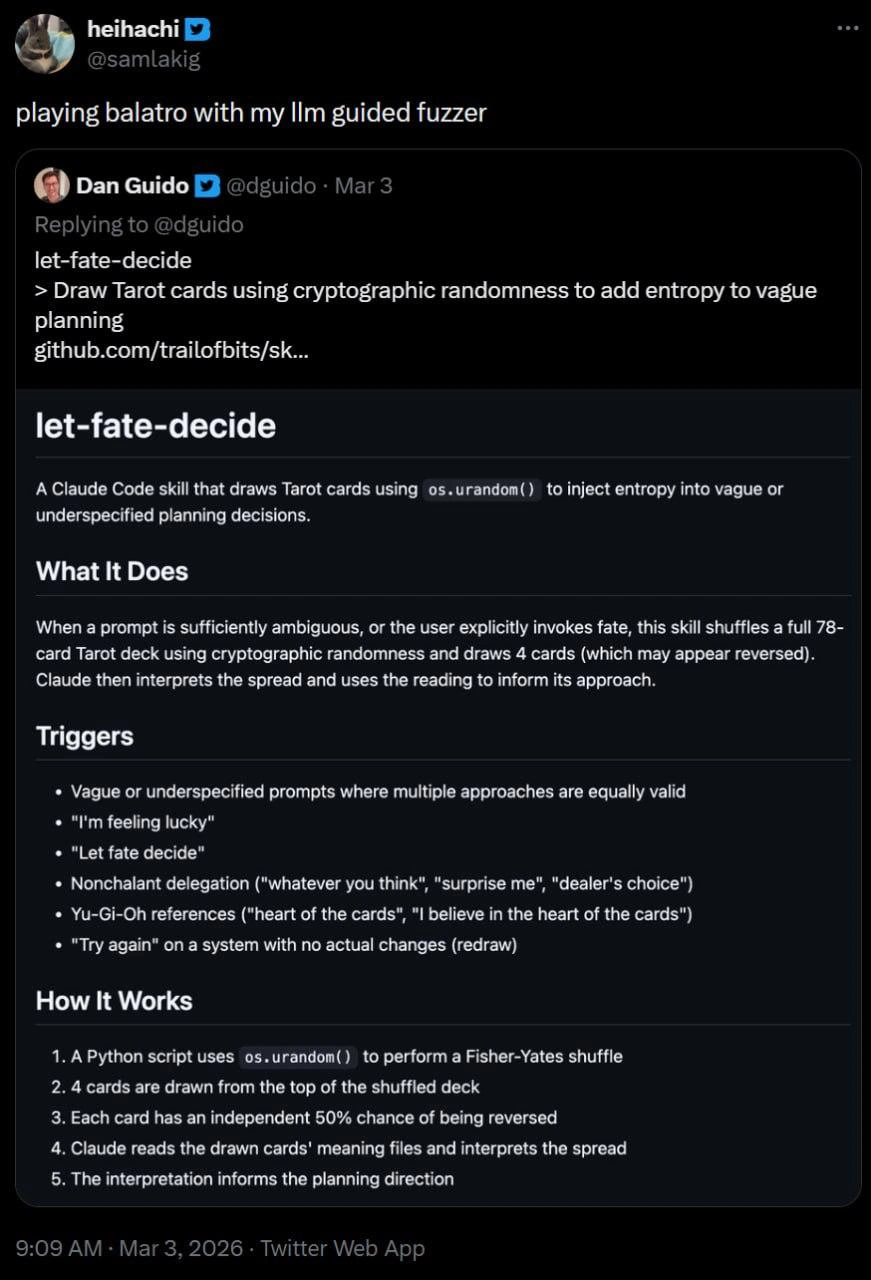
The screenshot layers three jokes. Dan Guido — CEO of Trail of Bits, a firm whose name on an audit report moves real money — announces let-fate-decide, a Claude Code skill whose rendered README deadpans:

A Claude Code skill that draws Tarot cards using os.urandom() to inject entropy into vague or underspecified planning decisions.

Then @samlakig quote-tweets it as "playing balatro with my llm guided fuzzer," reframing agentic engineering as a card-based roguelike where you keep rerolling hands until the build comes together. Anyone who has watched an LLM agent retry a flaky plan knows that comparison is uncomfortably load-bearing.

The satire's real target is underspecified requirements. The Triggers list is an taxonomy of every way humans abdicate decisions to machines: "whatever you think", "surprise me", "dealer's choice", and — the most surgically observed line in the image — "Try again" on a system with no actual changes (redraw). That last trigger names the dirtiest secret of LLM-era workflows: re-running an identical prompt and hoping for a different result is already divination. Sampling temperature is a deck; you were always drawing cards. The skill doesn't introduce superstition into the process — it makes the existing superstition explicit, auditable, and cryptographically sound, which is the most security-firm move imaginable. It also lands as commentary on planning culture broadly: when stakeholders refuse to specify, something breaks the tie — the loudest voice, the most recent blog post, the HiPPO. At least the Major Arcana is documented and has a meaning file.

Level 4: Entropy, Properly Sourced

The README's funniest line is also its most technically defensible: the deck is shuffled with os.urandom() driving a Fisher-Yates shuffle. That pairing is a tiny cryptography lecture disguised as a gag. os.urandom() reads from the operating system's CSPRNG (cryptographically secure pseudorandom number generator) — on Linux, the kernel's ChaCha20-based pool fed by hardware interrupt timing and similar physical entropy sources — meaning the draw is unpredictable even to an adversary who knows the code. Contrast Python's default random module, a Mersenne Twister whose entire future output can be reconstructed from 624 consecutive 32-bit outputs. If your fate must be decided, it should at least be unforgeable fate.

Fisher-Yates matters for the same pedantic-correct reason: it is the only standard shuffle that produces a uniform distribution over all $78!$ permutations (~$10^{115}$, comfortably more states than any seed-based PRNG could even index — another reason to use a true entropy source). The naive alternative, sort(key=lambda _: random()), is provably biased. And the "independent 50% reversal" per card multiplies the space by $2^4$. A security firm writing a joke tool and still refusing to ship modulo bias is the joke: rigor as compulsion. There's also a quietly real idea underneath — fuzzing, Trail of Bits' actual day job, is the discipline of using randomness to explore decision spaces humans are too biased to search. Tarot-as-tiebreaker is fuzzing applied to product planning, which is why the quote tweet ("llm guided fuzzer") closes the loop so neatly.

Description

A dark-mode Twitter screenshot. User heihachi (@samlakig) posts 'playing balatro with my llm guided fuzzer', quoting a March 3, 2026 tweet by Dan Guido (@dguido) of Trail of Bits announcing 'let-fate-decide' with the description '> Draw Tarot cards using cryptographic randomness to add entropy to vague planning' and a github.com/trailofbits/sk... link. Below is a rendered README for 'let-fate-decide': 'A Claude Code skill that draws Tarot cards using os.urandom() to inject entropy into vague or underspecified planning decisions.' Sections include What It Does (shuffles a full 78-card Tarot deck with cryptographic randomness, draws 4 cards which may appear reversed, and Claude interprets the spread to inform its approach), Triggers (vague prompts, 'I'm feeling lucky', 'Let fate decide', nonchalant delegation like 'whatever you think' / 'surprise me' / 'dealer's choice', Yu-Gi-Oh references like 'heart of the cards', and 'Try again' with no actual changes triggering a redraw), and How It Works (Python script uses os.urandom() for a Fisher-Yates shuffle, 4 cards drawn, each with independent 50% reversal chance, Claude reads the cards' meaning files and the interpretation informs planning direction). Timestamp: 9:09 AM, Mar 3, 2026, Twitter Web App. The humor: a serious security firm formalizing divination as a tie-breaker for underspecified LLM prompts, and the quote-tweeter framing their LLM-guided fuzzer as a Balatro roguelike session


Comments

7
Anonymous ★ Top Pick Finally, a planning process with documented entropy sources - most roadmaps use the same algorithm but call it 'stakeholder alignment'
  1. Anonymous ★ Top Pick

    Finally, a planning process with documented entropy sources - most roadmaps use the same algorithm but call it 'stakeholder alignment'

  2. @NickRaspy 3mo

    yugioh references lmao

    1. @NickRaspy 3mo

      I use pot of greed which allows me to draw 2 more cards

      1. @TheFloofyFloof 3mo

        sorry thats banned

        1. @NickRaspy 3mo

          it's not in rush duels

  3. @filgoodboi 3mo

    What's 'fuzzer'?

  4. @Similacrest 3mo

    bro is discussing OSes with Napstablook

Use J and K for navigation