
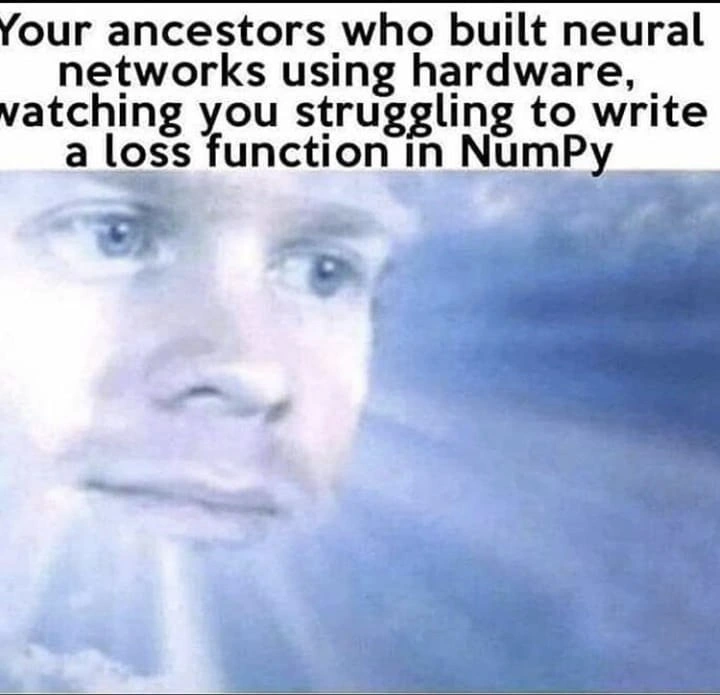
AI Pioneers Judging Your NumPy Struggles From the Afterlife
Description
The meme features a blurry, ethereal image of a man's face looking down from a cloudy, heaven-like background with a look of mild disappointment. Above this image, the text reads: 'Your ancestors who built neural networks using hardware, watching you struggling to write a loss function in NumPy.' This meme uses the 'Disappointed Ancestor' or 'Heavens Gate' format to create a humorous contrast between the foundational, hardware-level work of early AI pioneers (like building perceptrons with physical components) and the modern-day challenges of machine learning engineers. The joke lies in the idea that despite the high levels of abstraction and powerful libraries like NumPy available today, developers can still find it difficult to implement fundamental concepts like a loss function, much to the imagined disdain of their predecessors who worked with far greater constraints

Comments
7Comment deleted
My AI ancestors implemented backpropagation with soldering irons. I spent the afternoon fighting a tensor shape mismatch. I'm pretty sure I could hear a faint sigh of disappointment over the coil whine of my GPU
They hand-wired op-amps into perceptrons; I just spent two hours discovering my triple-nested Python loop was a single np.matmul - pretty sure we’re the dropout layer in their grand architecture
Back in my day, we didn't have automatic differentiation - we had potentiometers and oscilloscopes, and we liked it! Now you're telling me you can't even broadcast a tensor without checking Stack Overflow?
The irony is exquisite: pioneers like Rosenblatt literally soldered resistors and potentiometers to build the Mark I Perceptron, manually adjusting weights through physical hardware, while we sit here debugging why our vectorized cross-entropy implementation returns NaN because we forgot to clip the log input. They dealt with actual electrical noise in their gradients; we panic when floating-point precision causes our loss to oscillate. At least when their neural network failed, they could see the smoke
They built neural nets in hardware; I’m here negotiating (512,1) vs (1,512) in NumPy with np.newaxis as duct tape - turns out we didn’t retire the soldering iron, we just call it “broadcasting.”
Someone hand‑tuned op‑amps into a perceptron, and I’m burning a sprint remembering which axis to broadcast so (n,1) @ (1,n) doesn’t spawn a 4‑GB temporary
They debugged perceptrons with oscilloscopes; you're still googling 'numpy mean axis' at 3 AM