
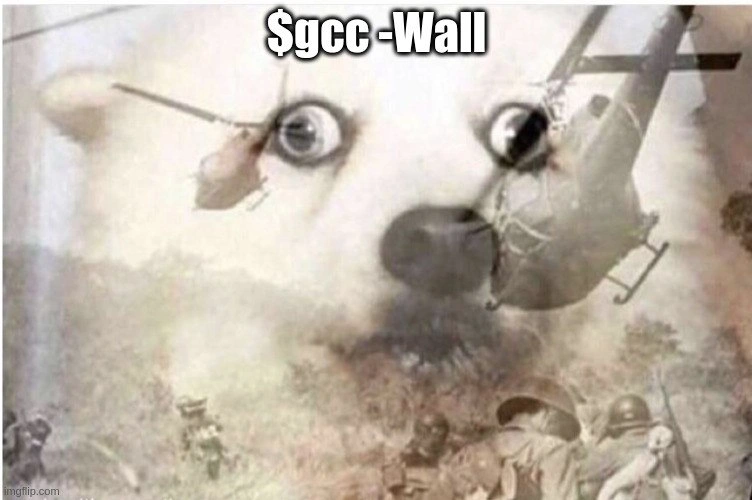
When gcc -Wall turns your codebase into a battlefield of warnings
Description
The meme shows the text "$gcc -Wall" in bold white letters centered at the very top. Below, a dramatic composite image overlays a wide-eyed Doge (white Shiba Inu face) with a sepia-toned Vietnam-war scene: Huey helicopters swoop in from both sides while weary soldiers in helmets advance across a smoky jungle. The dog’s anxious eyes dominate the frame, giving a shell-shocked expression that blends into the combat footage, evoking the classic "war flashback" meme format. Technically, it jokes that enabling the -Wall flag in the GCC compiler unleashes a barrage of warnings that make seasoned C/C++ developers feel like they’re under heavy fire. The humor relies on compiler flag culture, code-quality anxiety, and the overwhelming volume of warnings in large legacy codebases
Comments
14Comment deleted
Alias gcc to “gcc -Wall -Wextra -Werror -O3 -flto” and the build log turns into a war diary: “Day 1,003 - still pinned down by signed/unsigned artillery, morale low, template depth maxed at 1024… send reinforcements.”
That moment when you've been shipping 'production-ready' C code for years, then someone suggests adding -Wall to the build pipeline and suddenly your terminal looks like a CVE database having an anxiety attack while your imposter syndrome whispers 'I told you so' in undefined behavior
Enabling -Wall on a 'working' legacy C codebase is like opening Pandora's box, except instead of releasing all the evils of the world, you're releasing 847 warnings about implicit int declarations, unused variables, and that one pointer arithmetic operation that's technically undefined behavior but has 'worked fine for 15 years.' The real horror isn't the warnings themselves - it's realizing your entire production system has been running on compiler optimizations that could legally transform your code into a program that orders pizza
gcc -Wall: the after-action report that turns “it works in prod” into 600 lines on UB, shadowed locals, and implicit conversions your ’90s C code has been getting away with
Enable -Wall on a decade-old C repo and discover 'all' means reconnaissance; -Wextra and -Wpedantic are the helicopters, and the first -Werror turns your CI into a siren
gcc -Wall after a decade of -w bliss: every unused variable suddenly a war crime, choppers inbound for code evac
Maybe -0d? Comment deleted
-Woof Comment deleted
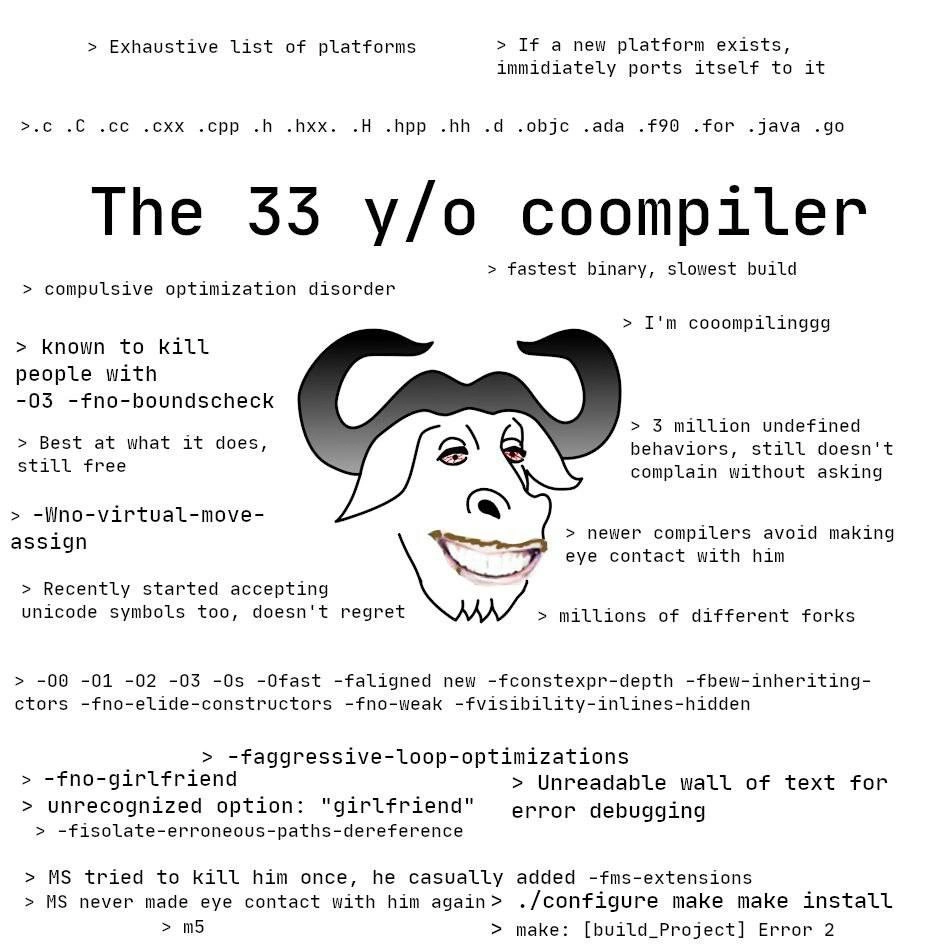
this smells of gentoo ricing 183% (https://forums.gentoo.org/viewtopic-t-309752.html) edit: adds source Comment deleted
got a question (for you or anyone else that understands CFLAGS) do those flags make sense? CPPFLAGS="-D_FORTIFY_SOURCE=2 -march=native -O2 -pipe -fno-plt -fuse-ld=lld" CFLAGS="-march=native -O2 -pipe -fno-plt -fuse-ld=lld" CXXFLAGS="${CFLAGS}" LDFLAGS="-Wl,-O1,--sort-common,--as-needed,-z,relro,-z,now" RUSTFLAGS="-C opt-level=2 -C target-cpu=native -C link-arg=-fuse-ld=lld -C debuginfo=0" half of those are default arch flags (for pkgbuilds), but I just wanted an opinion on the ones I added. Comment deleted
asking here bc I picked the ones that sounded good, but I really don't understand much of the technical jargon Comment deleted
just noticed that this forum thread is from 2005 - that's why they're talking about Pentiums and Athlons like they're the creme de la creme lol Comment deleted
my take on that was always stick to "safe cflags" (they're a thing, really, they're on the gentoo wiki) Comment deleted
yep, that was the golden age in gentoo... no idea how it goes today Comment deleted