Skip to content
DevMeme
4172 of 7435
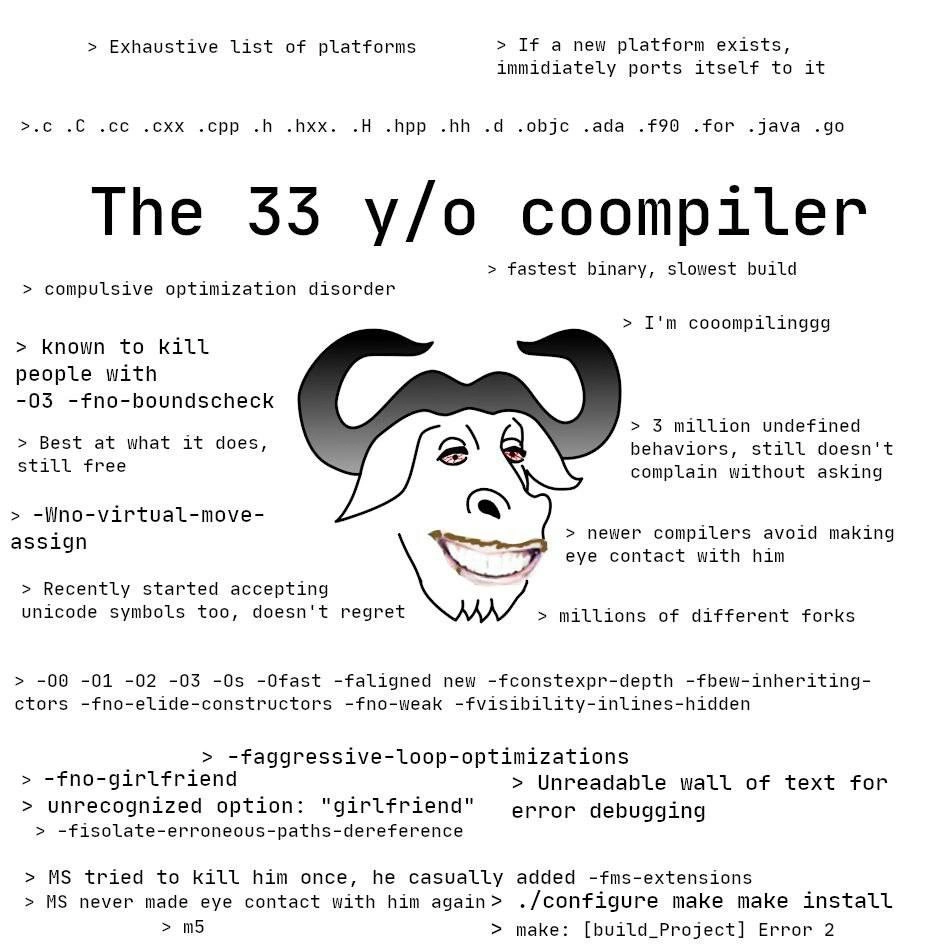
GCC meme: The 33-year-old compiler flaunting endless flags and undefined behavior
Compilers Post #4554, on Jun 23, 2022 in TG

GCC meme: The 33-year-old compiler flaunting endless flags and undefined behavior

Why is this Compilers meme funny?

Level 1: Wise Old Wizard

Imagine a wise old wizard who has been around for a very long time. This wizard knows every spell in the book – he can cast fire spells, water spells, healing spells, you name it. He can perform magic in any land or kingdom (deserts, forests, mountains, even far-off islands no one’s heard of). Younger wizards sometimes watch him in awe because he’s so skilled. Now, this old wizard is super generous – he helps everyone without asking for gold or payment (he’s a free wizard!). But there’s something funny about him: because he’s so old and has learned so many spells, he carries a huge spellbook with tiny notes and bookmarks sticking out everywhere. It’s almost comical how thick and heavy it is with all sorts of magical details. There’s a spell for making things really fast, a spell for shrinking things, even a quirky spell he jokingly wrote in the margins about “no girlfriends” (just as a silly note to himself).

When the wizard chants his most powerful spells to make something as fast or as strong as possible, it takes him a very long time to finish the chant. 🧙‍♂️💨 You might see him start casting in the morning and he’ll still be murmuring “✨ I’m conjuringggg… ✨” by afternoon. But once he’s done, wow – the results are amazingly fast and powerful. It’s like he can enchant a toy car to run as fast as a race car! The downside is you had to wait all day for that enchantment. If he uses all his secret techniques at once, the magic could get a bit unstable – like if he tries a risky spell to remove safety locks for speed, the toy car might zoom off uncontrollably or crash because the brakes were kind of taken out. That’s why you have to be a bit careful asking him for the absolute extreme magic.

This old wizard also has a fun history: once, a big famous king (let’s call him King Microsoft 😄) tried to outdo our wizard with his own royal magician. The king’s magician used some special secret tricks that other wizards didn’t use. But our wise old wizard just shrugged, learned those tricks too (so they couldn’t be used against him), and kept on helping people. The king eventually gave up trying to beat him in magic duels because our wizard could do everything his magician could, and more!

Sometimes, the wizard’s spells can be hard to understand – when something goes wrong, he might give you a very long, ancient scroll of magical runes describing the problem. You’d have to sit down and decipher it to figure out what happened. That part can be frustrating, like getting a big wall of text you have to read through. Imagine asking him, “Wizard, what went wrong with the spell?” and he hands you 20 pages of dense mystical writing. You’re like, “uh oh, time to find the clue in here…” It’s a bit funny because he’s so powerful and knowledgeable, but not the best at clear, short explanations.

At the end of the day, though, everyone respects this wizard. He’s been around forever, he’s helped countless people build things with his magic, and he doesn’t charge a single coin. New, young wizards have come along with flashy new spells, but none really want to challenge the old wizard face-to-face – he’s just too strong and experienced. In fact, those young wizards often learn from his grimoire (spellbook) or use the paths he paved.

So the meme is basically comparing GCC, the compiler to this wise old wizard:

  • GCC is very old (in tech years, 30+ years is ancient!) and very knowledgeable.
  • It can work on any platform (like the wizard in any land) and compile many languages (cast many spells).
  • It has tons of settings and options (a giant spellbook of flags) – some of them are pretty arcane or funny, like the joke about a -fno-girlfriend flag (which isn’t real, just like a wizard scribbling a joke spell).
  • It creates really fast programs (powerful magic results) but can take a long time to compile when using maximum optimization (a long chanting ritual for the best spell).
  • It’s free to use (the generous wizard).
  • It’s stood the test of time against competition (beating the king’s magician = Microsoft’s compiler story).
  • Sometimes it gives very complicated error messages (the long scroll of runes).

The humor and charm here come from imagining a serious, complex technology tool (a compiler) as this personified old wizard with quirky habits. It makes it easy to understand why developers both respect GCC a lot and also poke a little fun at its quirks. In simple emotional terms, the meme is saying: this old guy (GCC) is unbelievably good at his job and has seen everything, which is both awesome and a little absurd at the same time. It’s funny and endearing, especially to the programmers who’ve “worked” with this wizard for years while building software.

Level 2: Old Compiler, New Tricks

Let’s break down what this meme is talking about in simpler terms. GCC stands for GNU Compiler Collection. A compiler is a program that takes the source code you write (in languages like C, C++, etc.) and translates it into the machine code that computers can execute. GCC is one of the most famous compilers out there – it’s been around for a long time (over 30 years!) and is widely used in the programming world. When the meme calls it “33 years old,” that’s highlighting how old but experienced this tool is. Think of GCC as a veteran craftsman in the world of software: it’s been doing its job since the late 1980s, and it has kept up with the times.

One of GCC’s bragging rights is that it runs on and can produce code for almost any platform. When we say “platform” here, we usually mean a combination of a computer’s hardware architecture (like x86, ARM, etc.) and operating system (Linux, Windows, etc.). The meme jokes that GCC has an “exhaustive list of platforms” and even “if a new platform exists, [it] immediately ports itself to it.” In reality, porting a compiler to a new platform requires developers to do some work, but GCC’s design makes this easier. Because GCC is open-source and modular, whenever a new chip or system comes out, often engineers will write the necessary support for it in GCC pretty quickly. For example: if a new kind of CPU comes out next year, someone can add code to GCC so that it knows how to generate machine instructions for that CPU. As a result, GCC ends up supporting an enormous range of devices – from your PC, to Macs, to Raspberry Pi’s ARM processor, to even obscure chips in appliances. This is great for programmers because it means you can use the same compiler (GCC) to build your programs for different devices. The meme’s exaggeration makes it sound like GCC does this automatically, which is just a humorous way to say “wow, GCC is everywhere.”

Another thing: GCC is not just for one programming language. The “Compiler Collection” in its name hints at how it can handle many languages. Those extensions listed (.c, .cpp, .for, .java, .go, etc.) are file types that correspond to various programming languages:

  • .c = C source code
  • .cpp/.cc/.cxx = C++ source code (different people use different extensions, but GCC is flexible enough to accept them all)
  • .h/.hpp = header files (these are parts of C/C++ programs, basically included files)
  • .objc = Objective-C (a language once common on Apple systems)
  • .ada = Ada (a programming language used in some industries; GCC has a component called GNAT for Ada)
  • .f90/.for = Fortran (an older language used a lot in scientific computing; GCC’s Fortran compiler is called gfortran)
  • .java = Java (yes, GCC used to have a Java compiler that could turn Java into native machine code!)
  • .go = Go (GCC has a Go language front-end as well, although many Go programmers use the official Go compiler).

So essentially, GCC is like a multi-tool: one program that can compile all these different languages. Newer programmers might be more familiar with specialized compilers (like Go has its own compiler, Rust has its own, etc.), but GCC is a one-stop shop for a bunch of languages, especially the older and system-level ones. That’s why the meme portrays GCC as this all-encompassing, super-capable tool – “Best at what it does, still free” is emphasizing that despite doing so much, it doesn’t cost anything (GCC is free open-source software).

Now, about those flags (the things that start with - like -O2 or -fno-elide-constructors). In GCC, and compilers in general, flags are command-line options you pass in to change how the compilation is done. They can enable or disable certain features. The meme basically lists a ton of these to the point it looks ridiculous, and that’s the joke: GCC indeed has hundreds of options, as if it has a switch for everything, even silly things. Let’s clarify a few:

  • Optimization levels (-O0, -O1, -O2, -O3, -Os, -Ofast): These control how much effort the compiler puts into making your program run faster or be smaller. -O0 means no optimization (compile quickly, but the program might not run as fast or may be larger). -O2 and -O3 mean do more and more aggressive optimizations (make the program run faster, possibly use less memory, etc., but take longer to compile). -Os is optimize for size (make the program file smaller, which can also sometimes improve speed by fitting better in CPU caches). -Ofast is like saying “go wild”: it enables all the optimizations of -O3 and some that aren’t strictly standard-compliant (it might ignore some safe practices defined by the language standard in favor of pure speed).
  • Specific -f flags: these typically enable or disable a specific compiler feature. For instance, -fno-elide-constructors tells the C++ compiler not to do “return value optimization” (which is a standard optimization that avoids unnecessary object copies). Usually you wouldn’t disable that except maybe when debugging object creation. Flags like -faligned-new relate to how C++ new behaves with memory alignment. -fvisibility-inlines-hidden is about how C++ exports symbols for inline functions (used to reduce library size).
  • Warning flags (-W flags): An example from the meme is -Wno-virtual-move-assign. This is a flag to disable a specific warning about C++ objects – specifically, a warning you’d get if a class with a virtual function is missing a move assignment operator (it’s a niche C++ thing). The flag name basically reads as “turn off the warning about virtual move assignment.” So if that warning was bothering you, you can use this flag to silence it.

Seeing -Wno-... or -fno-... means disable something (whereas -Wall would enable all common warnings, and -fstrict-aliasing would enforce strict rules, etc.). The meme tosses in a fake one: -fno-girlfriend – this one is not real; it’s just for laughs. It follows the same naming style to sound legit, but obviously it has nothing to do with programming. It implies jokingly that using GCC extensively somehow correlates with “no girlfriend.” This is teasing the stereotype that hardcore programmers (especially those deep into complex tools like compilers) might not have much of a romantic or social life. When they show “unrecognized option: 'girlfriend'”, that’s mimicking what GCC actually does when you give it an unknown flag – it prints an error saying it doesn’t know that option. So they’re pretending someone tried to compile with -fno-girlfriend and even GCC was like “What?? I don’t have that option!” It’s just nerd humor – nothing actually to configure about girlfriends in a compiler 😛.

Another notable flag mentioned: -faggressive-loop-optimizations. This one is real – enabling it tells GCC to be extra aggressive in optimizing loops (trying things like reordering them, combining them, etc., more than it normally would). It’s often on by default at higher optimization levels anyway. The reason it’s highlighted is more for comedic effect: it sounds intense (aggressive optimizations!) and it’s a mouthful. If such an option misbehaves, it could make debugging tough because the compiler might transform your loops in complex ways.

The meme text “Unreadable wall of text for error debugging” likely refers to the fact that when you turn on so many options or when something goes wrong deep in optimization, the error messages or debugging output can be enormous and hard to read. If you’ve ever seen a C++ template error from GCC, you know they can be many lines of cryptic text – a nightmare for debugging. Senior devs joke that certain compiler outputs are “walls of text” because one error can produce pages of output (for example, a small mistake in template metaprogramming might result in a huge instantiation backtrace). So this line is probably saying, “with all these crazy options, if something fails, good luck reading through the output.” It’s a friendly tease since we’ve all squinted at long GCC error logs trying to find the actual issue.

Now, the meme mentions undefined behavior and killing people with -O3 -fno-boundscheck. Let’s break that down:

  • Undefined behavior (UB): In C and C++, not every possible thing you can do in code is defined by the language. Some operations are left “undefined,” meaning the language spec doesn’t say what should happen – it could crash, it could produce strange results, or seemingly nothing bad might happen… until it does. Examples of undefined behavior: accessing memory out of bounds (like reading past the end of an array), using a pointer after freeing it (use-after-free), integer overflow in C (like adding 1 to the max value of an int), or even something as odd as modifying a variable twice in one expression without an intervening sequence point. The compiler (GCC) generally assumes that your code does not do these illegal things, because if it does, all bets are off. So GCC won’t typically warn you about UB by default, and it might optimize the code in a way that makes the UB consequences surprising. For instance, if it assumes “this pointer can’t be null here because dereferencing a null is UB and the programmer wouldn’t have done that,” it might skip a check that you thought was there. This is why the meme says “3 million undefined behaviors, still doesn’t complain without asking.” It’s saying that there are countless ways your C/C++ program can go off the rails without the compiler telling you – unless you explicitly use flags or tools to check. To “ask” GCC to help, you use flags like -Wall (enable lots of warnings), -Wextra (even more warnings), or use sanitizers (-fsanitize=address for memory errors, etc.). But if you don’t, GCC’s attitude is sort of: compile and let the program handle it (or crash) at runtime.
  • -O3 -fno-boundscheck: -O3 as mentioned is the highest standard optimization level, making the program as fast as possible (potentially reordering and removing code in the process). -fno-bounds-check is not a flag for C or C++ (since they don’t have bounds checks by default), but GCC has it for other languages like Fortran or bounds-checking instrumentation. If you use gfortran, the GNU Fortran compiler, by default it can add code to check array bounds and some other things (to catch errors). -fno-bounds-check turns those checks off for speed, meaning if you do go out of bounds on an array, the program will just do the wrong thing or crash without any notice. So running something with -O3 -fno-boundscheck is like saying “make this program really fast, and don’t bother with any safety nets.” The meme exaggerates that as “known to kill people” – obviously GCC itself isn’t killing anyone, but a program compiled with aggressive optimization and no safety can have serious bugs. In safety-critical fields, using such flags recklessly could indeed lead to software malfunctions. It’s a dark joke acknowledging that when you push for maximum performance, you might be trading away some reliability, and in certain domains (medical, automotive, aerospace) that’s a big deal.

On the lighter side, the meme praises GCC as “Best at what it does, still free.” This is straightforward: GCC is very good (one of the best compilers in terms of the performance of the programs it produces and its wide support), and it doesn’t cost money – it’s free to use and also free in the open-source sense (its source code is available for anyone to study or modify). This is a point of pride in the developer community because a tool this powerful being open and free is amazing, given that many specialized compilers or tools from companies can be very expensive.

Next, “newer compilers avoid making eye contact with him”. Here “him” refers to GCC personified. Newer compilers could be things like Clang (from LLVM), or others that have come out in the last decade or two. This line jokes that GCC is like an intimidating legend that newer ones don’t even want to challenge directly. It’s a playful way to say GCC sets a high bar. For example, Clang is a newer C/C++ compiler that many developers like because it provides very clear error messages and is also quite fast at compiling. But even Clang took years to reach performance parity with GCC in some areas, and GCC still sometimes leads in pure optimized output speed for certain cases. So a meme-savvy way to put it: the young guns (new compilers) prefer not to stare down the old lion (GCC). In reality, compilers don’t have feelings – this is just anthropomorphic humor.

The bit about “Recently started accepting unicode symbols too, doesn’t regret” refers to a relatively modern feature. Historically, code was mostly written with plain ASCII characters (the basic English keyboard characters). Now, Unicode includes characters from many languages and even symbols like ✓ or Ω. New standards for C/C++ allow using Unicode characters in identifiers (like variable names). GCC added support for that, meaning you could name a variable π (pi symbol) in C++ for instance, and GCC would compile it fine. The meme stating it “doesn’t regret” adopting this feature jabs at the idea that sometimes old tools might resist change, but GCC has been surprisingly willing to incorporate new standards. So even as a 33-year-old compiler, it’s learning new tricks (like allowing Unicode or other modern C++20 features). No regrets – it’s adapting and staying relevant.

Now, the story with Microsoft (MS). “MS tried to kill him once, he casually added -fms-extensions, MS never made eye contact with him again.” This is a colorful way to describe something in the programming world: Microsoft has their own C/C++ compiler (the one included in Visual Studio). They historically had some unique extensions to the C/C++ language (like non-standard keywords or behaviors) that would make code not portable – in other words, code that compiled with MS’s compiler might not compile with others unless those others also understood the MS-specific stuff. GCC, being community-driven, decided to support many of those Microsoft extensions under a special mode (-fms-extensions). This flag basically tells GCC: “treat the code as if you were Microsoft’s compiler; accept Microsoft’s deviations from the standard.” This was GCC’s way to ensure that if a programmer or a project was tied to Microsoft’s ecosystem, they could still potentially use GCC without huge changes. The meme frames this like a confrontation where Microsoft wanted to knock GCC out of the game (by making devs rely on MS’s proprietary compiler), but GCC countered by saying “okay, I can do that too.” After that, Microsoft didn’t try that tactic again (the “no eye contact” line). It’s a fun narrative version of saying GCC survived attempts to be made irrelevant. In practice today, both GCC and Microsoft’s compilers coexist, and developers choose based on needs (especially across operating systems – GCC is big on Linux, MSVC on Windows, though both can target each other’s platforms in some ways).

Finally, the good old build process: ./configure && make && make install. If you’ve never built a large program from source code in a Unix-like environment, this might seem odd. It’s basically a sequence of commands:

  • ./configure – this runs a script (provided by the software) that checks your system for necessary tools and libraries and sets up a tailored Makefile (a recipe for building the software) for your environment. Think of it as prepping everything for compilation.
  • make – this actually compiles the program. It uses the instructions from the Makefile (which configure set up) to compile all the code. Under the hood, this will be invoking GCC (or another compiler) on each source file, linking them, etc. You’ll see a lot of output as it builds each component.
  • make install – once compiled, this will copy the built program and its files to the appropriate places on your system (like /usr/local/bin for executables, /usr/local/lib for libraries, etc.), effectively installing the software so you can run it normally.

This three-step dance is very common for installing open-source software from source. It’s practically a standard workflow for older or large C/C++ projects using the GNU build system (Autotools). The meme includes it to set the scene of someone doing a complete build of something (maybe GCC itself, or a big project using GCC).

Now, “make: [build_Project] Error 2” is the kind of error message you might see if something went wrong during the make step. make will print an error code (Error 2 is a generic one) and maybe the target that failed. It doesn’t directly tell you what the issue is; you have to scroll up in the log to find the first error from GCC (like a compilation error or missing file, etc.). This line being in the meme is basically the punchline representing failure after a long compile attempt. It’s common that you run make on a big project, and halfway through one file fails to compile – maybe due to a code error or a missing dependency – and then at the end you see just “Error 2”. It’s a bit frustrating in practice, but as a shared experience it’s funny to nod at. Many developers recall first learning to compile things and being baffled by cryptic make errors, having to dig through many lines of output. It’s almost nostalgic. The meme tosses that in probably to complete the picture of the “life with GCC”: you invoke these classic commands, and sometimes you end up with a failure that’s not immediately clear without some detective work.

In simpler terms, what’s the overall joke? It’s that GCC, the GNU compiler, is like an old superstar in programming:

  • It’s super capable (runs everywhere, compiles many languages, produces very fast-running programs).
  • It has a million settings (some useful, some very niche, to the point it’s comical).
  • It’s a bit scary or dangerous if used recklessly (you can make programs misbehave badly if you crank all dials without caution).
  • It’s venerable and has seen off challengers (like competing compilers, or attempts to outdo it).
  • And despite all this power and history, it’s free for everyone to use – which is almost like saying this 33-year veteran works pro bono for the world’s developers!

For a newer developer or someone not deeply into C/C++: imagine an old, legendary craftsman who built tools for every job and freely hands them out. He can fix or build anything (any platform, any language), but when he works, he’s old-fashioned and takes his time (your build might be slow). He’s got a tool or gadget for absolutely every scenario (so many options), even some you think are absurd. If you don’t explicitly ask him to be careful, he might assume you know what you’re doing and not warn you if you’re making a mistake (undefined behavior thing). He’s also not much for small talk or explaining himself unless prompted (GCC’s default errors/warnings are terse). And though many younger folks have tried to do what he does, none have completely surpassed his legacy yet.

The reason developers find this funny is because it’s relatable exaggeration. They’ve lived through slow compilations, they’ve googled weird GCC flags, they’ve cursed an “Error 2” at the end of a long build, and they know the almost mythical status GCC has in open-source history. This meme takes all those real experiences and amplifies them in a humorous way, painting GCC as an invincible, if slightly eccentric, old-timer in the compiler world. It wraps up with a failed build joke, which is like the cherry on top – because who among us hasn’t seen a build fail and thought, “of course it did, after all that…”?

Level 3: Battle-Tested Build Beast

This meme hits home for any seasoned C/C++ developer or systems engineer who’s wrestled with big builds. GCC is portrayed as the ultimate old-school champion of compilers – 33 years old and still flexing. The humor comes from exaggerating GCC’s traits as if it’s a rugged aging action hero in a world of younger tools. Picture GCC as that veteran coder in the corner with a ponytail and an Emacs T-shirt, looking down at the trendy new compilers like, “Back in my day, we optimized in assembly and we liked it.” The title “The 33 y/o coompiler” is a play on the “30-year-old boomer” meme format, implying GCC is the old guard. The spelling “coompiler” (with extra “oo”) hints at meme culture (possibly referencing the “coomer” meme) – in any case it adds a goofy tone, like GCC is an old champ with a quirky style. The GNU mascot (the GNU head logo) is front and center, smirking knowingly, reinforcing that we’re talking about the GNU Compiler Collection, an open-source OG (original gangster) in the compiler arena.

One thing experienced devs immediately nod at is GCC’s massive platform support. The meme says, “> Exhaustive list of platforms” and “> If a new platform exists, immediately ports itself to it.” This is only slight exaggeration – GCC truly runs on everything. As a senior dev, you’ve likely encountered GCC in contexts from compiling code on your Linux laptop, to cross-compiling for an ARM microcontroller, or even hearing that it was used on exotic systems. We’ve come to expect that no matter how niche the hardware, somebody out there has managed to get GCC running on it (or at least for it). This is a lifesaver when dealing with cross-compiling in build systems: if your CI/CD pipeline needs to build for a weird architecture, GCC is often the tool in the background making it happen. The meme pokes fun at this ubiquity – “immediately ports itself” anthropomorphizes GCC as if it eagerly jumps onto every new CPU that appears. Truthfully, there’s usually quite some effort by contributors to port GCC to new hardware, but from an outside perspective it feels like GCC is always just magically available. That’s a testament to the open-source community and 30+ years of continuous development. For developers, this means less worry about toolchain availability: you target a new embedded board or a novel OS, and sure enough GCC (or one of its many forks) is provided in the board support package or is one apt-get away. This reliability and coverage give GCC a kind of mythical reputation – hence the chuckle when the meme lists every file extension under the sun (.c, .cpp, .ada, .f90, .go…) to show how GCC’s tentacles spread into many languages and use cases. It’s basically saying “GCC will compile anything you throw at it, in any environment.” Seasoned devs appreciate this because they likely have taken it for granted; the meme reminds us how extraordinary that is.

Then there’s the endless flags. Oh boy, the flags. 😅 Anyone who has debugged a tough compile issue or tried to squeeze more performance knows the rabbit hole of GCC flags. The meme line listing -O0 -O1 -O2 -O3 -Os -Ofast ... -fno-elide-constructors ... -fvisibility-inlines-hidden ... -faggressive-loop-optimizations etc., is funny because it’s a wall of technobabble that looks overwhelming and absurd out of context. But to a seasoned C++ dev, many of those are recognizable old friends (or foes). We’ve spent time on forums or Stack Overflow reading about why we might need -fno-elide-constructors in some rare debugging scenario, or how -Ofast might break strict compliance but give a speed boost, or enabling -faggressive-loop-optimizations to let GCC auto-vectorize loops more boldly. The sheer length of that flag list in the meme is a nod to how configurable (and complicated) GCC can be. It’s both impressive and comical. Impressive, because you have granular control over compilation – you can fine-tune performance vs. safety trade-offs to an insane degree. Comical, because realistically only a very obsessive or desperate developer would go enabling that entire soup of flags at once! The meme exaggerates that GCC has a personality disorder of sorts: “compulsive optimization disorder.” As seniors, we know the type of developer who can’t resist turning every knob to 11 to chase micro-optimizations (maybe we see a bit of ourselves 😅). GCC embodies that personality – it literally has a flag for aligned memory allocation, a flag to tweak template instantiation depth, a flag to omit certain C++ object optimizations, countless -W warnings you can toggle on/off for the tiniest stylistic issues… If software had hobbies, GCC’s hobby would be hoarding command-line options.

Humor aside, this resonates because in practice, big projects or legacy build systems tend to accumulate a lot of these flags. As codebases age, developers add one flag to silence a warning here (-Wno-virtual-move-assign to quash a specific C++11 move assignment warning in a codebase that isn’t ready to handle it properly), another flag to disable some optimization that caused an obscure bug there (-fno-strict-aliasing is a common one to sidestep undefined behavior related to pointer aliasing), perhaps -fvisibility-inlines-hidden to reduce DLL size on Linux, and so on. The result can be monstrous compile commands that scroll pages long. If you’ve ever looked at the verbose build logs from tools like CMake or autotools in a large project, you know the sight: a single g++ command invoking GCC with an eye-watering list of -D, -I, and -f options. The meme’s cluttered text is capturing that absurdity. It’s the compiler equivalent of a seasoned soldier decked out with every gadget and ammo belt – effective, but a bit overkill.

Now, undefined behavior – this is a big inside joke among C/C++ folks. The meme quip “3 million undefined behaviors, still doesn’t complain without asking” hits on the shared pain that C/C++ compilers (GCC in particular) won’t warn you about many dangerous things unless you know to turn on the warnings or use sanitizers. A senior dev reading that line likely smirks remembering a time they spent days debugging a weird crash, only to realize they had an overflow or a use-after-free that the compiler just quietly ignored. By default, GCC adheres to the philosophy that silence is golden — it won’t nag you about potentially risky code beyond the minimal requirements of the standard. For example, writing past the end of an array is your problem unless you compile with something like AddressSanitizer (-fsanitize=address) or at least enable -Wall -Wextra to catch common mistakes. The phrase “doesn’t complain without asking” basically means GCC won’t hold your hand. It assumes you know what you’re doing, unless you explicitly request additional checks. This notion bonds veteran C/C++ programmers, who’ve learned often the hard way that with great power comes great responsibility: you can shoot yourself in the foot in myriad ways and GCC will still happily produce an executable with a smile (well, no diagnostic) – the infamous “undefined behavior” scenario. We often joke that undefined behavior can make demons fly out of your nose or cause nasal demons (a classic joke in the community) – unpredictable things. The meme’s hyperbole of “3 million” is just amplifying how vast the landscape of UB is. And indeed, more than a few careers have “battle scars” from chasing down an undefined bug that only appeared with certain optimization flags or only on a specific platform. The line is a sly tribute to that shared war story.

Another slice of everyday developer humor in the meme: “fastest binary, slowest build.” This one draws knowing groans from anyone who’s optimized builds or tuned CI pipelines. We know that enabling high optimization (-O3, -Ofast) can make your applications run significantly faster – crucial for performance-intensive software – but it makes the build times crawl. If you’ve ever worked on a huge C++ project (maybe something like LibreOffice, LLVM itself, or God forbid, WebKit), you know that building with max optimization can turn compile times from minutes into hours. This is why in development we often build with -O0 or -O1 for quick turnaround, and only do the full -O3 for release builds or profiling – otherwise, you’d go get a coffee every time you hit compile. The meme nails this irony: GCC is absolutely top-tier in producing fast machine code (often beating newer compilers in raw performance of output binaries), but it makes you pay in waiting. Modern build systems and CI have to balance this: e.g., continuous integration might use moderate optimization to catch issues faster, only nightly or release builds use full optimization. The slow build is practically a running joke – we’ve all said “time to rebuild with GCC, guess I’ll go have lunch,” especially before ccache and other tricks. The “I’m cooompilinggg” line in the meme embodies the coder’s impatient wail while staring at that progress bar that seems stuck at 99%. It’s funny because it’s true – we’ve anthropomorphized compilers as either speed demons or sloths depending on context, and GCC at -O3 is definitely a lovable sloth.

The meme also mentions some flags that are half-joke, half-real in meaning. “-fno-girlfriend” stands out – an obviously fake flag thrown in for a laugh. The idea is that GCC has so many options, it might as well let you toggle your social life! There’s a stereotype (especially in older tech circles) that hardcore low-level programmers have no girlfriend or a lacking social life, because they’re too engrossed in coding and tweaking things like compiler flags at 3 AM. The meme plays on that stereotype directly. A jaded dev reading that will chuckle, maybe a bit self-deprecatingly. We know it’s not literally true for everyone, but it taps into the image of the ultra-nerd buried in code. And indeed, messing with something as abstruse as -Wno-virtual-move-assign or -fisolate-erroneous-paths-dereference on a Friday night might suggest you have more code than human company in your life 😜. Senior devs often laugh at these jokes because many remember times when they chose debugging over social events or had to bail on a date because the build was broken (“sorry, can’t tonight, the code’s on fire”). The meme’s fictional error “unrecognized option: 'girlfriend'” is just the punchline: even if you tried, GCC doesn’t comprehend that concept – an absurd way to say “this compiler can do almost anything, but it sure ain’t a dating service.”

Let’s talk about the Microsoft angle: “MS tried to kill him once, he casually added -fms-extensions… MS never made eye contact again.” Anyone who’s been around since the Browser Wars or remembers Microsoft’s stance on open-source in the 90s will get a kick out of this. It recalls the era when Microsoft (MS) was seen as the big evil empire trying to snuff out competitors. The meme claims MS tried to “kill” GCC – likely referencing how Microsoft’s Visual C++ compiler was dominant on Windows and had proprietary features that locked devs in. There’s a grain of truth: Microsoft didn’t exactly attack GCC physically, but they certainly weren’t keen on GCC succeeding on Windows. However, projects like MinGW and Cygwin brought GCC to Windows, and GCC’s ability to accommodate MS-specific dialects (with -fms-extensions) meant that even code written with Microsoft’s idiosyncrasies could often be compiled with GCC. This was a big deal for cross-platform development. Senior devs chuckle because they recall that antagonistic dynamic. The meme frames it like a Western showdown: Microsoft made a move, GCC answered nonchalantly, and Microsoft backed off. It’s funny because it flatters GCC as this unbeatable Clint Eastwood character. Practically speaking, it’s hinting that GCC’s longevity comes from being adaptable and uncompromisingly free – no corporation could easily knock it out. And indeed, here we are decades later, GCC still a cornerstone of open-source development, while many proprietary compilers have faded or specialize in certain niches.

The ending line “./configure make make install” followed by an error is a chef’s kiss for those of us who maintain build systems. It encapsulates the build-from-source culture. Before modern package managers and CI pipelines, a lot of us manually built tools with that exact incantation. ./configure && make && make install is practically engraved on UNIX stone tablets. The fact that the meme includes it suggests the author is tipping their hat to every dev who’s built GCC (or any large software) themselves. And inevitably, something goes wrong during those builds, leading to cryptic make errors. The specific “make: [build_Project] Error 2” shown is a generic final output when a Makefile rule fails. To an experienced engineer, it immediately brings back the scenario: you run make on a huge project, somewhere a compilation fails (maybe an undefined reference or a syntax error in code), but all you see at the bottom is that dreaded “Error 2”. It means you’ll be scrolling upward through logs to find the first error message – in other words, your smooth install just hit a snag, time to troubleshoot. We find that funny in hindsight because we’ve all been frustrated by it. It’s schadenfreude and commiseration rolled into one. In a way, it’s the meme’s way of saying, “for all of GCC’s prowess, we know it often ends with some build error that tests your patience.”

All these points resonate strongly with C/C++ veterans, compiler enthusiasts, and DevOps/build engineers:

  • The insane breadth of GCC’s reach (so many platforms and languages) – we admire it.
  • The never-ending list of flags – we’ve used some, are bewildered by many, and joke about the lengths we go to optimize or fix things.
  • The careful dance with undefined behavior and lack of warnings by default – a universal gotcha that unites us in cautious respect for the compiler.
  • The historical scuffles with Microsoft and newer compilers – giving GCC an almost folk-hero status in our narrative of tech history.
  • The build process pains – emblematic of countless late-night compile sessions and Jenkins CI logs we’ve tailed.

The meme lampoons GCC lovingly: it’s basically saying “this old compiler is a beast – slightly crazy, extremely powerful, occasionally dangerous, but ultimately the best in the game (and hey, it’s free!).” For anyone who’s been through the wringer with GCC, that description is both humorous and oddly accurate. It highlights why GCC has a bit of a cult status: it’s been around forever, it’s everywhere, it’s saved our butts by being reliable on obscure systems, but it’s also given us headaches with its quirks.

In sum, the senior-perspective joke is that GCC is like that legendary sysadmin or coder who’s gruff and loaded with tricks: younger compilers (and developers) might find him intimidating or overkill, but he’s undeniably the best at what he does. And despite all those years of service, he’s “still free.” That line is a subtle nod to the fact that GCC is free both in cost and in freedom (open-source), which in a corporate world is something of a minor miracle – a gift that keeps on giving to developers everywhere. Just try to not anger him with too many -O3 and weird flags, or he might “kill” your program (or your weekend) with some unpredictable behavior!

Level 4: Arcane Optimization Arsenal

At its core, GCC (GNU Compiler Collection) is a legendary piece of software engineering – a retargetable compiler framework that has accumulated an almost arcane array of capabilities over 33 years. Originally released in the late 1980s as the Free Software Foundation’s flagship compiler, GCC was designed to be portable and extensible. That DNA shows: it can target practically any hardware architecture or operating system out there. If a new CPU or platform appears, chances are a GCC backend is either already available or will be swiftly developed. This “33-year-old compiler” has been ported to everything from big iron servers down to tiny microcontrollers. Its code generation backend is defined by machine description files and intermediate representations, making it (relatively) straightforward for compiler engineers to add support for new instruction sets. In meme terms, “if a new platform exists, [GCC] immediately ports itself to it” – a playful exaggeration of how GCC seems omnipresent across platforms. The joke about an “> Exhaustive list of platforms” hints at GCC’s exhaustive cross-platform support. Indeed, GCC earned its reputation by conquering every new architecture that emerged, establishing itself as a portable monolith in the compiler world. It’s one compiler to rule them all, unifying a staggering number of target systems under one roof.

Compilers are complex beasts, and GCC’s internals are particularly rich after decades of evolution. It’s not just one compiler – it’s a collection of frontends and backends (hence the name Compiler Collection). That list of file extensions in the meme (.c .cc .cxx .cpp .h .hpp .hh .H .hxx .d .objc .ada .f90 .for .java .go and so on) showcases GCC’s multi-language armory. Each extension corresponds to a programming language that GCC can compile:

  • .c / .h for C source and headers (the original language GCC supported),
  • .cc/.cpp/.cxx/.hpp for C++ source and headers (multiple extensions, same C++ code – a nod to how different communities name their files),
  • .objc for Objective-C, .d for the D language, .ada for Ada (via the GNAT frontend),
  • .f90/.for for Fortran,
  • .java for Java (historically via GCJ, an ahead-of-time Java compiler),
  • .go for the Go language (GCC has a Go frontend too).

This laundry list underscores GCC’s scope: it’s not limited to just C/C++. Over the years, the compiler was emboldened with more frontends, often contributed by different language communities, making it a polyglot powerhouse. The phrase “millions of different forks” winks at the open-source nature of GCC: since it’s free and open source, countless variants exist. Hardware vendors, research groups, and enthusiasts have forked GCC to experiment or to tune it for niche purposes. Historically, GCC even survived a major fork in the late ’90s (the EGCS fork) only to merge back stronger. This culture of forking and merging means GCC accumulated features like a coral reef accumulates layers – leading to a plentitude of compiler flags and settings that can feel otherworldly to the uninitiated.

GCC’s optimization capabilities are where the meme’s dark humor shines. The compiler has what one might call “compulsive optimization disorder.” In technical terms, GCC performs dozens of optimization passes over the code’s intermediate representation (GIMPLE/RTL), transforming and tuning the program for speed or size. Over 33 years, compiler engineers have added ever more optimization heuristics and toggles. The meme’s line “> fastest binary, slowest build captures a classic trade-off: when you compile with aggressive optimizations (-O3 or the even more extreme -Ofast), GCC will produce a lightning-fast executable, but the compilation process itself can be glacial on large codebases. Why slow? Because maximizing runtime performance is a complex search problem – the compiler analyzes control flow graphs, performs inlining, vectorizes loops, unrolls loops, reorders instructions for pipeline efficiency, and applies interprocedural analysis. Some of these tasks are computationally expensive (register allocation or instruction scheduling in a large function can approach NP-hard complexity). So with every notch up in optimization level (-O1 to -O2 to -O3…), the compiler spends more time and CPU trying numerous code transformations and heuristics to squeeze out extra performance. Senior developers know this feeling: enabling all the optimizations can make compilation painfully slow – it’s practically a rite of passage to stare at the terminal with GCC groaning “I’m cooompilinggg” for minutes or hours. The meme exaggerates the meme-y phrasing as if GCC itself is groaning under the weight of heavy optimization tasks. Under the hood, those tasks might involve solving data-flow equations or exhaustive pattern matching for instruction combinations. There’s even an element of pathological dedication: GCC will happily churn through a huge codebase at -O3 with link-time optimization (LTO) and aggressive inlining, resulting in a binary that runs blazingly fast – and a developer who has aged a few years waiting for it to finish building 😅.

That colossal list of flags shown (like -O0 -O1 -O2 -O3 -Os -Ofast -faligned-new -fconstexpr-depth=... -fno-elide-constructors -fno-weak -fvisibility-inlines-hidden, and many more) is a peek into GCC’s arsenal of compile options. These flags let developers fine-tune nearly every aspect of code generation and analysis:

  • The -O family (-O0 through -O3, plus -Os for size optimization and -Ofast for maximum speed at the cost of disregarding some strict standards compliance) controls broad optimization level.
  • Flags like -faligned-new or -fno-elide-constructors toggle specific C++ behaviors (e.g., enforcing aligned allocation in C++17, or disabling the optimization that normally omits extra copy constructors).
  • -fconstexpr-depth=... adjusts template instantiation or constexpr evaluation limits, -fno-weak disables weak symbol support, -fvisibility-inlines-hidden hides C++ inline functions’ symbols to reduce binary bloat.

Each of these exists for a reason – often to let advanced users navigate tricky corners of the language or to squeeze out performance in critical situations. Collectively, it’s overwhelming; GCC’s man page really can feel like an “unreadable wall of text” if you list all options. The meme humorously implies that GCC has a flag for everything, even absurd things like personal life: “> -fno-girlfriend. Of course, there’s no actual -fno-girlfriend option in GCC’s manual – that’s a tongue-in-cheek gag. It pokes fun at both the endless -f flags and the stereotype of obsessive programmers lacking a social life. (If you actually try to pass that flag, GCC will respond with an error about an unrecognized option, as the meme mimics with “unrecognized option: 'girlfriend'”.) This jokey flag naming follows a pattern; GCC flags often look like -fno- to disable a feature, so -fno-girlfriend humorously reads as “turn off girlfriend.” In a way, it satirizes how developers might jokingly wish for a single compiler switch to solve complex personal/social problems, analogous to how they wish for a -fno-bugs flag to magically eliminate all bugs in code. The meme doubles down by showing the hypothetical error message one would get, blending reality with the joke:

$ gcc main.c -fno-girlfriend
gcc: error: unrecognized command line option ‘-fno-girlfriend’

// GCC acknowledges a lot of options, but not that one – you’re on your own there.

One particularly ominous part of the meme notes “> known to kill people with -O3 -fno-boundscheck.” This is a darkly comic way to reference how using GCC’s most aggressive optimizations (like -O3) and disabling safety checks can lead to programs with undefined behavior that potentially crash or misbehave catastrophically. For instance, many languages (not C, but others like Fortran or Ada) have optional runtime bounds checking for array accesses. If you deliberately compile with something like -fno-bounds-check in gfortran, you remove those safety nets for the sake of speed. The resulting program might run faster, but if it ever reads past the end of an array, it could corrupt memory or outright crash. In a critical system (say, embedded medical devices or aerospace software), such a crash can be life-threatening – hence the meme’s hyperbole about “killing people”. Even in C/C++, which by default lacks bounds checks, -O3 can amplify the consequences of a bug: for example, the compiler might assume no integer overflow or no out-of-bounds happens (since according to the C++ standard those are undefined behavior and can be assumed never to occur), and then optimize away safety code or reorder instructions in a way that, if those things do happen, reality goes off the rails. The meme’s “3 million undefined behaviors” is a tongue-in-cheek exaggeration of just how many ways a C or C++ program can go rogue without the compiler complaining. In formal terms, the C++ language standard leaves many things undefined (from using uninitialized variables to shifting bits too far, to aliasing violations or memory frees), giving compilers freedom to optimize under the assumption “that won’t happen.” GCC (like other compilers) exploits these assumptions for performance – a field of study unto itself. As a result, unless you ask GCC to warn you (with flags like -Wall -Wextra for warnings or use dynamic tools like AddressSanitizer), it will happily compile code with subtle undefined behavior without emitting a peep. Seasoned engineers recognize this dual nature: GCC is extremely powerful, but it’s a sharp tool that “doesn’t complain without asking.” You must know how to wield it – enable warnings, use debug flags, or you might get cut by invisible bugs. This aspect of C/C++ compilation has been analyzed in countless papers and is a key reason newer languages (like Rust or Go) try to eliminate undefined behavior. But back in GCC’s early days, this trade-off was accepted: you got blazing performance and flexibility at the cost of having to be careful and disciplined. It’s a classic case of performance vs. safety in system programming.

The meme also alludes to GCC adopting new features over time: “> Recently started accepting unicode symbols too, doesn’t regret.” In technical terms, modern C/C++ standards (C++11 and onward) allow source code identifiers (variable names, etc.) to include Unicode characters beyond the basic ASCII. At first, this might seem trivial, but it’s significant for internationalization and math-heavy code – developers might want to use Greek letters or symbols like λ directly in their code. GCC eventually implemented support for these extended identifiers (in line with the standard and also in GNU-specific extensions), showing even a 30+ year-old compiler can learn new tricks. The “doesn’t regret” part is just playful anthropomorphism – unlike a human who might regret a late-life decision, GCC stoically incorporates the feature with no drama. This reflects a broader truth: GCC’s maintainers have continuously updated it to support the latest language standards (C++17, C++20, etc.), and even features unique to competitors when beneficial.

An interesting interpersonal (or inter-compiler) drama is hinted with: “> MS tried to kill him once, he casually added -fms-extensions. MS never made eye contact with him again.” This is a reference to the long-standing rivalry between GCC and Microsoft’s C/C++ compiler (MSVC). Back in the 90s and 2000s, Microsoft’s compiler introduced a bunch of proprietary language extensions and deviations from the standard (some useful, some designed to lock developers into the Microsoft ecosystem). This included different keywords, pragmas, and behaviors that were not part of vanilla C/C++. For a developer using Microsoft’s tools on Windows, their code might not compile elsewhere. GCC, being the stalwart of open-source portability, eventually implemented -fms-extensions – a flag that tells GCC to accept many of those Microsoft-specific quirks (like $__declspec, certain pragmas, or MS-specific template rules) so that code written for MSVC could be compiled by GCC with minimal changes. In essence, GCC said: “Nice try, Microsoft, but I can do that too.” It’s the compiler equivalent of a veteran fighter shrugging off an attack. The meme dramatizes it like an assassination attempt: Microsoft “tried to kill” GCC (perhaps by making their ecosystem incompatible), GCC responded by embracing and subsuming those extensions, and Microsoft backed off from that particular tactic (“never made eye contact again”). Of course, in reality Microsoft still develops MSVC and competes, but the point is GCC was unfazed and remains a dominant compiler, especially in the open-source world. This highlights GCC’s adaptability and resilience – it’s battle-tested. It also subtly references how Clang/LLVM, a newer compiler framework, has come onto the scene in recent years. That line “> newer compilers avoid making eye contact with him” anthropomorphizes modern compilers (like LLVM’s clang, or maybe Intel’s ICC, etc.) as if they’re youngsters intimidated by the grandmaster GCC. There’s truth in jest: reimplementing everything GCC does (all the languages, optimizations, targets, and years of real-world corner cases) is an enormous undertaking. LLVM/Clang has made great strides and often provides better developer experience (like nicer error messages), but even Clang hasn’t fully caught up on some optimization fronts or language support (for instance, Clang still doesn’t natively compile Ada or Fortran; the GNU toolchain remains the go-to for those). The meme cheekily implies that no one wants to directly confront GCC’s prowess head-on – better to sidestep than challenge the king of the hill.

Finally, the meme ends on a classic developer ritual: “> ./configure && make && make install followed by a cryptic error “> make: [build_Project] Error 2”. This is the quintessential sequence to build software from source in the Unix/Linux world, often used to compile GCC itself or other large projects. It’s referencing GNU Autotools: you run a configure script to detect system specifics and set up makefiles, then invoke make to compile, then make install to put the compiled binaries in place. Veteran engineers have typed or seen this thousands of times. The humor is that after going through the long compile (perhaps waiting as GCC “cooompiles”), you might still end up with a failure – make exits with an “Error 2”. In make terminology, Error 2 is a generic exit code indicating something went wrong during the build (often it corresponds to a file not found or a compile error; by convention an exit code of 2 is commonly thrown by compilers to indicate errors in the code or command-line). The meme reflects a shared experience: after all the complexity and powerful flags, GCC (and the build process) can still leave you with a cryptic error message at the end of a long build log. Typically, make will stop, print something like Error 2, and the developer has to scroll back through a huge wall of compiler output to find what actually failed. The inclusion of this in the meme is a wink to build-system veterans and CI/CD engineers: we’ve all been there, trying to debug a failing compile with only an Error 2 at the bottom of a 10,000-line log 😅. It’s essentially the punchline to the saga – even the mightiest compiler can throw an obscure error and make you pull your hair out at the last step. “m5” in the text is likely a typo or stylized way of writing “MS” (for Microsoft) in the greentext format – not directly a technical point, so it can be ignored here.

In summary, at this deepest level, the meme is a tribute to GCC’s technical legacy:

  • its unparalleled platform support (a result of a solid retargetable design and decades of contributions),
  • its obsessive pursuit of performance (with myriad optimization passes and flags, yielding fast binaries but slow builds),
  • the perilous edge of undefined behavior in C/C++ (where GCC optimizations and C standards make for a double-edged sword),
  • and its standing in the history of compilers as the grizzled free champion that fended off corporate attempts at control and still dominates large swaths of systems programming.

The humor is both appreciative and teasing: GCC is “the best at what it does, and still free,” an elder statesman of compilers that has seen it all – but by God, interacting with it means dealing with its vast trove of flags, its occasionally inscrutable errors, and the need to respect its power (or suffer the consequences of unchecked undefined behavior). It’s like a wizened, bearded wizard in the compiler universe – immensely powerful, a little intimidating, storied in battles… and maybe just a tad eccentric from age.

Description

Black-on-white meme with the stylized GNU head centered and text arranged in “>” greentext style bullets. The headline reads “The 33 y/o coompiler”. Surrounding lines include: “> Exhaustive list of platforms”, “> If a new platform exists, immediately ports itself to it”, “>.c .cc .cxx .cpp .h .hxx .H .hpp .hh .d .objc .ada .f90 .for .java .go”, “> compulsive optimization disorder”, “> fastest binary, slowest build”, “> I’m cooompilinggg”, “> known to kill people with -O3 -fno-boundscheck”, “> Best at what it does, still free”, “> -Wno-virtual-move-assign”, “> 3 million undefined behaviors, still doesn’t complain without asking”, “> newer compilers avoid making eye contact with him”, “> Recently started accepting unicode symbols too, doesn’t regret”, “> millions of different forks”, “> -O0 -O1 -O2 -O3 -Os -Ofast -faligned new -fconstexpr-depth -fbew-inheriting-ctors -fno-elide-constructors -fno-weak -fvisibility-inlines-hidden”, “> -faggressive-loop-optimizations”, “> -fno-girlfriend”, “> unrecognized option: 'girlfriend' error debugging”, “> -fisolate-erroneous-paths-dereference”, “> MS tried to kill him once, he casually added -fms-extensions”, “> MS never made eye contact with him again”, “> ./configure make make install”, “> m5”, “> make: [build_Project] Error 2”. The joke lampoons GCC’s age, vast architecture support, obscure -f/-W flags, build-time pain, and the peril of undefined behaviour, resonating with C/C++ developers and build-pipeline veterans
Comments

6
Anonymous ★ Top Pick Triggered a Friday 5 PM gcc -O3 -flto -faggressive-loop-optimizations build - came back Monday to binaries 8% faster, 500 KB smaller, and exercising three fresh categories of undefined behavior no debugger admits exist
  1. Anonymous ★ Top Pick

    Triggered a Friday 5 PM gcc -O3 -flto -faggressive-loop-optimizations build - came back Monday to binaries 8% faster, 500 KB smaller, and exercising three fresh categories of undefined behavior no debugger admits exist

  2. Anonymous

    The compiler that spent 30 years perfecting every possible optimization except the one where it explains why your perfectly valid C++98 code suddenly segfaults after upgrading from GCC 4.8 to 13.2

  3. Anonymous

    After 33 years, GCC has accumulated so many compiler flags that even its own developers need `-fhelp-me-remember-what-this-does`. It's the only tool where adding `-O3 -fno-boundscheck` is considered both a performance optimization and a lifestyle choice - because who needs memory safety when you can have those sweet nanosecond gains? Meanwhile, newer compilers nervously avoid eye contact, knowing that GCC has undefined behaviors older than their entire codebases and still ships production code daily

  4. Anonymous

    GCC’s fastest optimization: assume the program is correct; anything that suggests otherwise gets optimized away as undefined behavior

  5. Anonymous

    GCC can target every ISA since the Bronze Age, but the only flag I’ve never seen work is -fno-undefined-behavior-in-legacy-code - cue make: Error 2 after a four‑hour link step for a 12µs speedup

  6. Anonymous

    Fastest binary, slowest build: the compiler's eternal trade-off, mirroring every architect's microservices migration promise

Use J and K for navigation