
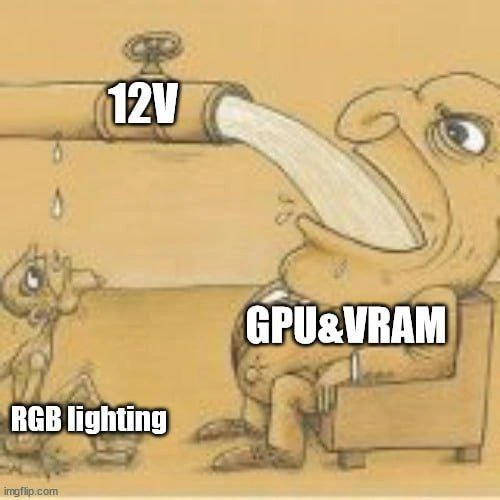
The reality of power distribution in a high-end PC
Description
A cartoon meme illustrating the disparity in power consumption within a modern computer. The image depicts a large, grotesque character labeled 'GPU & VRAM' sitting in a chair and greedily guzzling a massive stream of liquid from a large pipe labeled '12V'. Below, a small, emaciated, and desperate-looking character labeled 'RGB lighting' is on the ground, trying to catch single drops falling from the pipe. This meme is a technical joke for PC builders and hardware enthusiasts, humorously representing how modern high-performance Graphics Processing Units (GPUs) and their Video RAM (VRAM) consume the vast majority of the power delivered by the 12-volt rail of a power supply unit (PSU), while aesthetic features like RGB lighting use a comparatively insignificant amount



Comments
26Comment deleted
My GPU's power connector has more pins than my first CPU had transistors. The RGB lights are just there for a 0.1% performance boost and to signal when the power bill is due
Proof my PC is really a Kubernetes node: the GPU runs a privileged TensorFlow job guzzling 300 W, while the RGB sidecar sits in Best-Effort QoS praying for a single milliamp
After 20 years in the industry, I've watched GPUs evolve from sipping 75W through the PCIe slot to requiring dedicated nuclear reactors, yet somehow the RGB ecosystem still manages to make our power supplies cry - because nothing says 'enterprise-grade architecture' like allocating 10% of your PSU capacity to making your RAM sticks pulse in rainbow colors while your GPU melts through the floor
This perfectly captures modern PC building priorities: we've reached a point where motherboards have dedicated RGB headers with more sophisticated controllers than some embedded systems, while engineers are desperately trying to fit 600W GPUs into ATX specs designed in the 90s. The real kicker? That RGB controller probably has better documentation than your GPU's memory subsystem, and costs more to implement than the actual performance delta it provides. It's the hardware equivalent of spending sprint velocity on CSS animations while the backend is on fire - except here, the backend is literally thermal throttling
My PSU is a multi-tenant system: GPU+VRAM are the noisy neighbor on the 12V rail, and RGB runs as best effort QoS
GPU diets: chug 12V like open bar, hoard VRAM like it's Y2K, flex RGB to hide the power bill horror
12V QoS: GPU+VRAM are Guaranteed, RGB is BestEffort - then when the PSU brownouts, the only P1 ticket is “LEDs stopped breathing.”
don't actually power rgb from the 12V rail unless your led strip has resistors and is designed for it, PC PSUs regulate voltage, not current Comment deleted
AMS1117 ftw. Comment deleted
it's easy for a regular led strip to overcurrent and catch fire due to yoinking too many amps or just strain the psu Comment deleted
„Overcurrent“ is not a thing. Look up ohm‘s law. Comment deleted
Komedy Comment deleted
Dude, Ohm's law says there's a limit to how much current a circuit can pull. It doesn't say that said circuit will be fine with that current. It doesn't say that is the amount of current needed for said circuit to work. There are a lot (most actually) of circuits it microelectronics that die instantly if you don't limit their current. That's why 12V led strips have resistors, and why connecting one not designed for PC12V application will make it die and/or catch fire. Comment deleted
Resistors is the key word; it’s usually constant along with the design voltage. This leaves no wiggle room for current Comment deleted
Not only the design voltage, but also the design application. A lot of led strips are made to work with their own PSU that has a current limit below the led strip, so the strip itself does not have any protection in place. Powering it with a PC PSU is a recipe for a bad time. Comment deleted
How does resistors limit current? 🤔 Comment deleted
resistors are just wires with high internal resistence Comment deleted
Yeah...the name suggests so. But as per my knowledge resistors only lowers the current in ratio of voltage and resistance. Very high voltage will still result into very high current. Comment deleted
yes Comment deleted
Why don't people use simpler terms to convey the exact same thing ? Comment deleted
Ye. the reason for it is you'd have to include a resistor on every segment due to it being snippable to arbitrary length, and that'd be expensive for no reason if you can just put that in the led driver circuit Comment deleted
Snippable is a good point; makes the resistance variable and the brightness being bound to voltage and desired to be constant, the current has to be adjusted. Thx Comment deleted
so you know, the reverse meme would actually be funnier Comment deleted
Why? 😂 Comment deleted
Why are you explaining it. Those who get it..get it. Comment deleted
What happened saaar Why are you laughing saaaar ??? Comment deleted