
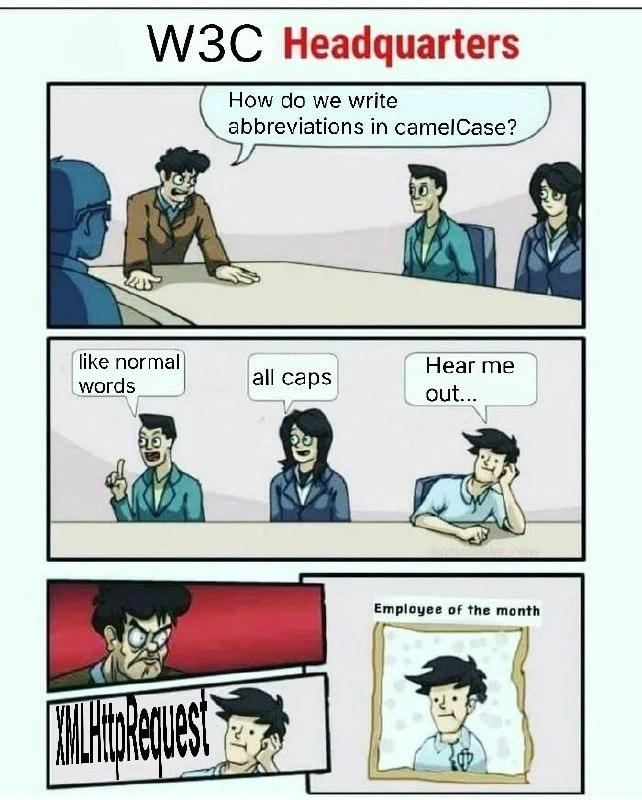
The W3C's Controversial Decision on camelCase Abbreviations
Description
This is a three-panel comic meme format, often called 'Boardroom Suggestion' or 'Employee of the Month'. The comic is titled 'W3C Headquarters' in large black and red text. In the first panel, a group is in a meeting, and the boss asks, 'How do we write abbreviations in camelCase?'. In the second panel, two employees offer logical suggestions: 'like normal words' and 'all caps'. A third, smug-looking employee leans back and says, 'Hear me out...'. The third panel is split. On the left, the boss has an angry, strained expression as the smug employee's suggestion is revealed: 'XMLHttpRequest'. On the right, a picture of the smug employee is shown with the caption 'Employee of the month'. The meme humorously blames the World Wide Web Consortium (W3C) for the famously inconsistent and awkward capitalization of the XMLHttpRequest API. The convention for handling acronyms within camelCase (e.g., XML, HTTP) is a common debate, and XMLHttpRequest violates all sensible conventions by capitalizing 'XML' but only the 'H' in 'Http'. The joke is that this terrible idea was not only accepted but celebrated, a relatable frustration for web developers who have dealt with this API for decades

Comments
20Comment deleted
Some say the developer who named XMLHttpRequest was a genius, forcing two decades of engineers to pause and reflect on the arbitrary nature of standards every time they type it
Proof that if your bikeshedding adds just enough entropy, the name survives long enough to become a browser API - and a generation of linters just sighs and skips the check
The real irony is that XMLHttpRequest became so successful despite its naming convention that we now have fetch() - proving that sometimes the best refactoring is just starting over with a completely new API rather than fixing 20 years of backwards compatibility
XMLHttpRequest perfectly encapsulates the W3C standardization process: take a Microsoft innovation, debate it for years, and emerge with a naming convention that violates every style guide while somehow becoming so entrenched that we're still teaching it to junior devs two decades later - right before explaining why they should use fetch() instead
XMLHttpRequest: the reason every style guide has a grandfatheredIdentifiers allowlist
XMLHttpRequest: W3C's camelCase 'standard' that's haunted enterprise refactors since dial-up days
Only in web standards can you fetch JSON over HTTP with an interface named XMLHttpRequest - proof that casing by committee outlives every linter
Ah, that perfectly normal english word «http», just like Shakespeare intended Comment deleted
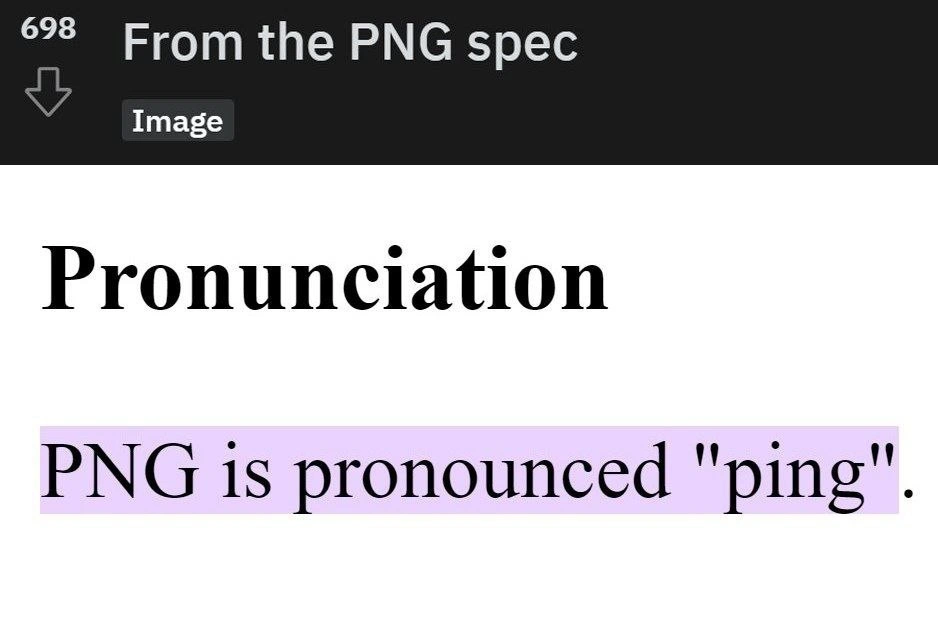
a shitty pee Comment deleted
XMLH TITI PEE Comment deleted
Http is an acronym to "hot potato", optionally Https = "hot potatoes", still relevant ✅ Comment deleted
XML_HTTP_Request SNAKE_camelCase Comment deleted
snamel Comment deleted
h titty pee 👌 Comment deleted
This took me as long to get as answering in 3 other chats Comment deleted
The latin h letter in japan is literally a sex symbol Comment deleted
Oh really? Comment deleted
/s? Comment deleted
Why was comment counter showing 30 and then 15? Comment deleted
French government intervention. Comment deleted