Skip to content
DevMeme
5295 of 7435
The PNG Pronunciation Debate: Settled by the Spec
DevCommunities Post #5807, on Jan 12, 2024 in TG

The PNG Pronunciation Debate: Settled by the Spec

Why is this DevCommunities meme funny?

Level 1: The Dictionary Decides

Imagine two friends arguing about how to say a tricky word they found. Maybe it’s the name of a new cartoon character or a weird animal — one friend says it one way, the other friend says it another way. They keep arguing and laughing because neither is sure who’s right. Then their teacher comes over with a big dictionary (or an official guide) and points to the word, showing them exactly how it’s supposed to sound. Suddenly it’s clear: the word is pronounced only one way. The friends giggle, realizing the answer was in the book all along, and the argument is finally over. This meme is just like that, but for computer people: developers were unsure how to say “PNG,” so the official manual stepped in, gave the final word, and everybody can finally agree (and smile about how silly the fight was). The big lesson? Sometimes the easiest way to settle a name debate is to look it up in the official guide and let it have the final say, just like a dictionary settling a playground argument.

Level 2: Say It, Don’t Spell It

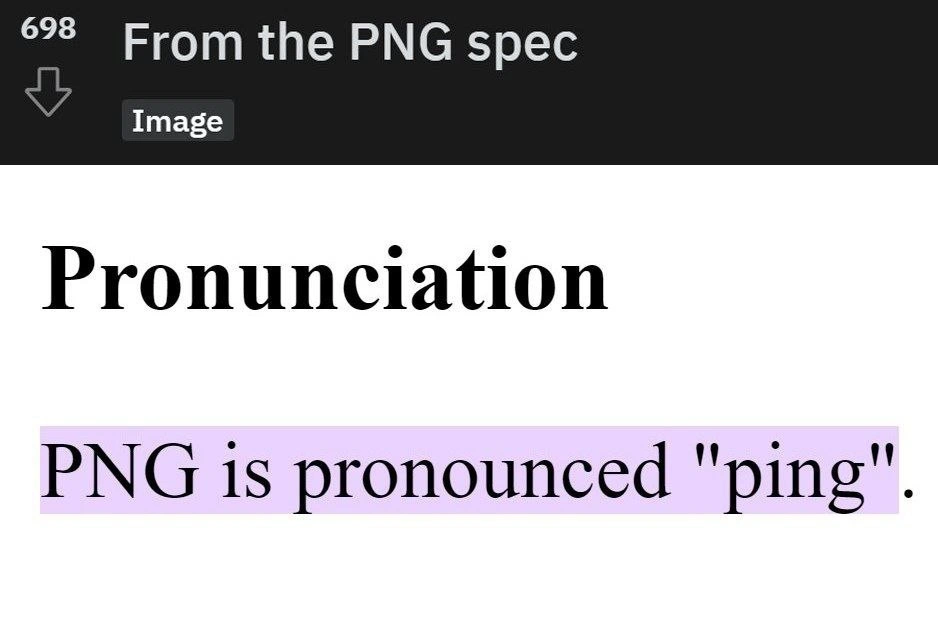
Let’s break down what’s going on here. PNG stands for Portable Network Graphics, which is a widely used image file format (like JPEG or GIF). If you’ve ever saved an image with a transparent background, chances are it was a PNG file. Now, the meme shows a snippet from the official PNG specification (basically the rulebook or detailed documentation for the PNG format) where they talk about how to pronounce “PNG”. The key line is: “PNG is pronounced ‘ping’.” This means that instead of saying each letter P-N-G out loud, the people who created the format intended for us to say it as one short word: “ping” (yes, just like the sound or the network utility named ping). In other words, they want the abbreviation to be spoken as a word, not spelled out letter by letter. This is a bit like how we say “JPEG” as “jay-peg” instead of J-P-E-G, or how “SQL” often rolls off the tongue as “sequel” instead of S-Q-L. It’s a little naming convention baked into the documentation to guide everyone on talking about the technology consistently. This snippet turning up in a meme is a form of DocumentationHumor – it’s funny to see a super formal document weigh in on something as small as pronunciation.

Why does this matter? Well, in tech and developer circles, there are a lot of acronyms and special terms, and people often end up debating the “right” way to say them. These are the pronunciation debates you might have heard of, like the famous GIF vs. JIF argument. (For context: GIF is another image format – Graphics Interchange Format – and for decades some folks have said it with a hard “g” sound like “gift” without the “t”, while others, including the inventor of GIF, insist it should sound like “jiff”, like the peanut butter. That debate became a running joke in the tech world.) Similarly, with PNG, some people might just spell out the letters “P-N-G” when talking about a file, whereas others might say “ping” as a quirky shorthand. Until you read the PNG spec, you might not even know there is an official stance! The meme is highlighting that the official documentation itself took a side – it literally spelled out the preferred way to say the name. This is both educational (now you know!) and humorous, because it’s like finding an answer to a silly argument hidden in an instruction manual.

For a new developer or someone early in their tech journey, this meme is also poking fun at how much programmers care about naming and correctness, even for something as small as pronunciation. There’s a saying: “Naming things is hard,” which partly means picking good names in code is tricky, but it also reflects that we fuss over terminology a lot. This scenario shows that even the acronym of a file format can cause a mini controversy. The PNG spec adding a pronunciation guide is a bit unusual — most technical documents focus on how the format works, how to implement it, etc., rather than how to say it out loud. But here the authors probably thought, “People might get confused or disagree, so let’s clear it up.” It’s a little like including a note in a recipe book that says “By the way, ‘quinoa’ is pronounced ‘keen-wah’.” It saves everyone from arguing at the dinner table later. In developer terms, the spec is the ultimate reference (kind of like the dictionary or rulebook for that technology), so when it explicitly says “pronounce it like ping,” that carries weight. It’s telling all developers: “We chose this name on purpose, and here’s how you say it.”

This connects to a broader developer in-joke: often, arguments in the programming world (be it tabs vs spaces, how to pronounce SQL, or what to name a variable) can go in circles forever because everyone has an opinion. Sometimes the argument lasts until someone finally pulls out the official documentation or standard and points, “See? It’s written here.” In our meme’s case, one clever soul basically did just that — quoting the documentation to settle the score. It’s a perfect example of tech humor where a mundane piece of a data format’s documentation becomes a punchline. Plus, it’s a gentle reminder: when in doubt, check the docs (they might even have the exact answer to what you’re squabbling over!). And if the docs say “PNG is pronounced ping,” then hey, now you can correct your friends with confidence — or at least know why that one colleague keeps saying “ping image” during meetings. It’s all part of the fun in learning the little quirks of tech lingo.

Level 3: Spec to the Rescue

In the annals of developer lore, few battles are as enduring (and endearing) as the pronunciation debate. This meme delivers a mic-drop moment straight from the PNG specification itself, highlighting a section titled “Pronunciation” where the official text declares: “PNG is pronounced ‘ping’.” For seasoned developers, this is hilariously on the nose. We’ve seen these skirmishes before — the classic GIF vs. “JIF” saga, the SQL (“sequel” vs. S-Q-L) dilemma, the “Linux” vs. “Line-ux” confusion — and here comes the Portable Network Graphics spec settling its own score. The humor lies in the spec’s authority casually ending an endless debate that geeks have hashed out on forums for years. It’s as if the documentation itself stepped into a Reddit thread to say “Alright folks, RTFM and calm down.”

Why is this combination of elements so funny to an experienced dev? First, it satirizes our industry’s knack for obsessing over NamingThings. There’s an old joke: “There are only two hard things in Computer Science: cache invalidation, naming things, and off-by-one errors.” Pronunciation might not usually make that list, but we sure treat it like it does. Entire flame wars have raged simply because one engineer said “Pee-Enn-Gee” and another insisted on “ping.” Sound trivial? It is — and that’s exactly why it persists. This is bikeshedding in its purest form (focusing on trivial details everyone has an opinion on). It’s much easier to argue about how to say an acronym than to, say, rewrite the image processing library, so naturally developers dive in and take sides. The meme winks at this tendency: the Documentation itself had the answer all along, if only we cared to read it. It’s a classic case of DocumentationHumor where the punchline comes from an official source schooling the community.

Historically, PNG was created in the mid-1990s as an open alternative to GIF (after a patent snafu with GIF’s compression algorithm). Perhaps scarred by the GIF pronunciation debacle (and the ongoing “hard G vs soft G” holy war), the PNG authors proactively included a pronunciation note in the spec. It’s as if they foresaw developers in 2024 still arguing about whether to say the format’s name as letters or as a word. By canonizing “ping” in the spec, they tried to nip that confusion in the bud. The meme’s image of the spec snippet — complete with a formal Pronunciation heading — beautifully captures this hyper-precise engineering culture. It’s simultaneously a nod to our reverence for standards (the spec is like scripture for file formats) and a gentle ridicule of how pedantic we can be about language. After all, if a single line in a PDF can end a thousand forum posts, why not celebrate it?

The senior dev perspective also catches an ironic undertone: even when the spec lays down the law, will it truly end the debate? Seasoned engineers know the answer: probably not. We’ve been here before — the inventor of GIF outright said “It’s pronounced JIF,” yet plenty of programmers staunchly stick to a hard G as in “gift.” Specs and standards often declare one thing, while colloquial usage does another. (How many of us still say “master branch” even after the official terminology changed?) The meme hints at this disconnect. Sure, the PNG spec has spoken – case closed, right? – but the real inside joke is that developers love the debate itself. Even with the DataFormats gods weighing in, some will playfully refuse (“I’ve been saying P-N-G for 20 years, not gonna stop now!”). So the meme nails that too real sentiment: on one hand, a relief that there’s a definitive answer straight from the source; on the other, the knowledge that our community will find a way to keep arguing anyway (because, tradition!). It’s this blend of tech documentation precision and age-old developer stubbornness that makes the meme resonate. In short, the file_format_pronunciation war might have an official victor, but the fun was always in the fighting. The spec just gave us a great punchline to end on.

Description

A screenshot of what appears to be official documentation, decisively ending a common tech debate. The image has a header section with the text 'From the PNG spec', indicating the source is the official Portable Network Graphics specification. Below this, a large, bold heading reads 'Pronunciation'. The key piece of information is a highlighted sentence that states, 'PNG is pronounced "ping".'. This meme derives its humor from its appeal to authority - the official 'spec' - to settle a trivial but often passionately debated topic among developers: whether to pronounce the acronym as 'P-N-G' or 'ping'. It's a classic 'well, actually' moment that resonates with the pedantic nature of engineering culture and the ultimate respect for primary documentation as the source of truth
Comments

44
Anonymous ★ Top Pick Great, the PNG spec settled it. Now, can the SQL standard please issue a formal ruling on whether keywords should be uppercase or lowercase? The people need to know
  1. Anonymous ★ Top Pick

    Great, the PNG spec settled it. Now, can the SQL standard please issue a formal ruling on whether keywords should be uppercase or lowercase? The people need to know

  2. Anonymous

    The spec says PNG is “ping” - great, now when I ask for a high-res ping the designers hand me a 4 MB image and the SREs start tracing ICMP packets; at least the bikeshed finally has a color

  3. Anonymous

    After 20 years of saying 'pee-en-gee' in meetings, discovering the spec says 'ping' is like finding out you've been pronouncing 'SQL' wrong your entire career - except now you have to decide whether to die on this hill or quietly gaslight everyone who heard you say it differently

  4. Anonymous

    After decades of developers arguing whether it's 'P-N-G' or 'ping,' someone finally RTFM'd the spec. Turns out the answer was on page 698 all along - right there in the official documentation that nobody reads until they need to win an argument. Classic case of 'the documentation was inside us all along'... or rather, publicly available since 1996

  5. Anonymous

    PNG spec mandates 'ping' pronunciation - finally, an image format with mandatory network round-trip latency in every utterance

  6. Anonymous

    Great, now Grafana alerts for "high ping" could mean ICMP latency or a 4MB hero image

  7. Anonymous

    Spec says PNG is pronounced “ping”; somewhere ops is chasing ICMP latency while marketing ships a 10MB transparent hero ping - different pings, same SLO breach

  8. @mihanizzm 2y

    Pee an gee

  9. @bubblechuk 2y

    3.14ng

  10. @dp229 2y

    Oh hell nah man

  11. @callofvoid0 2y

    they lied us all

  12. @sorokdvasorrow 2y

    No, it's not...

  13. @buffy_bara 2y

    peng

  14. @M_Ali_S_S 2y

    These are the same people who call gif, jif

  15. @ZgGPuo8dZef58K6hxxGVj3Z2 2y

    Is this Linus Tech Tips reference?

  16. @callofvoid0 2y

    damn

    1. @ZgGPuo8dZef58K6hxxGVj3Z2 2y

      Do you think they will mark me as “never ever look at this guy’s complaint ever”?

      1. @callofvoid0 2y

        nah they will mark your next reports as:"hey gather here, here's the new joke"

        1. @ZgGPuo8dZef58K6hxxGVj3Z2 2y

          💀💀💀😂😂😂

  17. @SamsonovAnton 2y

    Many people dare to say that SCSI is pronounced as "SKUZ-ee" (ˈskʌzi), but true oldfags know that it sounds "Sexy".

    1. @sylfn 2y

      ass-see-ass-eye

  18. @Le_o_R 2y

    At a conference I had lunch with a guy who worked at MySQL (which had just been bought by Sun). He said some people call it My Es Cue El. Some people call it My Sequel. But he personanly preferred calling it My Sexual.

  19. @Horace4815162342 2y

    ПЭ ЭН ГЭ

    1. @purplesyringa 2y

      use english in this chat please

    2. @sylfn 2y

      peh -- enne -- gheh

      1. @purplesyringa 2y

        are you french or what

        1. @sylfn 2y

          what

          1. @purplesyringa 2y

            i don't even know how to count how many unpronounceable letters there are

            1. @sylfn 2y

              a fucking lot

              1. @sylfn 2y

                but they all are necessary!!

        2. @sylfn 2y

          lmao

      2. @sylfn 2y

        ipa is unneeded if you can read this bullshit

        1. @purplesyringa 2y

          i can't

          1. @sylfn 2y

            why

      3. @sylfn 2y

        sorry i miswrote

        1. @sylfn 2y

          ref

          1. @RiedleroD 2y

            XD

            1. @sylfn 2y

              whaaaats wrooong 😭

  20. @Horace4815162342 2y

    I know about the speciffic rule of this channel but english language does not have the same Э sound that i picture in my head

    1. @purplesyringa 2y

      right

      1. @purplesyringa 2y

        i've just tried translating it into IPA and failed

        1. @purplesyringa 2y

          this is probably [pə ɛn gə] (the default russian pronounciation of the letters П meaning P, Н meaning N, Г meaning G separately)

    2. @callofvoid0 2y

      Eh

  21. @Horace4815162342 2y

    Not even close

Use J and K for navigation