
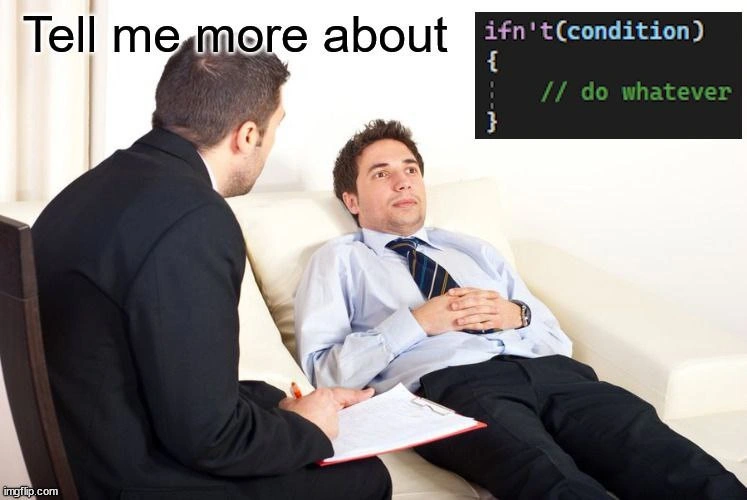
When Your Bad Code Ideas Need Professional Help
Description
The image uses the 'man in therapy' meme format. A man in a shirt and tie lies on a therapist's couch, looking up with a troubled or distant expression. A therapist, seen from behind, sits in a chair holding a clipboard and pen, seemingly taking notes. Above them is the text 'Tell me more about' followed by a black code block. The code block contains the following text: 'ifn't(condition) { \n // do whatever \n}'. The joke lies in the fictional 'ifn't' statement, a portmanteau of 'if not'. It represents a nonsensical or 'cursed' coding idea that a developer has invented. The meme humorously suggests that such a terrible idea is a source of psychological trauma for the developer, requiring a therapy session to process. For experienced developers, it's a relatable jab at the 'clever' but unreadable shortcuts one might invent and later regret, touching on themes of code quality, maintainability, and the inner monologue of programming
Comments
21Comment deleted
Some developers write code that needs a profiler. This developer writes code that needs a psychologist
Somewhere out there a compiler just added another stage: denial, anger, bargaining, depression, acceptance… and now ‘ifn’t’. Guess we finally shipped the Kübler - LLVM pipeline
The same developer who writes if(!(condition)) is now explaining why their microservice needs 47 environment variables and a custom DSL for configuration because "YAML wasn't expressive enough."
This is what happens when you let your code reviewer take a sabbatical - someone merges 'if'n't' into production and now your entire team needs therapy to process the trauma. It's the programming equivalent of discovering your predecessor implemented a custom boolean algebra where true means 'maybe' and false means 'ask again later.' The real horror isn't the syntax itself - it's knowing that somewhere, in some legacy codebase, there's probably a macro that actually makes this work, and it's been in production for 15 years because nobody dares touch it
It starts as a cute macro - ifn't(x) expands to if(!(x)) - and ends with on-call debugging ifn't(!feature_enabled && !!ready) at 3am and a new style guide that simply says: never be clever
After 20+ years, ifn't(condition) remains the holy grail of syntax sugar - languages give us !condition instead, and therapy bills for the emotional debt
‘ifn’t’ is cute until 3am on-call, when the only interpreter left is your future self
condition't Comment deleted
return't Comment deleted
COME FROM Comment deleted
whilen't Comment deleted
read like violent Comment deleted
don't { // whatever } while (c); Comment deleted
don't looks like multiline comment block Comment deleted
vnature Comment deleted
It's awesome! Can be useful:) Comment deleted
Ruby coming in with the unless Comment deleted
actually why not, just a block for correct code that can be highlighted and linted but is unreachable Comment deleted
#if 0 Comment deleted
int variable = foo #if 0 + #else - #endif bar; so the code in unreachable preprocessor blocks always has to be cut off by linter to not eat some junk instead. The pure {} is supposed to have complete statements only. That's it Comment deleted
https://t.me/devs_chat/114545 credits? Comment deleted