
Unit Tests vs. Integration Tests: The Cybertruck Method
Description
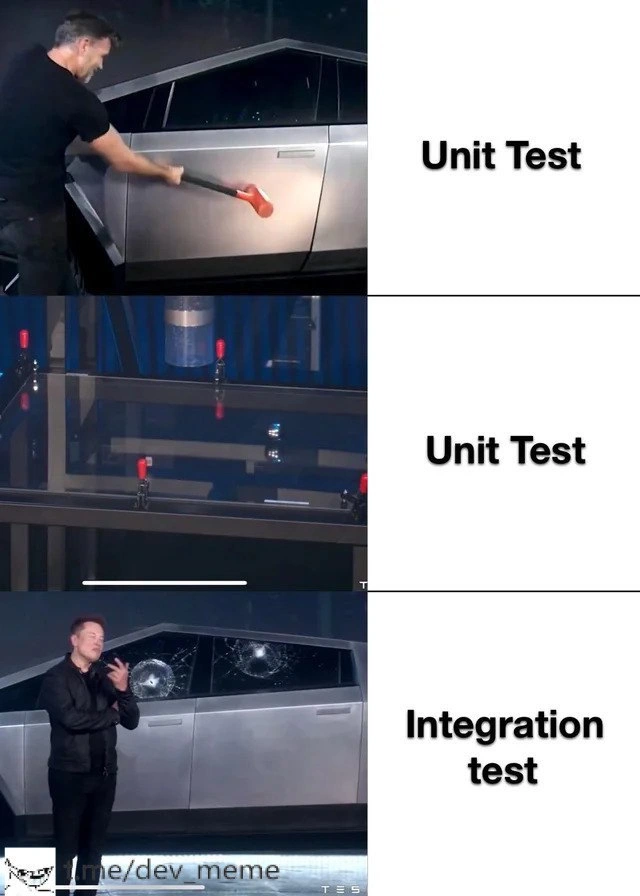
A three-panel meme using the infamous Tesla Cybertruck demonstration to explain software testing concepts. The first panel shows a man hitting the Cybertruck's door with a sledgehammer, which remains undamaged, labeled 'Unit Test'. The second panel shows a lab test of the 'armor glass' withstanding an impact, also labeled 'Unit Test'. The final panel shows Elon Musk on stage looking dismayed in front of the same Cybertruck, now with two large, shattered windows, labeled 'Integration test'. This meme perfectly illustrates a common software development scenario where individual components (units) pass their isolated tests, but the system as a whole fails when these components are combined and tested together (integration). The humor lies in the very public and catastrophic failure of the live demonstration, which serves as a painfully relatable real-world analogy for when 'it works on my machine' meets the production environment



Comments
7Comment deleted
The Cybertruck windows are the perfect metaphor for microservices. They work flawlessly in their isolated test environment, but the moment they have to interact with another service - like a small metal ball - the entire system shatters and you're left explaining it to a bewildered CEO on stage
Everything was green in CI until DoorService published an unmocked “sledgehammer” event and GlassService discovered the contract tests were as brittle as the glass
Unit tests passing with 100% coverage is just your code's way of building false confidence before the integration tests reveal you've been mocking reality the whole time
This perfectly captures the eternal optimism of green CI pipelines: your unit tests pass with 100% coverage, your mocks are pristine, your stubs are elegant - then you deploy to production and discover that while each microservice works flawlessly in isolation, together they create a distributed system that shatters like Cybertruck glass. The real test isn't whether your code works; it's whether your code works with everyone else's code, third-party APIs having a bad day, network partitions, and that one legacy service written in 2003 that nobody dares touch. Unit tests give you confidence; integration tests give you humility
100% unit coverage on door and glass; integration failed due to an undocumented coupling via the "car frame" event bus - aka physics
Everything was green locally until CI ran the integration suite with real dependencies and we learned the door test mutated global state - turns out my mocks were tempered, not the glass
Unit tests: 100% coverage on seams. Integration: 'Congrats, your monolith just became a sieve at scale.'