
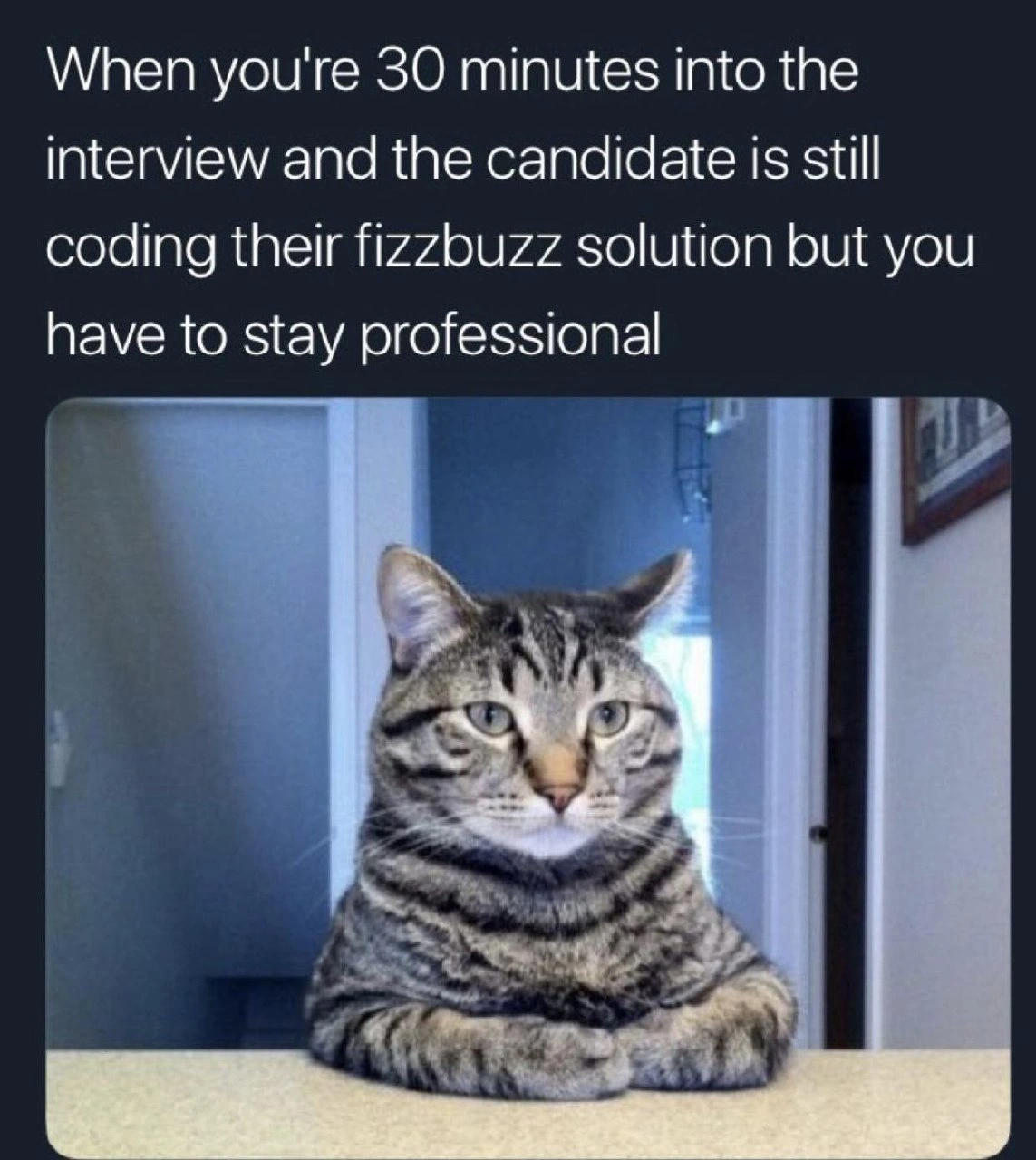
The Agony of a FizzBuzz Interview That Never Ends
Description
A popular meme format featuring a grey and black tabby cat sitting upright at a table with its paws neatly folded, looking directly at the viewer with a serious, slightly judgmental expression. The image is captioned with white text on a dark background above the cat: 'When you're 30 minutes into the interview and the candidate is still coding their fizzbuzz solution but you have to stay professional'. The humor stems from the juxtaposition of the cat's human-like, professional posture with the exasperating scenario described. FizzBuzz is a notoriously simple programming problem used in early-stage interviews to filter out candidates who lack the most basic coding skills. A candidate taking 30 minutes to solve it is a major red flag, and the cat's expression perfectly captures the interviewer's internal struggle to maintain composure and professionalism in the face of such incompetence

Comments
20Comment deleted
30 minutes on FizzBuzz? Forget time complexity, at this point we're measuring the solution's half-life
Keeping a straight face while the candidate architects FizzBuzz as an eventually-consistent, event-sourced microservice - thirty minutes in and we still don’t have a single modulo
After 15 years of conducting interviews, you realize the real FizzBuzz test isn't whether they can solve it - it's whether you can maintain your poker face when they start implementing a factory pattern with dependency injection for a problem that needs three if-statements
The FizzBuzz problem: simultaneously the most trivial coding challenge and the most reliable predictor of whether someone can actually code. When a candidate hits the 30-minute mark on a problem that should take 5, you're not just watching them struggle with modulo operators - you're witnessing the exact moment your hiring pipeline's time complexity degrades from O(1) to O(please-make-it-stop). At least the cat's composure reminds us that maintaining professional decorum is itself a senior engineering skill, especially when you're internally calculating the opportunity cost of this interview in terms of PRs you could have reviewed
Thirty minutes into FizzBuzz, I quietly switch the rubric from algorithms to forecasting our mentorship burn rate and start drafting the onboarding runbook
FizzBuzz: turning O(n) basics into an exponential test of interviewer patience
Minute 30 of FizzBuzz: calculating our hiring funnel’s precision/recall and debating a circuit breaker - SLO: modulo within five minutes
https://github.com/EnterpriseQualityCoding/FizzBuzzEnterpriseEdition Comment deleted
What does fizzbuzz means? Comment deleted
FizzBuzz is a game that has gained in popularity as a programming assignment to weed out non-programmers during job interviews. The object of the assignment is less about solving it correctly according to the below rules and more about showing the programmer understands basic, necessary tools such as if-/else-statements and loops. The rules of FizzBuzz are as follows: For numbers 1 through 100, • if the number is divisible by 3 print Fizz; • if the number is divisible by 5 print Buzz; • if the number is divisible by 3 and 5 (15) print FizzBuzz; • else, print the number. Comment deleted
Got it, thanks, never heard about this Comment deleted
It’s a small problem that gives insight of how well the programmer can improvise. Like Fizz, Buzz can be made by 2 if statements, maybe even the Fizz Buzz FizzBuzz. But if you add another rules then the programmer must come up with an eleganter solution than just have a bunch of if statements checking each possibility… Comment deleted
Indian style: print "1" print "2" print "Fizz" print "4" print "Buzz" ... print "98" print "Fizz" print "Buzz" Comment deleted
Advanced Indian style: switch (i) { case 1: printf("%i\n", i); break; case 2: printf("%i\n", i); break; case 3: printf("Fizz\n"); break; ... } Comment deleted
No, it's worse, the first one was O(n), this one is O(nlogn) unless optimizer converts it to the 1st solution anyway Comment deleted
Won't it be just a O(1) jump table? Comment deleted
Oh, I got it: you referred to the entire 1 to 100 loop, not just the switch statement. However, by "Advanced" I didn't mean "more effective", but rather "more impressive" — looking more sophisticated. Comment deleted
I love this community, the sarcasm 💀😂 Comment deleted
💀💀💀💀💀😂😂😂 Comment deleted
so frustrating nobody yet invented a website you can search thing at Comment deleted