
Rubber Duck Debugging's Final Verdict
Description
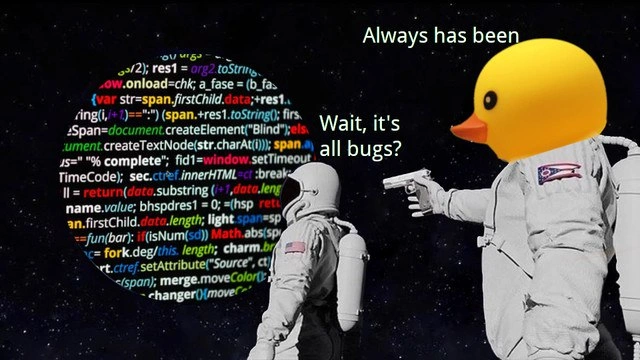
A popular meme format known as 'Wait, It's All Ohio? Always Has Been' is adapted for a software development context. The scene is set in outer space, with two astronauts. The first astronaut is looking at a celestial body that, instead of being a planet, is a sphere composed entirely of multi-colored lines of code. This astronaut says, 'Wait, it's all bugs?'. The second astronaut, standing behind the first, is aiming a pistol at them and replies, 'Always has been'. The head of this second astronaut has been replaced with a large, yellow rubber duck head, and the Ohio state flag is visible on their spacesuit's shoulder. This meme cleverly combines the existential dread of the original format with a core software development practice. 'Rubber duck debugging' is a method where programmers explain their code to an inanimate object (like a rubber duck) to uncover errors. In this meme, the ultimate debugging tool, the rubber duck, is delivering the grim news that the entire system is fundamentally flawed, a relatable sentiment for any developer who has worked on a complex or legacy codebase

Comments
7Comment deleted
Some programmers use a rubber duck to find bugs. Senior engineers know the duck is just there to confirm their suspicion that the entire architecture is a distributed monolith held together by hope and a single, undocumented environment variable
Turns out our 1.8 MB minified bundle isn’t an app at all - it’s just eleven years of hotfixes orbiting a single “undefined is not a function.”
After 20 years in the industry, you realize the junior dev asking 'is this a bug or a feature?' was actually asking the wrong question. The real enlightenment comes when you understand that your entire microservices architecture, with its carefully orchestrated containers and service meshes, is just bugs holding hands in a circle, hoping nobody notices they're all leaning on each other for support
After 20 years in the industry, you realize the astronaut was right all along - it's not that we write bugs, it's that bugs are the fundamental building blocks of software, and our job is just arranging them into patterns that occasionally produce the desired side effects. The real skill isn't avoiding bugs; it's achieving just enough correctness that the system limps into production before anyone notices the Earth is actually a giant ball of DOM manipulation edge cases
Senior take: once a bug survives three sprints and one incident review, it’s not a defect - it’s an implicit API with backward-compatibility guarantees
That forgotten event listener from '09? Still leaking memory across your SPA rewrites - true technical debt immortality
Wait, it’s all bugs? Always has been - we just call the deterministic ones “APIs” and hide the rest behind feature flags