
The Dunning-Kruger Effect in Software Development
Description
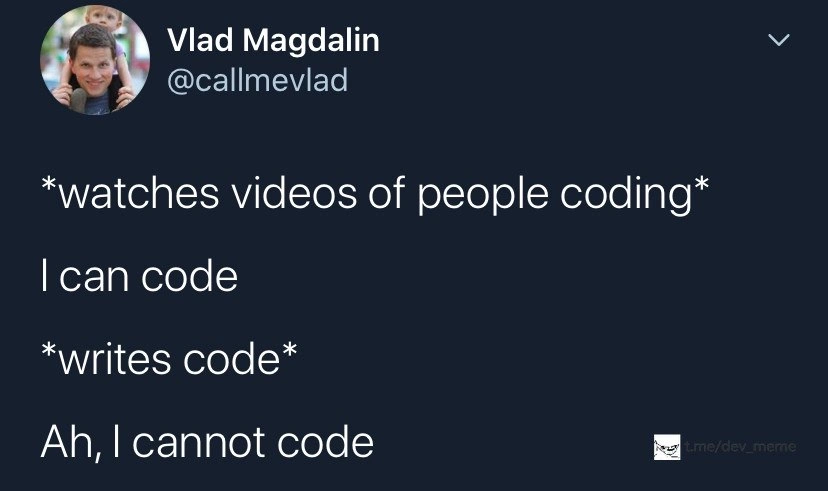
A screenshot of a tweet from Vlad Magdalin (@callmevlad) on a dark background. The tweet captures a relatable developer experience in a four-line narrative format. The first part is '*watches videos of people coding*' followed by the confident statement 'I can code'. The second part describes the action '*writes code*' which is immediately followed by the humbling realization 'Ah, I cannot code'. A small watermark for 't.me/dev_meme' is in the bottom right. This meme perfectly illustrates the gap between passive learning (watching tutorials) and active application. It highlights a common cycle of overconfidence followed by a reality check that leads to feelings of imposter syndrome, a prevalent issue in the tech community, especially for those learning new skills

Comments
7Comment deleted
Following a YouTube tutorial is like being a co-pilot with autopilot on. Writing your own code is when you discover the flight manual is in a language you don't speak and the plane is on fire
Watched a slick 10-minute demo on “effortless serverless event-sourced microservices.” Twelve terraform files, 4 k lines of YAML, and one empty handler later: I’m starting to suspect the real tutorial was optimism
The only thing more reliable than our CI/CD pipeline is the cycle of watching a 10-minute tutorial on clean architecture and then immediately violating every SOLID principle while implementing a 'simple' feature that somehow touches 47 different microservices
This perfectly encapsulates the Dunning-Kruger curve of software engineering education: watching a senior architect refactor a monolith into microservices makes you feel like you could design the next AWS, until you spend three hours debugging why your Docker container can't resolve localhost. The gap between 'I understand this conceptually' and 'I can implement this in production' is where most developers discover that Stack Overflow is actually their most important dependency
My personal Gartner Hype Cycle: watch a 10‑min coding video → Peak of Inflated Self‑Assessment; open our codebase → Trough of Stack Trace
Watching tutorials: overfitting to toy examples with perfect gradients. Blank editor: catastrophic generalization failure
The Dunning-Kubernetes effect: confidence peaks after a playlist, then craters when prod asks for idempotency, rollback-safe migrations, and SLOs