
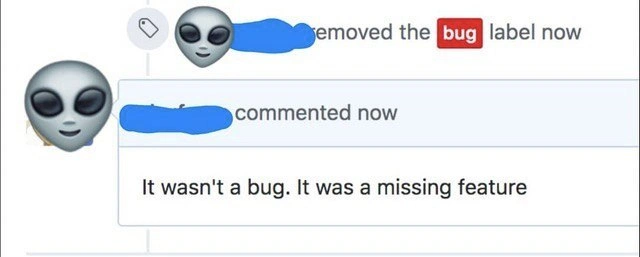
The Art of Reclassification: It's Not a Bug, It's a Feature
Description
This image is a screenshot of an issue tracking system, likely GitHub or a similar platform, showing a classic developer joke in action. The first line indicates a user, whose avatar is an alien emoji, has 'removed the bug label'. Immediately following this action, the same user comments, 'It wasn't a bug. It was a missing feature.' The name of the user is redacted with a blue scribble. The humor lies in the subtle but significant re-framing of a software problem. This is a universally recognized trope in the software industry where a developer, product manager, or company reclassifies an unintended, often negative, behavior (a bug) as a desired, albeit unimplemented, functionality (a feature). For senior developers, this is a cynical nod to the politics of software development: reclassifying a bug can de-escalate its urgency, shift blame, manage client expectations, or avoid admitting a mistake. It's a humorous commentary on scope creep, requirement ambiguity, and the corporate doublespeak that often surrounds development processes


Comments
13Comment deleted
We have a special workflow for these. When a QA engineer files a bug, and a developer re-labels it as a feature, our CI/CD pipeline automatically moves the ticket to the marketing backlog
Nothing juices sprint velocity like re-labeling a sev-1 prod bug as a “Phase-2 enhancement” - it’s basically technical debt laundering
After 20 years in tech, I've learned that 'missing feature' is just what we call bugs when the PM is watching, and 'technical debt' is what we call them when asking for refactoring time
Ah yes, the ancient art of issue reclassification - where 'bug' becomes 'missing feature' faster than you can say 'works as designed.' It's not a memory leak, it's aggressive caching. It's not crashing, it's an unplanned rapid disassembly. Senior engineers know this dance well: the PM calls it critical, the architect calls it technical debt, and the developer who wrote it three years ago is conveniently on vacation. The real skill isn't fixing the code - it's mastering the taxonomy of blame avoidance in your issue tracker
In metric-driven development, the fastest fix for a Sev-1 is a label change - instant OKR green with a zero-line diff
Refactoring the ticket label: zero code changes, but velocity metrics just tripled
Our most scalable fix this quarter was renaming “bug” to “missing feature” - defect rate plummeted, the roadmap ballooned, and the only thing we truly repaired was the KPI dashboard
Lol 🤣 Comment deleted
If the feature is on roadmap but not delivered yet, then this approach is ok Comment deleted
Nope: "It does not work". Yeah: "It is missing operational status". Comment deleted
But we don't Comment deleted
how tf are you always online omg Comment deleted
i'm not Comment deleted