
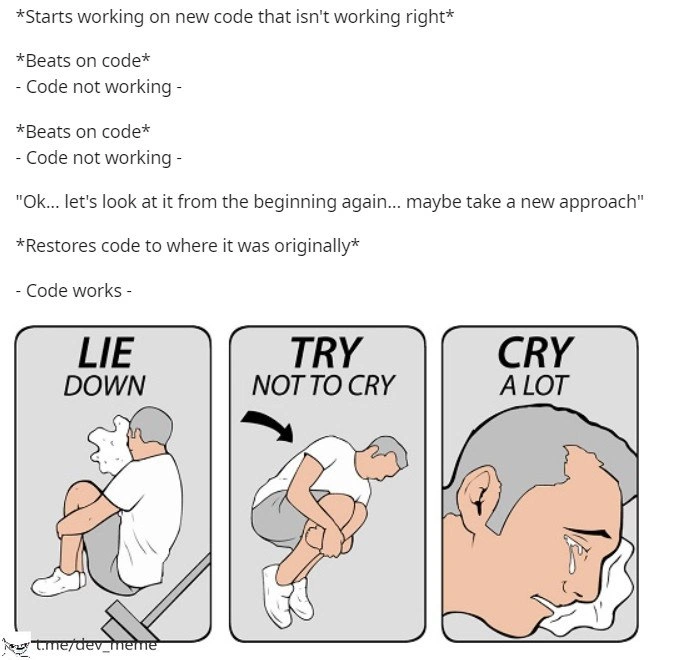
The existential dread of a self-fixing bug
Description
A two-part meme about a frustrating coding experience. The top part consists of text describing a developer's process: starting with non-working code, attempting to fix it multiple times ('Beats on code'), failing, deciding to revert to the original state, and then discovering that the original code now works perfectly. The bottom part is a three-panel comic, stylized as a safety instruction manual, that shows a man's reaction to this situation. The panels are labeled: 1. 'LIE DOWN', showing him curled up on the floor. 2. 'TRY NOT TO CRY', showing him curled tighter. 3. 'CRY A LOT', a close-up of his face as he weeps. The watermark 't.me/dev_meme' is in the bottom left. This meme captures the maddening, illogical nature of certain bugs (often called 'Heisenbugs') that seem to disappear when you try to fix them. It's a shared trauma for experienced developers, where the cause isn't a logical code error but likely a caching issue, a build process glitch, or some other hidden state problem that resolves itself after a reset, leaving the developer confused and emotionally drained

Comments
7Comment deleted
The code wasn't broken, your 'fixes' were. `git restore` is just a polite way of telling you to step away from the keyboard
Six hours rewriting the service with shiny patterns, one `git reset --hard` later it works; apparently the only stateful singleton was my ego
After 20 years in this industry, I've learned that sometimes the most sophisticated debugging technique is admitting defeat to git and accepting that the universe operates on quantum mechanics where observation changes the outcome - your code was both broken and working until you tried to fix it
The most humbling moment in a senior engineer's career: spending 6 hours refactoring perfectly working code into an elegant, well-architected solution that mysteriously breaks everything, then doing a `git revert HEAD` and watching the tests go green again. Sometimes the real technical debt is the hubris we accumulated along the way - and the only winning move is `git checkout -- .` and pretending that architectural vision never happened
Revert-Driven Development: after six hours of “fixes”, git reset --hard and it works - the Heisenbug lived in the build cache; the repo is just documentation
'New approach' always means git revert --hard HEAD~N, where N is hours of debugging-induced tech debt
Senior debugging tip: git reset --hard; RCA - an undocumented invariant guarded only by the build cache and a rogue feature flag