
The Anatomy of a Seemingly 'Easy' Ticket
Description
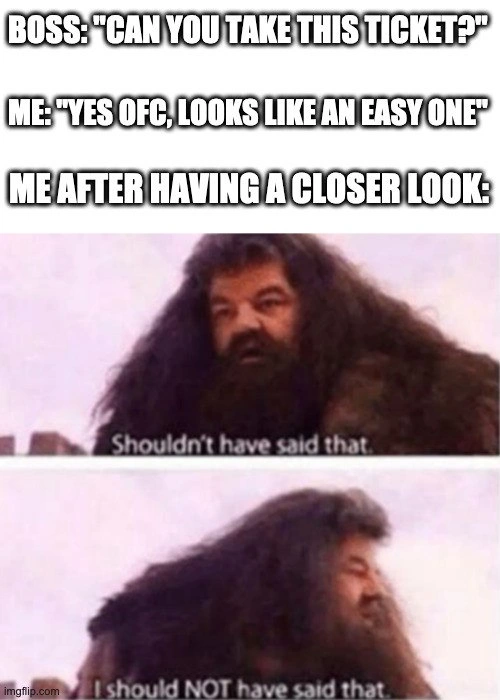
A three-part meme that illustrates the classic developer scenario of underestimating a task. The top section contains text on a white background: 'BOSS: "CAN YOU TAKE THIS TICKET?"', 'ME: "YES OFC, LOOKS LIKE AN EASY ONE"', and 'ME AFTER HAVING A CLOSER LOOK:'. The bottom section consists of two panels featuring the character Rubeus Hagrid from the Harry Potter series. In the first panel, a close-up of Hagrid shows him looking concerned, with the subtitle, 'Shouldn't have said that.' The second panel shows him with an even more regretful expression, with the emphatic subtitle, 'I should NOT have said that.' This meme perfectly captures the dawning horror a developer feels after confidently accepting a task, only to discover it's vastly more complex than it appeared on the surface. It speaks to the universal experiences of scope creep, hidden dependencies, and the dangers of premature estimation

Comments
7Comment deleted
The ticket was to change a button color. Turns out the button is rendered by a third-party service, the color is hardcoded in a WASM binary, and the original developer now lives in a monastery with no internet access
“Sure, I’ll take the 2-point ‘rename a field’ ticket” - cut to me tracing that name through six message buses, every Snowflake view, a legacy Perl cron from 2004, and the CFO’s favorite Tableau dashboard. Apparently I just volunteered to map the company’s entire dependency graph
After 15 years in the industry, I've learned that 'easy tickets' are like null pointer exceptions in production - they only appear harmless until you realize they're symptoms of an architectural decision made in 2008 by someone who left the company in 2009
Every senior engineer knows this moment intimately: that confident 'looks like an easy one' before discovering the ticket involves three deprecated APIs, a race condition that only manifests in production, undocumented legacy code from 2009, and somehow requires coordinating deployments across four microservices. The real skill isn't avoiding this trap - it's learning to add 'let me investigate first' to your vocabulary before committing to any timeline
The 1‑pointer was still O(1) - after the schema migration, feature flag archaeology, and four downstream contract updates, n just turned out to be hope
That 'easy' ticket? Straight to unraveling a load-bearing if-statement from the founder's first commit, now propping up quarterly earnings
“Looks easy” - then the one-line change touches time zones, cache invalidation, a backward-compatible schema migration, three downstream contracts, and our error budget; estimate: 30 minutes ± two sprints