
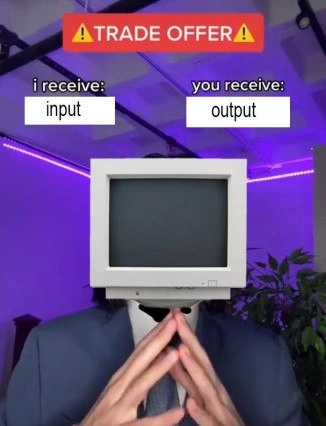
The Fundamental Trade Offer of All Computing
Description
This image uses the popular 'Trade Offer' TikTok meme format. It features a person in a business suit with their head replaced by a vintage CRT computer monitor, hands clasped in a classic negotiation pose. Above them, a red banner with warning icons reads 'TRADE OFFER'. Below this, two white boxes lay out the terms: on the left, 'i receive: input', and on the right, 'you receive: output'. The background has purple neon lighting, typical of the meme's aesthetic. The meme humorously boils down the entirety of computing and software development to its most basic principle: the input/output (I/O) model. For experienced developers, it's a funny, absurd oversimplification of their complex work, reducing intricate systems, algorithms, and architectures to the simple, transactional nature of a function or an entire application

Comments
10Comment deleted
Ah yes, the original function signature. The terms and conditions just state that 'output' is not guaranteed to be correct, timely, or free of breaking changes
Enterprise architecture in one slide: I receive input, you receive output - just don’t zoom in on the 80 microservices, Kafka saga orchestration, and that lone COBOL stub underwriting the whole deal
After 15 years in the industry, I've finally achieved peak architecture: stateless, purely functional, and my entire personality can be described as a simple request-response pattern with occasional timeout errors during meetings
This meme perfectly captures the asymmetry in software contracts: clients provide chaotic, unvalidated input (often with edge cases they swear 'will never happen'), while expecting pristine, performant output. It's the eternal struggle of the black box - garbage in, somehow gold out - where the developer's entire value proposition is compressed into that mysterious transformation layer between 'input' and 'output', conveniently abstracted away in this 'fair' trade offer
Trade Offer: I receive input; you receive output; fine print: missing idempotency turns retries into duplicates, Ops into PagerDuty, and Finance into chargebacks
The architect's dream monolith: inputs specs left, outputs miracles right, CRT internals forever unrefactorable
Classic microservice covenant: you send input, I return output - plus schema drift, p99 latency, retries, rate limits, and a Result<T, Error> wrapped in eventual consistency
In our Antediluvian era, we say Read/Write in Pascal, also, Input/Print in Basic. Comment deleted
No, thanks Comment deleted
> /dev/null Comment deleted