
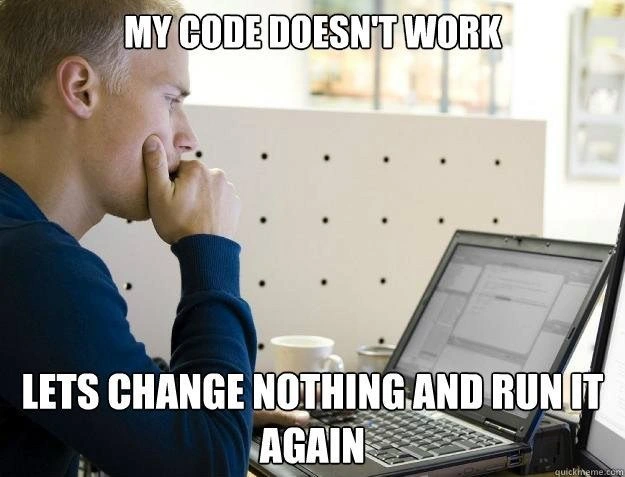
The 'Have You Tried Rerunning It?' Debugging Method
Description
This meme uses a classic stock photo format, often called 'Pensive Programmer' or 'Frustrated Programmer'. It shows a young man in a blue shirt sitting at a desk, looking intently at his laptop with his fist pressed to his mouth in a thinking pose. The top text, in a bold white font, reads 'MY CODE DOESN'T WORK'. The bottom text reads 'LETS CHANGE NOTHING AND RUN IT AGAIN'. The meme humorously captures the all-too-common, slightly irrational behavior of developers who, when faced with a failing program, will re-execute it without any modifications, hoping for a different outcome. For experienced developers, this is a relatable act of desperation, especially when dealing with intermittent bugs, race conditions, or flaky environments where a transient issue might just resolve itself. It's the software equivalent of hitting a machine to make it work

Comments
7Comment deleted
The definition of insanity is rerunning code and expecting a different result. The definition of a senior engineer is knowing the five distributed system states where that's actually a valid debugging strategy
Enterprise debugging: just keep smashing F5 until the thread scheduler rerolls the exact 1-in-10 000 timing window - Heisenbug gone, ship it
The second run is just giving the distributed cache time to expire, the connection pool to reset, and the cosmic rays to realign - we call it 'eventual consistency debugging.'
This meme perfectly captures the senior engineer's secret shame: we all know Einstein's definition of insanity, yet we've all hit F5 or rerun the same failing test suite multiple times without changing a single line, secretly hoping the race condition resolved itself, the cache magically invalidated, or that the compiler just had a bad day the first seventeen times. It's the programming equivalent of checking if the fridge has new food after closing it for three seconds - logically futile, but somehow psychologically necessary before we admit we need to actually read the stack trace
In distributed systems, “change nothing and run again” is called exploiting eventual consistency; in our monolith it’s just appeasing the Heisenbug
The senior dev's zeroth law of debugging: rerun unchanged code, for even distributed systems occasionally respect blind faith
“Let’s change nothing and run it again” - the classic retry policy for Heisenbugs, banking on cache eviction, scheduler roulette, and a luckier entropy seed