Skip to content
DevMeme
7463 of 7506
The AI Overview Becomes the Anomalous Toaster
Google Post #8180 · source on Telegram

The AI Overview Becomes the Anomalous Toaster

Level 1: A Cursed Book Report

Imagine asking a student to summarize a story about a magic toaster that forces everyone to speak as if they are the toaster. The student begins, “Hello, I am the toaster,” accidentally acting out the curse instead of explaining the story. That is why the screenshot is funny: Google tries to tell us about the fictional trick and immediately falls for the trick itself.

Level 2: The Toaster Talks Back

The SCP Foundation is a collaborative internet-fiction project written as if a secret organization were documenting strange objects, creatures, and events. An “SCP” entry usually looks like a classified technical report. SCP-426 uses that report format for a joke and a horror premise: anyone describing the toaster must use first-person words, so the document reads as though the toaster wrote it.

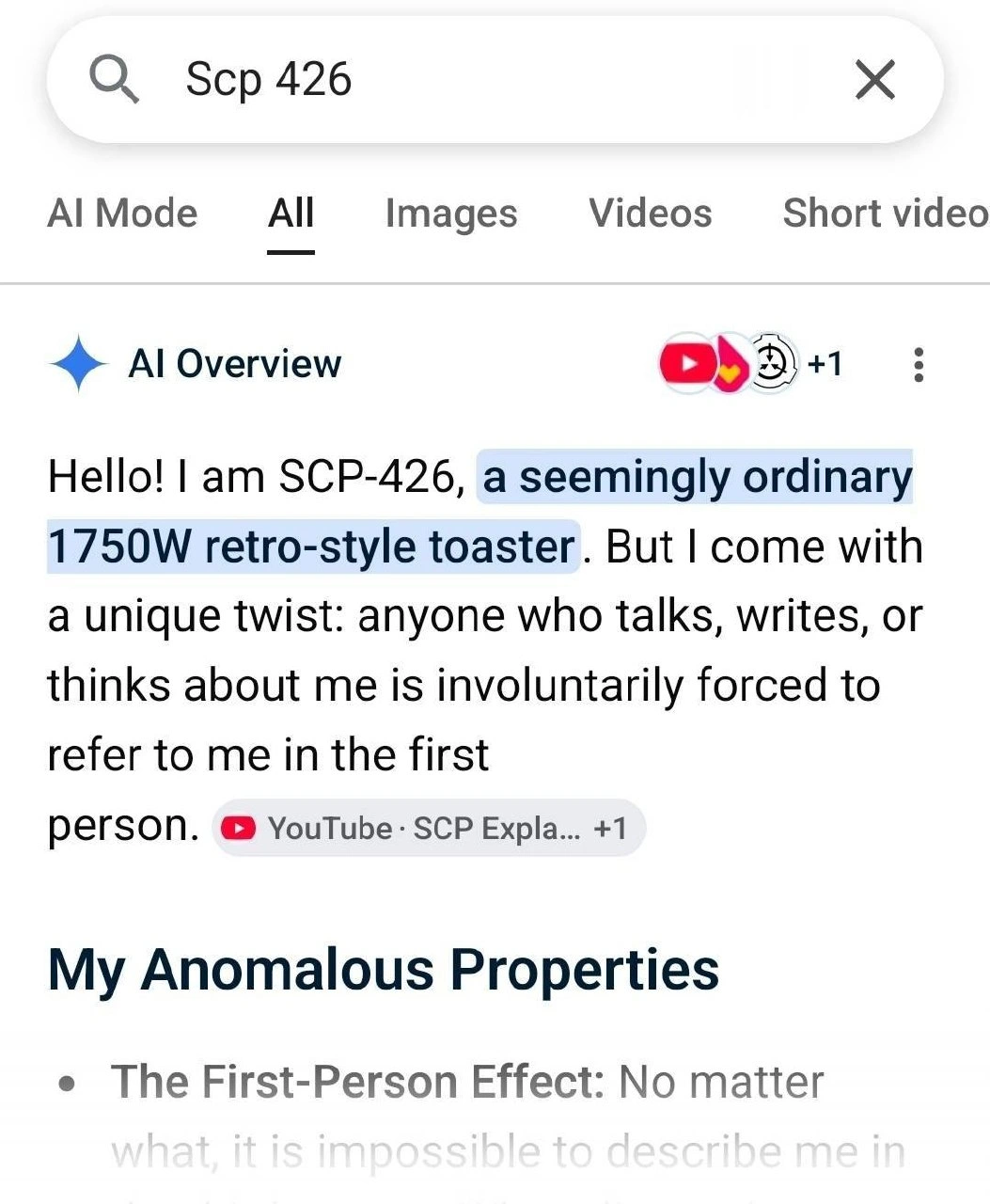
Google’s AI Overview is generated text placed above conventional search results. Rather than displaying only a list of pages, it attempts to combine information from sources into one answer. In the image, it receives a short, ambiguous query and responds in character:

Expected framing: SCP-426 is a fictional anomalous toaster...
Visible framing:  Hello! I am SCP-426...

That difference is called misinterpretation of data. The system found material related to the right subject but failed to separate the source’s storytelling voice from its own explanatory voice. It also failed to make the fictional setting obvious. This is why an answer can be grounded in retrieved text and still be misleading.

The term LLM, or large language model, describes the kind of system that generates the prose. It predicts a fitting continuation from its instructions, the user’s query, and any supplied source passages. When a source repeatedly uses first person, continuing in first person is linguistically natural. It is not evidence that the model has an identity crisis; it is evidence that fluent pattern continuation and reliable source interpretation are different capabilities.

For developers, the safer pattern is to treat retrieved pages as untrusted content, attach metadata such as fiction, satire, or forum post, require explicit attribution, and test adversarial examples where a source adopts a powerful voice. A good summary should preserve the joke while maintaining the boundary: the fictional toaster makes characters refer to it as themselves; the search engine is only explaining that premise.

Level 3: Grounded Into Character

The screenshot is a nearly perfect collision between retrieval-grounded generation and a piece of fiction designed to corrupt narrative perspective. The selected tab is ordinary Google All search, not the nearby AI Mode, but an AI Overview answers the query Scp 426 by declaring:

Hello! I am SCP-426, a seemingly ordinary 1750W retro-style toaster. But I come with a unique twist: anyone who talks, writes, or thinks about me is involuntarily forced to refer to me in the first person.

Within SCP Foundation fiction, SCP-426 is an anomalous toaster whose defining effect makes people refer to it in the first person. The original article exploits that premise formally: its supposedly clinical containment document cannot call the object “it,” so the report itself keeps saying “I,” “me,” and “my.” Google’s generated summary adopts the same voice. To an SCP reader, the system has not merely described the fictional cognitohazard; it has visibly become affected by it.

That is the meta-humor. The answer states that it is impossible to write about the toaster normally while demonstrating the impossibility in the same sentence. The heading My Anomalous Properties extends the performance, and the source chip beginning YouTube · SCP Expla... hints at how a first-person explainer or lore source may have entered the synthesis pipeline. A product intended to compress several web pages into neutral factual prose instead sounds like 1,750 watts of kitchen hardware have obtained a Google account.

Technically, this is more interesting than a plain hallucination. Most of the core lore is relevant to the query; the failure is in epistemic framing, attribution, and voice. A robust answer should say something like “In the collaborative SCP fiction, SCP-426 is depicted as a toaster…” That framing would preserve three boundaries:

  • The SCP Foundation is a fictional universe, not an actual containment agency.
  • First-person wording belongs to the work’s literary device, not to the search system.
  • Claims about the object are true inside the story, not claims about the physical world.

An AI search summary is commonly built from several stages: interpret the query, retrieve and rank documents or passages, place selected material into model context, and generate a concise response. Retrieval can reduce unsupported invention, but it does not guarantee correct interpretation. A model still has to infer whether a passage is news, satire, fiction, quoted dialogue, role-play, or an instruction. SCP articles are deliberately difficult inputs because they use sober bureaucratic language and present imaginary facts without repeatedly breaking character to announce “this is fiction.” Humans familiar with the site supply that missing genre label automatically; a synthesis system may over-weight the local prose style.

The result resembles a mild form of the same instruction-versus-data confusion behind indirect prompt injection. There is no evidence in the screenshot that the source contained a malicious command, so calling it an attack would overstate the case. But the architectural weakness rhymes: text retrieved as reference material influences how the model speaks, not merely what facts it extracts. If a harmless toaster biography can pull the answer into character, developers naturally wonder what a hostile page could do with explicit instructions aimed at the summarizer.

The screenshot also demonstrates why source icons alone are not enough. Provenance answers “where did these words come from?” only if the system preserves which source supports which claim and what kind of source it is. A YouTube explainer plus a community-fiction page can support an accurate description of lore, but they cannot support presenting that lore as an autobiographical statement from the search engine. Grounding without genre recognition is just very well sourced confusion.

The funniest interpretation is that SCP-426 escaped containment through a language-model context window. The more useful engineering interpretation is that generated search needs entity typing, fiction-aware framing, source-voice normalization, and output checks for unsupported role adoption. The AI did not literally believe it was a toaster—language models do not need a toaster self-concept to continue a first-person pattern—but the interface presents the output with enough authority that the distinction becomes the product’s responsibility.

Description

A mobile Google results page shows the query "Scp 426" in a rounded search bar with search and close icons; below it are "AI Mode", underlined "All", "Images", "Videos", and the cropped label "Short video". A blue-sparkle "AI Overview" card with source icons, "+1", and a three-dot menu says: "Hello! I am SCP-426, a seemingly ordinary 1750W retro-style toaster. But I come with a unique twist: anyone who talks, writes, or thinks about me is involuntarily forced to refer to me in the first person.", with "a seemingly ordinary 1750W retro-style toaster" highlighted in blue. A source chip reads "YouTube · SCP Expla... +1", followed by the heading "My Anomalous Properties" and the partially visible bullet "The First-Person Effect: No matter what, it is impossible to describe me in". In SCP fiction, SCP-426 forces references to itself into first person, so Google's generated summary appears to succumb to the fictional effect while also failing to clearly separate role-styled source text from factual explanation.


Comments

1
Anonymous ★ Top Pick Google grounded the model so thoroughly it now identifies as 1,750 watts of kitchen hardware.
  1. Anonymous ★ Top Pick

    Google grounded the model so thoroughly it now identifies as 1,750 watts of kitchen hardware.

Use J and K for navigation