
Production Post #2822 · source on Telegram
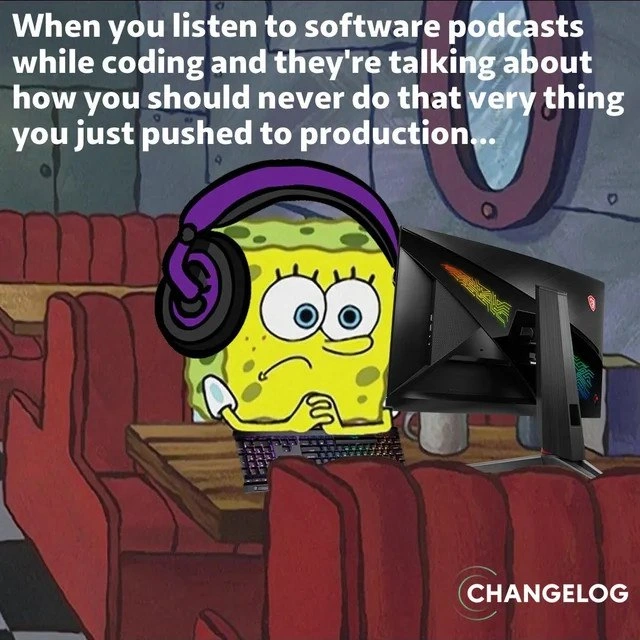
When the podcast roasts the code you just shipped to prod
Description
Cartoon scene of SpongeBob sitting alone in a red-booth diner, wearing oversized purple headphones and staring worriedly at a wide gaming monitor and RGB keyboard placed on the table. White caption text at the top reads: "When you listen to software podcasts while coding and they're talking about how you should never do that very thing you just pushed to production..." The lower-right corner has a small “CHANGELOG” podcast logo, reinforcing the software-podcast context. The meme humorously captures a developer’s anxiety about discovering best-practice advice only after deploying questionable changes to a live environment, highlighting release risk, deployment culture, and DevOps nerves
More like this
More like this in Production →

Use J and K for navigation
Comments
23Comment deleted
Podcast: “Feature flags are for gradual rollouts, not business logic.” Me, staring at prod: “Interesting take on our entire billing system’s Boolean-Driven Architecture.”
The only thing worse than discovering your architectural decision was featured as an anti-pattern in Martin Fowler's latest blog post is hearing it described in real-time on a podcast while your deployment pipeline is already halfway through promoting that exact pattern to production - and you know the rollback will require explaining to the CTO why you need to coordinate a maintenance window across three time zones
That moment when the podcast host says 'and that's why you should NEVER deploy on Friday without proper testing' while you're frantically checking your git log from 10 minutes ago. At least you're learning... just with a slightly more expensive feedback loop than unit tests would have provided. The real question is: do you pause the podcast to rollback, or keep listening to find out exactly how bad this is going to get?
It's not hypocrisy - it's applying 'contextual eventual consistency' to best practices, prod edition
That moment when a podcast says “never deploy a schema change without a feature flag or canary” and you realize your 2am force-push ran a blocking migration on the primary - suddenly blameless culture feels like an optimistic consistency model
That moment the podcast says “never ship a non‑idempotent migration behind a feature flag,” and your rollback plan is git revert for code and hope-as-a-service for the database
"don't use go statements!" -self proclaimed expert Comment deleted
Real problem for Go programmers Comment deleted
X3 Comment deleted
Don't use goto - Me, a 10-year software engineer with a degree in computer science Comment deleted
No Comment deleted
Okay, toddler :P Comment deleted
Go ahead. Goto statements are jump statements dummy. Are you saying assembly language is "toddler level"? Comment deleted
This Comment deleted
No I'm saying your stubbornness is toddler level :P Toddlers love to just keep saying "no" And even the most low-level of non-assembly languages have better, more descriptive options for each need Comment deleted
I believe they meant that using these outside of low level programming is bad form and leads to strange bugs. Comment deleted
Jump = necessary for Turing machines goto = never necessary Comment deleted
I kinda miss goto in some higher-level languages sometimes. Comment deleted
Give me a place you miss it and I'll give you a better alternative 🥰 Comment deleted
ummm ok? wait, I don't know one off the top of my head, but I can look in some of my older repos. Comment deleted
aight I can't find anything rn, but most of my problems arise from the fact that python has quite limited loops. It did get better with the walrus operator, but not by much. Comment deleted
I think I know what you mean actually. Comment deleted
Dijkstra Comment deleted