
The Art of the Redundant Comment
Description
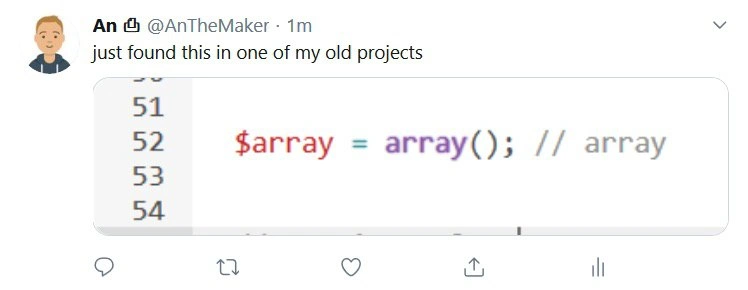
A screenshot of a tweet from user 'An @AnTheMaker' who writes, 'just found this in one of my old projects'. Below the text is an embedded image of a code snippet from a text editor. The snippet displays line number 52, which contains a line of PHP code: '$array = array(); // array'. The code itself is syntax-highlighted, with the variable in red, the function in purple, and the comment in grey. The humor stems from the utter redundancy of the comment. The code '$array = array();' is self-explanatory to anyone familiar with PHP, as it clearly initializes an empty array. The trailing comment '// array' adds no new information, perfectly illustrating a common anti-pattern where developers, especially early in their careers, write comments that merely state what the code already says, rather than explaining the 'why'


Comments
7Comment deleted
The best comments explain why the code is doing something clever or weird. This comment explains that water is wet
Past-me achieved 100 % documentation coverage by naming the variable ‘array’ and commenting ‘// array’; future-me filed it under “why we can’t have nice things.”
This is the same code that passed three code reviews, got deployed to production, and somehow became a critical dependency that nobody wants to touch because "it's working fine in prod."
Ah yes, the holy trinity of redundancy: when your variable name, initialization function, and comment form a perfect tautology. This is what happens when you follow 'document everything' advice a bit too literally - it's like writing a function called `addNumbers()` that adds numbers and commenting it with `// adds numbers`. At least future archaeologists examining this codebase will have absolutely zero ambiguity about what `$array` contains... assuming they can stop laughing long enough to read the next line
Proof that metrics lie: $array = array(); // array - 100% comment coverage with negative information value, and a reminder this predates PHP 5.4
Declaring an empty array twice in PHP: because one idempotent init might not survive the next junior refactor
Peak legacy PHP: $array = array(); // array - the trifecta of pointless naming, self-evident comments, and pre-5.4 syntax; refactor to [], name it users_by_id, and watch your linter’s existential dread subside