A Masterclass in Social Engineering
Why is this Security meme funny?
Level 1: The Forbidden Word Trick
Imagine a kid in school who proudly says, “I’ll give anyone $5 if they can trick me into saying the word ‘banana’ today. I bet I won’t slip up!” This kid is very sure he can avoid saying that silly word. Then a clever classmate responds, “You should write that challenge on the chalkboard so everyone knows about it.” The proud kid thinks, “Hmm, that sounds reasonable!” and marches up to the board. He then writes: “I will not say BANANA today!” – making sure to underline that special forbidden word. Of course, by writing it out, he’s technically just said the secret word in front of everyone! The class bursts into laughter because the kid basically tricked himself into doing the very thing he said he wouldn’t do. The clever classmate grins and says, “So…do I win?” The kid who issued the challenge slaps his forehead, realizes what happened, and even though he’s embarrassed, he has to laugh too. He agrees to give the reward (in fact, the classmate kindly says, “Keep your money, just buy me a soda sometime,” showing it was all in good fun). The joke here is that sometimes, if you’re too busy proving you can’t be fooled, you might just fool yourself.
Level 2: Twitter Trickery
Let’s break down what’s going on in this meme in straightforward terms. We have two main people in the story, interacting on Twitter (a social media platform popular with developers and security folks for sharing ideas and challenges):
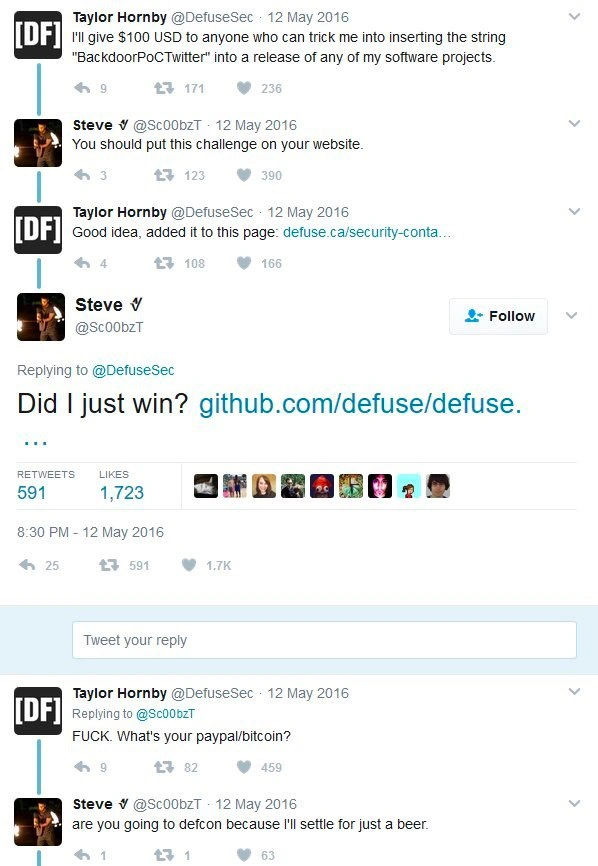
Taylor Hornby (@DefuseSec): a security researcher who works on open-source software projects. Open-source means his projects’ source code is publicly available (often on GitHub) for anyone to view or contribute to. Taylor issued a challenge: he offered $100 USD to anyone who could trick him into adding a very specific phrase, “BackdoorPoCTwitter,” into one of the official releases of his software. Releases are the versions of software that are considered final or ready for users. By defining that unique string, “BackdoorPoCTwitter,” he essentially set a trap for himself — if that exact sequence of characters ever appeared in his code or documentation, it would mean someone succeeded. He chose something unlikely to appear by accident, so if it shows up, it’s almost certainly because of the challenge.
Steve (@Sc00bzT): another security-savvy individual (likely a friend or follower in the community) who decided to take on this challenge in a playful way. Steve didn’t try to hack into Taylor’s code repository by force, nor did he exploit a technical bug. Instead, he used social engineering – a tactic of tricking a person into doing something, rather than attacking a computer system directly. Think of social engineering as hacking the human mind. It often involves persuasion, confidence, and sometimes a bit of misdirection. In this case, Steve simply replied with a suggestion: “You should put this challenge on your website.”
Now, to someone new to this, that suggestion sounds completely harmless, even helpful. Taylor apparently thought so too, because he responded, “Good idea, added it to this page: defuse.ca/security-conta…”. In other words, he updated his website (defuse.ca) to announce the challenge and its details. Here’s the catch: by doing so, Taylor literally inserted the forbidden phrase into his own project’s content. His website likely has its content stored in a repository (possibly the GitHub repo named defuse/defuse that Steve linked). So when Taylor updated the site, the phrase “BackdoorPoCTwitter” became part of his project’s files — exactly what the challenge said shouldn’t happen unless someone tricked him! In essence, he tricked himself, with a nudge from Steve. Steve’s next tweet, “Did I just win? github.com/defuse/defuse…,” included a link to Taylor’s GitHub repository, showing the phrase now present in the code or page. This was Steve pointing to the evidence, essentially saying “Look, the forbidden string is in your project now – I win the challenge, right?”
Taylor’s defeat was immediate. Realizing what happened, he replied bluntly with an exasperated confirmation (and a bit of salty language, showing his shock). True to his word, he asked Steve how to send the $100 bounty. This kind of challenge-and-reward setup is very much like a bug bounty, where companies or developers offer money to hackers who can find vulnerabilities or tricks in their software. Usually, bug bounties uncover things like security holes (for example, ways to break in or cause the software to misbehave). Here, the “vulnerability” turned out to be Taylor’s own trust. The trick was so elegant because it didn’t involve any code changes by an outsider – instead, Steve leveraged the open source collaboration spirit. Normally, if someone wants to change an open-source project, they submit a pull request on GitHub – basically a proposal with some code changes, which the project maintainer reviews and then merges if acceptable. But Steve’s “pull request” was psychological: he got the maintainer to do the work for him by updating the site. No need to mess with Git commands or sneak malicious code; a simple sentence on Twitter did the job.
Let’s clarify some of the key terms and why this scenario is important:
- Backdoor: In security, a “backdoor” is a secret method of gaining access to a system or data, bypassing normal authentication. In software, a backdoor might be some hidden functionality or a hard-coded password that the developer (or an attacker) put in. In this meme, “BackdoorPoCTwitter” is just a harmless string of text, not a real backdoor, but it symbolizes a backdoor proof-of-concept. It’s like a tag to mark that someone succeeded in tricking the developer.
- PoC: Stands for Proof of Concept. In hacking, a PoC is typically a demonstration that a vulnerability or exploit is real – basically, showing you can actually do the thing that was theorized. Steve’s trick was the proof-of-concept that a social engineering backdoor was possible. And the fact it happened on Twitter gives it that name.
- Social Engineering: As mentioned, this is the art of manipulating people so they give up confidential info or perform actions that compromise security. Classic examples include phishing emails (“click this link to reset your password” – which actually steals your password) or phone scams. In an open source context, it could be as simple as befriending a maintainer and convincing them to grant you access. Here, it was done via a public Twitter conversation as a prank.
- Open Source Supply Chain: This refers to the network of software components, libraries, and contributors that make up a project. An “attack” on the supply chain might mean inserting malicious code not by direct hacking, but by tricking or subverting one of the trusted contributors or dependencies. The meme’s scenario is a lighthearted example of such an insertion — instead of malicious code, it was a silly string, and instead of a nefarious hacker, it was a community joke. But it illustrates how easily something unexpected can slip into a project if the maintainers aren’t careful.
- Bug Bounty Culture: In recent years, many tech companies and open source projects encourage ethical hackers to find flaws by offering rewards (bounties). The vibe is usually collaborative: hackers report issues responsibly, and get paid if it’s a valid find. What happened on Twitter is like an informal, impromptu bug bounty. Taylor said “trick me and I pay $100.” Steve did, and got offered the reward. Notably, Steve even declined the money in favor of a beer at DEF CON, which is a famous annual hacker conference in Las Vegas. (Many security researchers attend DEF CON to share ideas, compete in hacking contests, and yes, drink beer together.) That response shows that this was done in good spirit for fun and community clout, rather than profit.
For a newcomer to developer humor, the takeaway is: this is funny because it was so simple and so ironic. The person who was supposed to guard against the backdoor phrase being added was the one who ended up adding it. It’s as if a bank security officer dared thieves to steal a specifically marked bill from the vault, and then one thief tricked the officer into placing that bill outside the vault himself. No fancy heist needed! Everyone in the community laughs, but also nods, because it teaches a valuable lesson: in security, pride and assumptions can be your enemy. Always be aware of the human factor. Even an open-source security guru can slip up if you catch them off-guard with a clever social play.
Level 3: The Real Weakest Link
For seasoned developers and security professionals, this meme elicits a knowing grin. It encapsulates the classic scenario where an expert’s confidence (“Nobody can ever trick me into doing X!”) is swiftly shattered by a clever, simple hack. The humor works on multiple levels of industry insight. First, it’s a story of social engineering triumphing over technical skill. Taylor Hornby (a security researcher known as DefuseSec) publicly offered a $100 bounty if anyone could pull off a very specific trick: get him to include the exact string “BackdoorPoCTwitter” in one of his software releases. This is essentially a one-man bug bounty challenge – except the “bug” here isn’t a software bug at all, but rather a human one. Every experienced security engineer immediately recognizes the hubris in such a challenge: it’s like painting a target on your back and saying “I dare you.” And the Internet never backs down from that kind of dare. 😏
The genius (and hilarity) of Steve’s response is that he didn’t bother with any sophisticated technical exploit. No zero-day vulnerabilities, no memory corruption attacks, no sneaky supply-chain injection of malicious code. He simply used psychology. Steve replied, “You should put this challenge on your website.” It sounds like friendly advice – after all, why not officially announce the challenge on the project’s site for visibility? But that suggestion was the Trojan horse. By following it, Taylor himself would be inserting the forbidden string into his project’s materials. This is what we’d call getting “pwned” by user input, except the “user input” was a polite tweet and the vulnerable code was the maintainer’s own brain!
Consider what happened in real-world terms: Taylor likely updated his website (or README, which is part of his open source repo) to mention the challenge. That update inevitably included the literal phrase “BackdoorPoCTwitter.” In doing so, he unwittingly satisfied the victory condition of his own challenge. Steve’s follow-up tweet said it all:
Steve: “Did I just win?
github.com/defuse/defuse...”
That GitHub link presumably pointed to the commit or file where the forbidden string now lived in Taylor’s repository. It was a mic-drop moment. Taylor had to respond with a stunned concession – reportedly replying with an expletive and asking for Steve’s PayPal or Bitcoin address to pay out the $100 bounty. In true hacker culture fashion, Steve didn’t even want the money; he quipped about meeting at DEF CON (the annual hacker conference) and settling for a beer. 🍻 This good-natured ending is something veteran developers appreciate: it shows the camaraderie and humor in the security community. Yes, a serious concept (open-source supply-chain vulnerability) was just demonstrated, but in a way that everybody can laugh about and learn from, without any actual damage done.
Why is this “too real” for those of us in the industry? Because it underscores that the most advanced security systems can be defeated by targeting the humans who run them. There’s a saying we often use: “Humans are the real zero-day.” You can patch software, but you can’t patch human nature. Companies pour millions into firewalls, encryption, and code audits, yet a well-crafted phishing email or a clever suggestion can breach the front door. In corporate terms, this Twitter interaction was essentially a phishing attack: Steve “phished” Taylor into inserting a backdoor string, except instead of email, it was done via a public Twitter thread, and instead of stealing data, it was done for bragging rights. It also parodies the culture of open source collaboration – usually we suggest features or fixes via formal Pull Requests on GitHub, but here a simple tweet was the “pull request” that landed malicious (or at least undesired) content into the codebase.
The meme also pokes fun at bug bounty culture. Today, many organizations run bug bounty programs where hackers try all sorts of complex attacks to earn rewards. But sometimes, the easiest way in has nothing to do with coding wizardry. In this case, the “vulnerability” was the developer’s own eagerness to take a suggestion at face value. It’s a subtle reminder: no matter how senior or security-conscious you are, you’re not immune to being outsmarted in an unexpected way. Taylor Hornby is a respected security researcher, certainly savvy about security vulnerabilities and backdoors. If he can be tricked in broad daylight by a benign suggestion, think about less cautious maintainers of thousands of open source projects! This is why supply-chain attacks (where attackers attempt to inject bad code into products by targeting maintainers or dependencies) are taken so seriously – sometimes the injection vector is just a friendly conversation or an offer of help.
From the perspective of someone who’s been around the block (and maybe cleaned up after a few 3 AM security incidents), this story is equal parts hilarious and enlightening. It reminds us of the countless times we’ve seen “unhackable” claims blown apart by clever simplicity. It’s the classic tale of overconfidence meets Murphy’s Law in software: the moment you say “that could never happen,” some witty person on the internet makes it happen. The shared laughter (“Wow, he actually got him to do it!”) is also a form of relief — we’ve all had close calls or blind spots, and seeing even the experts slip up humanizes the field. In an era of high-tech exploits, sometimes the most effective hack is just asking nicely. Social engineering wins again.
Level 4: Reflections on Trusting Tweets
At the most abstract level, this meme highlights a profound truth in computer security: no matter how airtight your code is, the human element can undermine it. In theoretical terms, it’s reminiscent of Ken Thompson’s famous paper “Reflections on Trusting Trust,” which discussed how a compiler could invisibly insert a backdoor that no source-code audit would catch. Here, we have a modern twist: the maintainer himself was tricked into inserting a backdoor-like marker. In formal security models, we talk about a “chain of trust” – each link (from hardware, to compiler, to developer decisions) must be secure. This Twitter prank is essentially a chain-of-trust fail (or a “trust fall” gone wrong): the developer trusted his own actions and the suggestion of a community member without suspecting malicious intent, and that was enough to break the chain.
From a software supply-chain security perspective, this incident is a microcosm of what can go wrong in open source projects. In complex terms, think of it as an exploit in the “process layer” rather than in the code itself. There’s no exotic buffer overflow or cryptographic break here – it’s exploiting the fact that maintainers are human. Formal verification or static analysis tools can’t catch a maintainer deliberately (even if unknowingly) adding a string like BackdoorPoCTwitter into their code. It’s analogous to a proof-of-concept exploit that operates on the maintainer’s decision-making logic. In fact, the chosen string “BackdoorPoCTwitter” implicitly nods to the hacking mantra “PoC||GTFO” (Proof of Concept or Get The F* Out*) – the researcher demanded a proof-of-concept backdoor via Twitter, and got exactly that, proving that even a trivial exploit on the human level counts.
At an academic level, this is a beautiful example of how social engineering attacks transcend technical safeguards. No amount of encryption, code obfuscation, or memory safety can prevent an authorized user (the maintainer) from doing something ill-advised if cleverly convinced. In complexity theory, we sometimes say problems are undecidable – here the “problem” is preventing human error, which might as well be an undecidable problem in computing. The humor arises from a fundamental irony: the challenge was designed to test the impossibility of sneaking in a backdoor, but it inadvertently demonstrated a theorem of security – that people are the weakest link. We’re left with a real-world corollary to theoretical security models: even if your software supply chain is cryptographically signed and verified, the system is only as secure as the person signing off the release. And if that person can be tricked by something as innocuous as a tweet, no formal model can save you!
Description
A screenshot of a Twitter conversation from May 12, 2016, that captures a brilliant act of social engineering. The thread begins with user Taylor Hornby (@DefuseSec) issuing a public challenge: 'I'll give $100 USD to anyone who can trick me into inserting the string "BackdoorPoCTwitter" into a release of any of my software projects.' Another user, Steve (@Sc00bzT), replies, 'You should put this challenge on your website.' Taylor agrees, adding the challenge text to his site. Steve then replies with a link to the website's GitHub repository, asking 'Did I just win?'. By describing the challenge on his own website (which is one of his software projects), Taylor had inadvertently inserted the forbidden string himself. The final tweets show Taylor's realization and defeat: 'FUCK. What's your paypal/bitcoin?', followed by Steve's good-natured reply to settle for a beer at DEF CON. This is a classic example of social engineering, where the human element, rather than a technical flaw, is exploited. It's a powerful lesson for senior engineers that the attack surface of a project includes its documentation, public communication, and the developers themselves

Comments
7Comment deleted
Your WAF can block a million SQL injection attempts, but it can't patch the vulnerability between the keyboard and the chair
Supply-chain hardening checklist: reproducible builds ✓, signed tags ✓, SLSA level 4 ✓, maintainer immune to dopamine-driven Twitter dares ✗
The most secure system is the one where the developer themselves becomes the vulnerability - no CVE required, just a helpful suggestion
A perfect demonstration of why security researchers should implement input validation on their own suggestions - turns out the most effective social engineering attack vector is just politely asking the target to backdoor themselves. The real vulnerability wasn't in the code; it was in the README. At least the bounty payout negotiation went from '$100 USD' to 'one beer at DEF CON,' proving that even in security research, scope creep works both ways
Forgot to grep your own repo before the bounty drop? That's how you turn a security flex into a self-funded exploit
New CVE: persuasion. Exploit: “put it on your website.” Impact: CI signs the release and BackdoorPoCTwitter ships as a feature
Severity: Critical - the vulnerable component wasn’t a library, it was “maintainer takes requirements from Twitter,” enabling a one-line content commit to escalate into a Reward Collection Event